

Why Your Pills Don’t Work the Same After Bariatric Surgery
After bariatric surgery, many patients are shocked when their medications stop working as expected. A woman on levothyroxine for hypothyroidism finds her TSH levels climbing again. Someone taking metformin for diabetes suddenly feels their blood sugar spiking. A man on warfarin gets a dangerous INR reading despite taking the same dose. These aren’t rare mistakes-they’re predictable outcomes of how bariatric surgery rewires your digestive system.
It’s not that the drugs are broken. It’s that your body can’t absorb them the way it used to. Bariatric procedures like gastric bypass and sleeve gastrectomy don’t just shrink your stomach-they change how, where, and when your body takes in medication. And if you’re not adjusting doses or formulations, you’re risking treatment failure, hospital visits, or even life-threatening complications.
How Different Surgeries Change Drug Absorption
Not all bariatric surgeries affect medications the same way. The two most common procedures-Roux-en-Y gastric bypass (RYGB) and sleeve gastrectomy-have very different impacts on drug absorption.
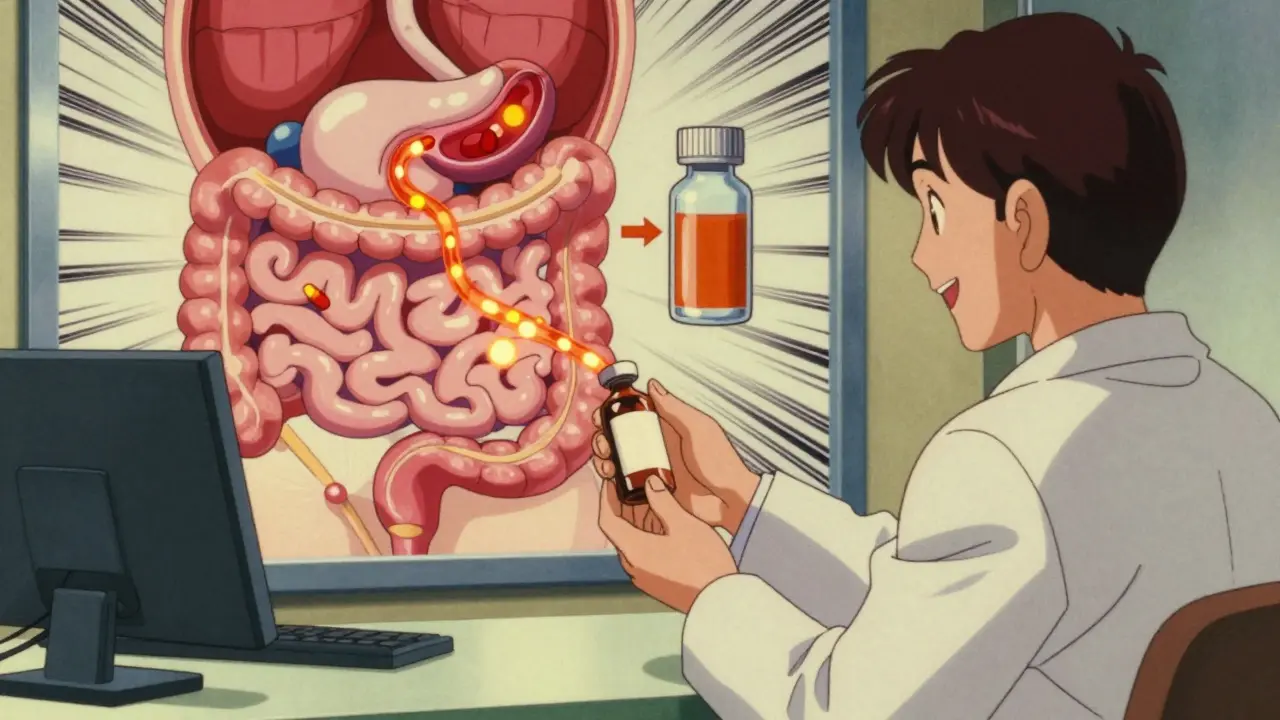
RYGB cuts off the stomach and bypasses the first 100-150 cm of the small intestine, including the duodenum. This is where most drugs get absorbed. The result? Drugs that need acid to dissolve-like certain antibiotics, antifungals, or levothyroxine-don’t break down properly. Extended-release pills, designed to release medication slowly over hours, zip through the shortened tract too fast. Studies show up to 60% of patients on extended-release metformin or glipizide see a sharp drop in blood levels after RYGB.
Sleeve gastrectomy, on the other hand, removes about 80% of the stomach but leaves the intestines intact. It doesn’t bypass any part of the small bowel. So while the smaller stomach means less acid and faster emptying, most drugs still reach their absorption sites. Still, even here, 15-20% less of some drugs get absorbed. That’s enough to cause problems for drugs with narrow therapeutic windows, like seizure meds or blood thinners.
Then there’s biliopancreatic diversion with duodenal switch-the least common but most extreme. It bypasses over 70% of the small intestine. Patients on this procedure often need 50-70% higher doses of many medications just to reach normal levels.
Which Medications Are Most at Risk?
Some drugs are far more vulnerable to absorption changes than others. Here are the top categories that need immediate review after surgery:
- Thyroid hormone (levothyroxine): Absorption drops 25-30% after RYGB. Many patients need dose increases of 30-50%. Liquid or sublingual forms often work better than tablets.
- Extended-release medications: Metformin ER, glipizide XL, oxycodone CR, and similar drugs are designed to dissolve slowly. After bypass surgery, they pass through too quickly and release all their content at once-or not at all. Converting to immediate-release versions is standard practice.
- Anticoagulants (warfarin): Blood levels fluctuate wildly. Up to 60% of RYGB patients need higher doses. Weekly INR checks for the first 3 months are critical.
- Antiepileptics (phenytoin, carbamazepine): These have narrow safety margins. Even small drops in absorption can trigger seizures. Therapeutic drug monitoring is non-negotiable.
- Immunosuppressants (cyclosporine, tacrolimus): Used by transplant patients who also undergo bariatric surgery. Dose changes can mean organ rejection or toxicity.
- Calcium and vitamin D supplements: Absorption drops by 35% after RYGB. Most patients need 1,200-1,500 mg of calcium citrate daily-never carbonate, which needs stomach acid to dissolve.
- Enteric-coated pills: These are designed to survive stomach acid and dissolve in the small intestine. But if the duodenum is bypassed, they may never dissolve at all.
What to Do: Practical Adjustments After Surgery
There’s no one-size-fits-all fix. But here’s what works in real-world practice:
- Switch extended-release to immediate-release: If you’re on metformin ER, ask your doctor to switch to regular metformin taken two or three times a day. Same for glipizide, oxycodone CR, or any other slow-release drug.
- Use liquids or crushable tablets: In the first 3 months after surgery, liquid forms of medications are preferred. If your pill isn’t labeled as crushable, don’t crush it-talk to your pharmacist. Some capsules can be opened and mixed with water.
- Take acid-dependent drugs on an empty stomach: Levothyroxine, ketoconazole, and iron supplements absorb better when taken 30-60 minutes before food. Avoid coffee, calcium, or antacids for at least an hour after.
- Use calcium citrate, not calcium carbonate: Calcium carbonate needs stomach acid to dissolve. After surgery, that acid is gone. Citrate doesn’t need acid and is absorbed better in the small intestine.
- Check therapeutic drug levels: For warfarin, phenytoin, cyclosporine, and other narrow-window drugs, regular blood tests are essential. Don’t wait for symptoms to appear.
Why Pharmacists Are Your New Best Friend
Most patients don’t realize their pharmacist is trained to spot these issues. A 2022 survey found 78% of community pharmacists felt underprepared to help bariatric patients. But that’s changing.
Specialized bariatric pharmacy services are growing fast. Hospitals now have pharmacists who focus solely on post-bariatric care. They track which drugs are affected by which surgeries, know which formulations to switch, and can flag dangerous interactions before they happen.
If your pharmacist hasn’t asked you about your surgery, ask them. Say: “I had gastric bypass/sleeve surgery. Can you check if my medications are still appropriate?” Most will run a quick check and offer a free consultation.

What’s New in 2026: Better Tools and New Formulations
The field is evolving fast. In 2024, the European Medicines Agency started requiring all new oral drugs to include bariatric surgery absorption data in their approval packages. That means future medications will be designed with these patients in mind.
New technologies are also emerging:
- pH-adaptive capsules: These open only when they reach the right pH level, even in the higher-acid environment after surgery. Early trials show 85% absorption efficiency.
- Subcutaneous implants: For diabetes meds like exenatide, implants that release medication under the skin bypass the gut entirely. One 2023 study found they worked 92% as well in RYGB patients, compared to just 68% for oral versions.
- AI-powered dosing calculators: Used in 83 U.S. hospitals, these tools combine your surgery type, weight, lab values, and meds to suggest precise doses. One hospital saw a 41% drop in dosing errors after implementation.
What Patients Are Saying
Reddit threads from the r/bariatricsurgery community are full of stories like this:
“I took my 75mcg levothyroxine for 2 years after RYGB. My TSH kept rising. My doctor said it was stress. Finally, I asked my pharmacist. She said, ‘Try 125mcg.’ I did. My TSH dropped to normal in 6 weeks. I wish I’d known sooner.”
Another user wrote: “I was on oxycodone CR for back pain. After surgery, it stopped working. I was in agony. My pharmacist switched me to immediate-release every 4 hours. It worked. No more pain.”
These aren’t outliers. They’re the rule. If your meds aren’t working, it’s not your fault. It’s a pharmacokinetic issue-and it’s fixable.
Bottom Line: Don’t Assume Your Dose Is Still Right
After bariatric surgery, your body is not the same. Your medications aren’t the same. Your doses shouldn’t be either.
Don’t wait for symptoms. Don’t assume your doctor knows. Ask your pharmacist. Ask your surgeon. Get your blood levels checked for key drugs. Switch extended-release to immediate-release. Use the right form of calcium. Take your thyroid med on an empty stomach.
The data is clear: 38% of bariatric patients need a medication change within six months. You could be one of them. The good news? With the right adjustments, your meds can work better than ever.
Do all bariatric surgeries affect medication absorption the same way?
No. Roux-en-Y gastric bypass (RYGB) and biliopancreatic diversion cause major absorption changes because they bypass parts of the small intestine. Sleeve gastrectomy mainly reduces stomach size and alters acid levels, so absorption changes are milder. Gastric banding has the least impact since it doesn’t alter anatomy beyond the stomach.
Can I still take pills after gastric bypass?
Yes, but many need to be changed. Extended-release, enteric-coated, or large tablets may not dissolve properly. Switch to immediate-release versions, liquid formulations, or capsules that can be opened. Avoid pills larger than a pea for the first 3 months. Always check with your pharmacist.
Why does my thyroid medication stop working after surgery?
Levothyroxine needs stomach acid to dissolve and is absorbed in the upper small intestine. After RYGB, acid drops and the absorption site is bypassed. Many patients need 30-50% higher doses. Liquid or sublingual forms often work better. Always get your TSH checked 6-8 weeks after surgery.
Should I switch my metformin ER to regular metformin?
Yes, most experts recommend it. After RYGB, metformin ER is absorbed 30-40% less effectively. Switching to immediate-release metformin taken two or three times a day restores blood sugar control. Dose conversion is usually 1:1.25 (e.g., 1000 mg ER becomes 1250 mg immediate-release daily, split into doses).
Is it safe to crush my pills after bariatric surgery?
Only if the medication is labeled as crushable or your pharmacist confirms it’s safe. Crushing extended-release or enteric-coated pills can cause dangerous spikes in drug levels or reduce effectiveness. Never crush without professional advice.
What supplements are most important after bariatric surgery?
Calcium citrate (1,200-1,500 mg/day), vitamin D (3,000 IU/day), vitamin B12 (1,000 mcg daily or monthly injection), iron (45-65 mg elemental iron), and a complete multivitamin. Calcium carbonate and iron sulfate are less effective and should be avoided. Take calcium and iron at least 2 hours apart-they compete for absorption.
How often should I get blood tests after bariatric surgery?
For high-risk drugs like warfarin, phenytoin, or cyclosporine, check levels every week for the first month, then monthly for 3 months, then quarterly. For thyroid and vitamins, test every 3-6 months for the first year, then annually. Always test before and after any dose change.
Katrina Morris
January 6, 2026 AT 16:03Rachel Steward
January 7, 2026 AT 02:02Anthony Capunong
January 8, 2026 AT 14:34Kyle King
January 8, 2026 AT 19:15Vince Nairn
January 9, 2026 AT 15:04Ayodeji Williams
January 10, 2026 AT 05:05Mina Murray
January 10, 2026 AT 18:57Emma Addison Thomas
January 11, 2026 AT 14:26Kamlesh Chauhan
January 13, 2026 AT 12:48