
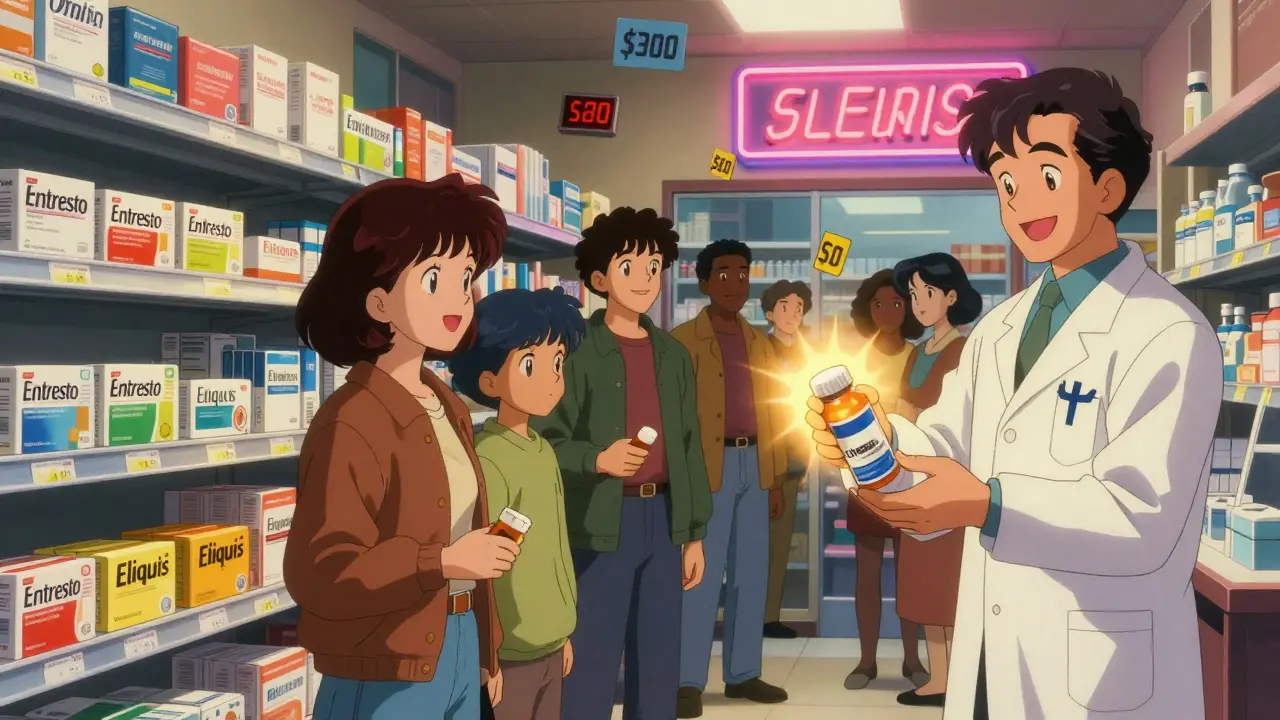
By mid-2025, millions of Americans will start seeing their monthly prescription bills drop by 80% or more. Not because of insurance changes, not because of coupons - but because the patents protecting some of the most expensive drugs in history are finally running out. This isn’t a slow shift. It’s a financial earthquake in the pharmacy aisle, and it’s already starting.
What Exactly Is a Patent Expiration?
A pharmaceutical patent gives a company exclusive rights to sell a drug without competition. For about 20 years from the original filing date - often stretched even longer with extra patents on formulations, delivery methods, or uses - no one else can make the same medicine. When that protection ends, generic manufacturers can step in and sell chemically identical versions at a fraction of the price.
It sounds simple, but the system is full of layers. A drug like Entresto doesn’t just have one patent. It has dozens: one for the chemical combo, another for how it’s made, another for how it’s taken, another for treating a specific type of heart failure. These are called patent thickets. Companies use them to delay generics, sometimes for years after the core patent expires.
But starting in 2025, those layers are starting to fall. The FDA has approved dozens of generic versions ahead of schedule. Hospitals are already changing their formularies. Pharmacies are stocking up. Patients are asking their doctors: "Will my pill look different next month?" And the answer is yes - and cheaper.
The 2025-2030 Patent Expiration Timeline: Key Drugs and Dates
The next five years are packed with drug expirations worth more than $187 billion in global sales. Here’s what’s coming:
- Entresto (sacubitril/valsartan) - Novartis | U.S. core patent expires July 2025 | 2024 sales: $7.8 billion
- Eliquis (apixaban) - Bristol Myers Squibb & Pfizer | Key crystalline patent expires November 2026 | 2024 sales: $13.2 billion
- Trulicity (dulaglutide) - Eli Lilly | Core patent expires 2027 | 2024 sales: $9.1 billion
- Ibrance (palbociclib) - Pfizer | Patent expires 2026 | 2024 sales: $5.4 billion
- Keytruda (pembrolizumab) - Merck | Core composition patent expires 2028 | 2024 sales: $29.3 billion
These aren’t obscure drugs. They’re the backbone of modern treatment for heart failure, cancer, diabetes, and blood clots. Entresto alone is prescribed to over 1.2 million Americans with heart failure. Eliquis is the most-prescribed blood thinner in the U.S., replacing warfarin for millions.
What makes 2025 stand out? It’s the first year where multiple billion-dollar drugs lose protection at once. Entresto’s July 2025 expiration isn’t just a date - it’s a trigger. Generic manufacturers have already filed applications. The FDA has approved the first version of sacubitril ahead of schedule. Retail pharmacies are preparing for supply chain shifts. And patients? They’re already seeing price drops in clinical trials and hospital systems.
Why Entresto’s 2025 Expiration Is a Game-Changer
Entresto isn’t just another drug. It’s a breakthrough. Before Entresto, heart failure patients took ACE inhibitors or beta blockers - drugs from the 1980s. Entresto, approved in 2015, cut hospitalizations and deaths by 20% in clinical trials. But it cost $150-$300 a month without insurance.
By mid-2025, generic versions will cost $20-$40. That’s not a discount. That’s a revolution.
Doctors like Dr. Emily Chen in California are already preparing their patients. "I’m telling them now: by August, your pill will look different. It’ll be just as effective, but you’ll pay less than a coffee a day," she said in a September 2024 post on the Sermo physician network.
But it’s not just about price. It’s about access. In a 2024 American Heart Association survey, 68% of heart failure patients said they’d switch to the generic immediately - not because they distrust it, but because they can’t afford the brand anymore. For many, Entresto was the difference between treatment and skipping doses.
And it’s not just patients. Hospitals are already negotiating 60% price reductions with pharmacy benefit managers (PBMs) in anticipation of the generic launch. One hospital system in Ohio reported saving $2.1 million in the first quarter of 2025 just by switching 300 patients to the generic ahead of schedule.
Keytruda: The Billion Elephant in the Room
If Entresto’s expiration is a tidal wave, Keytruda’s is a tsunami.
Merck’s cancer immunotherapy brought in $29.3 billion in 2024 - more than any other drug in history. It’s used for melanoma, lung cancer, Hodgkin’s lymphoma, and more. And it has no direct competitors. Unlike blood thinners or heart meds, there’s no chemical alternative to Keytruda. Only biosimilars - and those take longer to develop.
Its core patent expires in 2028, but the race is already on. At least 12 biosimilar companies are in late-stage trials. The FDA has fast-tracked several applications. But because biologics are made from living cells - not just chemicals - they’re harder to copy. That means the first biosimilars won’t hit shelves until late 2028 or early 2029.
And even then, they won’t be cheap right away. Biosimilars typically cut prices by only 30-40% at first, compared to 80% for generics. Why? Because doctors are cautious. Patients are scared. Insurance companies are still figuring out how to cover them.
But Merck knows the clock is ticking. In November 2024, the company announced a $12 billion investment in next-generation cancer drugs - new immunotherapies, gene therapies, and targeted treatments - to replace the revenue lost when Keytruda’s patent expires.
What This Means for You: Lower Costs, But Watch for Pitfalls
For patients, this is good news. You’ll pay less. But it’s not all smooth sailing.
- Switching meds isn’t automatic. Your doctor or pharmacist won’t switch you without telling you. Some states don’t allow pharmacists to substitute certain generics without a doctor’s approval - especially for complex drugs like Entresto.
- Supply shortages could happen. When Humira’s patents expired, there were delays. Manufacturers couldn’t ramp up fast enough. The same could happen with Entresto or Eliquis in 2025-2026.
- Insurance plans might change. PBMs will push generics hard. Your plan might stop covering the brand-name version entirely. You might get a letter saying your drug is no longer on formulary. Don’t panic - it just means you’ll get the generic.
- Don’t assume "generic" means "inferior." The FDA requires generics to be bioequivalent - meaning they work the same way, in the same amount of time, with the same safety profile.
Here’s what to do now:
- If you’re on Entresto, Eliquis, Trulicity, or Ibrance - ask your doctor in early 2025 if a generic will be available soon.
- Call your pharmacy and ask if they’re stocking the generic versions. Many will start carrying them weeks before the official expiration date.
- Check your insurance formulary. You might need to switch to the generic to avoid higher copays.
- Don’t stop taking your medication. Even if the brand runs out, the generic will be there.
Who Benefits? Who Loses?
The biggest winners? Patients. The U.S. healthcare system. The federal government.
The Congressional Budget Office estimates these expirations will save the U.S. $312 billion between 2025 and 2035. About $198 billion of that will come in just the first three years - 2025 to 2027.
Generic manufacturers like Teva, Mylan, and Sandoz are investing billions to be ready. Teva alone is developing 37 drugs targeting this patent cliff. They’re the ones who’ll make the profits - and keep prices low.
The losers? The big pharma companies. Merck could lose up to $31 billion in revenue by 2030. Bristol Myers Squibb faces a 50% drop in Eliquis revenue after 2026. That’s why they’re buying smaller biotech firms - like BMS’s $4.1 billion purchase of Karuna Therapeutics - to replace lost income.
And while patients save money, some small clinics and pharmacies might struggle. If a hospital’s entire budget was built around high-margin brand-name drugs, switching to generics can hurt cash flow. That’s why 87% of hospital pharmacy directors are already training staff on the transition.
What’s Next After 2030?
The patent cliff doesn’t end in 2030. It just changes shape.
After 2030, more biologics will expire - drugs like Humira’s biosimilars, which are still gaining traction. New cancer drugs, autoimmune treatments, and rare disease therapies will enter the market. But they’ll come with their own patents, their own delays, their own battles.
What’s different now? The system is waking up. Regulators are approving generics faster. Pharmacies are preparing better. Patients are more informed. And the financial pressure is forcing innovation.
The next decade won’t be about protecting old drugs. It’ll be about creating new ones that can’t be copied easily - gene therapies, mRNA treatments, personalized cancer vaccines. And that’s where the real future of medicine lies.
For now, if you’re on one of these blockbuster drugs, take a breath. The cost is about to drop. You don’t need to wait for a letter. Don’t wait for your doctor to bring it up. Ask. Now. Because the change is already here - and it’s cheaper than you think.
lisa Bajram
January 11, 2026 AT 05:47OMG I just got my Entresto prescription filled last week and the pharmacist said the generic’s already in stock?? I cried. Like actual tears. $28 for a month’s supply?? I’ve been skipping doses because it was $280. This is literally life-changing. Thank you for writing this - I finally feel seen.
Paul Bear
January 11, 2026 AT 19:35Let’s be clear: this isn’t a ‘revolution’ - it’s the inevitable collapse of a rent-seeking oligopoly. The 20-year patent term was never meant to be extended via patent thickets and evergreening. The FDA’s accelerated approvals are long overdue. What’s remarkable is how little public outrage there’s been. This is systemic exploitation, and we’re only now seeing the consequences.
Jaqueline santos bau
January 12, 2026 AT 01:07Wait wait wait - so if Keytruda’s biosimilars only drop prices by 30-40%, does that mean people with cancer are STILL gonna be screwed?? Like… are we just gonna watch Merck cash in until 2030 while people die?? I’m not even mad, I’m just disappointed. This system is a horror movie and we’re all stuck in the basement.
Ritwik Bose
January 13, 2026 AT 21:09Respectfully, this is a moment of great hope for global health equity. In India, we’ve long relied on generics for life-saving medicines. Seeing the U.S. finally catch up feels like justice delayed but not denied. 🙏💙
Kunal Majumder
January 15, 2026 AT 20:27Bro, I’ve been on Eliquis for 3 years. My mom had a stroke because she couldn’t afford it back in 2020. I’m so glad this is happening. Don’t overthink it - just ask your doc for the generic. It’s gonna be fine. You got this.
Aurora Memo
January 15, 2026 AT 20:51Thank you for highlighting the supply chain risks. I’m a pharmacist in rural Ohio - we’ve seen shortages with Humira. I’m already coordinating with 3 regional distributors to pre-order generics. This isn’t just about price - it’s about access. Let’s not forget the people in small towns who can’t drive 50 miles for a refill.
chandra tan
January 16, 2026 AT 16:42India’s been making generics since the 90s. We call it ‘pharmacy of the world’ for a reason. I remember my uncle getting hepatitis C meds for $10/month here vs $80k in the US. Now the US is finally learning what we’ve known all along: medicine shouldn’t be a luxury. 🇮🇳❤️
Dwayne Dickson
January 18, 2026 AT 11:35Oh, so now we’re celebrating the collapse of Big Pharma’s profit margins like it’s a TED Talk? How quaint. The real story is the $12B Merck is pouring into next-gen drugs - which will be patented for 20 more years. This isn’t reform. It’s a cycle. A very expensive, very predictable cycle.
Ted Conerly
January 19, 2026 AT 15:21Just talked to my cardiologist. He said if I’m on Entresto, I should switch to generic as soon as it’s available - same active ingredients, same bioavailability, same outcomes. He’s seen patients save $3,000 a year. Don’t let fear stop you. Ask. Now. It’s not a gamble - it’s science.
Faith Edwards
January 20, 2026 AT 19:38How dare we celebrate the erosion of intellectual property? These drugs were developed by brilliant scientists who risked everything. Now we’re treating their life’s work like a commodity to be stripped bare? This isn’t progress - it’s moral bankruptcy dressed up as affordability.
Jay Amparo
January 22, 2026 AT 03:59When I saw the stats on how many heart failure patients skip doses because of cost… I just sat there. Silent. Then I called my sister - she’s on Trulicity. We cried together. But now? Now there’s light. This isn’t just about money. It’s about dignity. Thank you for writing this. I’m sharing it with everyone I know.
Lisa Cozad
January 23, 2026 AT 13:50My insurance already sent me a letter: Entresto is no longer covered as brand. Generic is preferred. I thought I’d be upset - but honestly? I’m relieved. I’ve been saving up for it for months. Now I can finally afford to eat healthy too. Win-win.
Saumya Roy Chaudhuri
January 25, 2026 AT 00:20Anyone else notice that the FDA approved the first generic of sacubitril/valsartan 11 months before patent expiry? That’s not coincidence - that’s sabotage. Big Pharma knew this was coming. They’re just playing the long game. You think you’re winning? You’re just part of the script.
Ian Cheung
January 26, 2026 AT 14:05Just got my Eliquis generic today. Cost me $18. I used to pay $290. I bought myself a new pair of shoes. Then I donated $50 to a local food bank. That’s the ripple effect. This isn’t just about pills - it’s about freedom. And yeah I’m still smiling