

When a patient walks into the emergency room gasping for air, doctors don’t guess. They test. And one of the most powerful tools in their toolkit isn’t an imaging scan or a stethoscope-it’s a simple blood test: NT-proBNP.
Why NT-proBNP Matters More Than You Think
NT-proBNP stands for N-terminal pro-B-type Natriuretic Peptide. It’s a protein released by the heart when its walls are stretched too thin-usually because the heart is struggling to pump blood. This isn’t just a marker. It’s a direct signal from the heart saying, “I’m under pressure.” In 2025, NT-proBNP testing is no longer optional. It’s standard. And for good reason: if the level is below 300 pg/mL, heart failure is ruled out with 98% accuracy. That means avoiding unnecessary hospital stays, expensive echocardiograms, and weeks of anxiety for patients and families. The test isn’t new-it’s been around since the early 2000s-but its use has exploded. In the UK, NICE guidelines require it for every adult presenting with suspected acute heart failure. In the US, 89% of hospitals now offer it within two hours. Medicare reimburses $18.42 per test, but the real savings? Thousands in avoided imaging and admissions.When to Order NT-proBNP: The Real Clinical Scenarios
Doctors don’t order this test for everyone. It’s targeted. Here’s when it changes everything:- Unexplained shortness of breath-especially in older adults. Is it heart failure? COPD? Pulmonary embolism? NT-proBNP cuts through the noise. A level of 120 pg/mL in an 82-year-old with wheezing? Likely not heart failure. Save the echo.
- Acute dyspnea in the ER-this is where the test shines. If the level is under 300 pg/mL, discharge is safe. No need to admit for observation.
- Chronic heart failure follow-up-rising levels over weeks or months signal worsening disease, even before symptoms return. It’s a warning light.
- Post-acute coronary syndrome-new 2024 guidelines now recommend NT-proBNP for risk stratification after a heart attack. Higher levels mean higher risk of death or rehospitalization.
- Unexplained fatigue or swelling-especially in patients with diabetes, hypertension, or a history of heart disease. These are silent signs.
What the Numbers Really Mean (And What They Don’t)
NT-proBNP levels aren’t a yes-or-no answer. They’re a story-and context is everything.- Age matters. Levels naturally rise 15-20% per decade. For someone under 50, 450 pg/mL might be high. For someone over 75, 900 pg/mL is the new normal. Using the same cutoff for all ages leads to overdiagnosis.
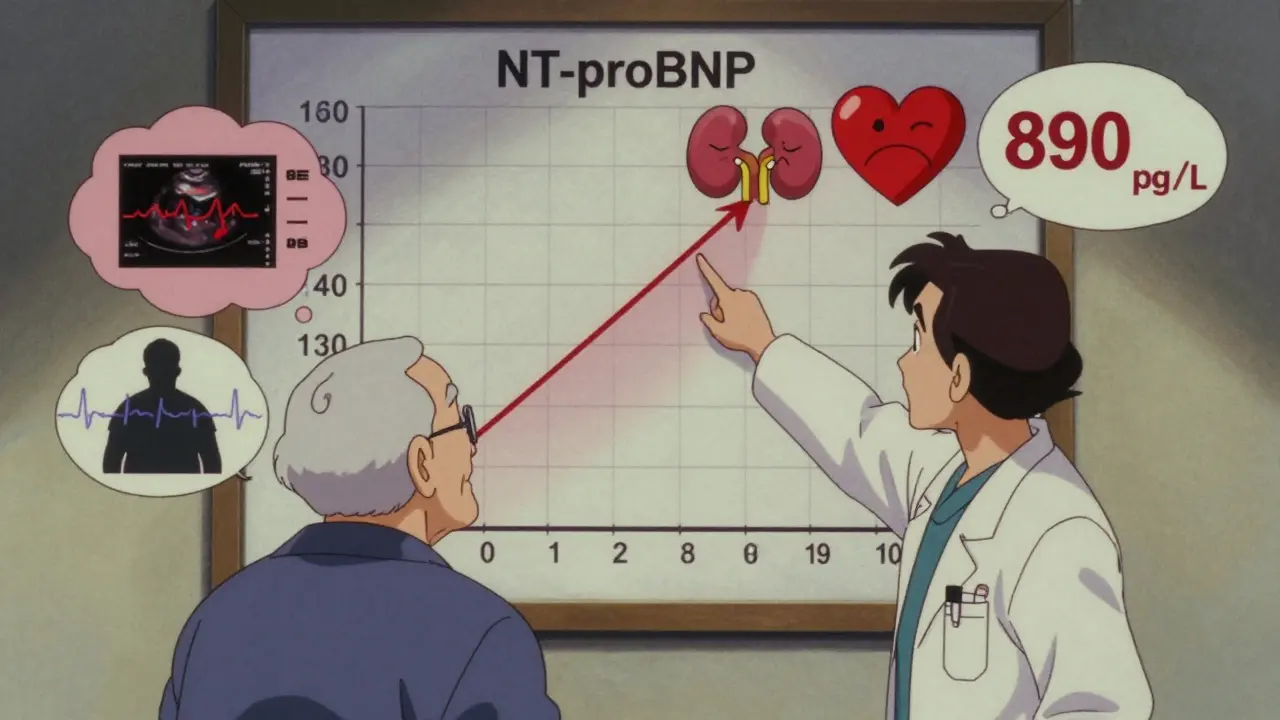
- Kidney trouble. If a patient has stage 3 or higher chronic kidney disease, NT-proBNP levels can be 28-40% higher-even without heart failure. Adjust the rule-out threshold to 1,200 pg/mL in these cases.
- Obesity. Fat tissue suppresses NT-proBNP. A person with a BMI over 35 may have levels 25-30% lower than expected. A “normal” result here could still mask heart failure.
- Atrial fibrillation. This common rhythm problem can raise NT-proBNP independently. A level of 850 pg/mL in a 78-year-old with AFib? Could be heart failure. Could be just the arrhythmia. You need the full picture.
NT-proBNP vs. BNP: Why One Dominates
You might hear about BNP testing too. So why is NT-proBNP the go-to?- Stability. NT-proBNP lasts 60-120 minutes in the blood. BNP breaks down in 20 minutes. That means NT-proBNP samples can sit for hours before testing-no rush to the lab.
- Accuracy. Studies show NT-proBNP has a higher diagnostic accuracy (AUC 0.91) than BNP (AUC 0.88). It correlates better with echo results.
- Market dominance. Roche’s Elecsys assay holds 73% of the US market. Siemens is second at 22%. Most labs use NT-proBNP because it’s reliable, standardized, and backed by decades of data.
What Happens When You Order It Wrong
Overuse is a real problem. Medicare data shows 18% of NT-proBNP tests are ordered in patients with no symptoms. That’s waste. And it’s getting worse. Starting January 2025, CMS will require prior authorization for NT-proBNP tests in asymptomatic patients. That’s not bureaucracy-it’s a correction. This test isn’t a screening tool for healthy people. It’s a diagnostic tool for those with signs of heart failure. The biggest mistake? Treating NT-proBNP like a standalone answer. One cardiologist put it bluntly: “I’ve seen patients with levels of 800 pg/mL get labeled with heart failure-then we find out they have end-stage kidney disease and no signs of fluid overload.” The test doesn’t replace clinical judgment. It supports it.
What’s Changing in 2025
The field is moving fast. In 2023, the FDA cleared the first point-of-care NT-proBNP device-the Roche Cobas h 232. Results in 12 minutes. Concordance with lab tests? 94.7%. This means ERs and urgent care centers can now make decisions on the spot. The 2024 ACC/AHA/HFSA guidelines (released September 2024) expanded NT-proBNP’s role to include risk assessment after heart attacks and in patients with new-onset atrial fibrillation. The VICTORIA trial showed that patients whose NT-proBNP levels dropped after treatment had a 35% lower risk of dying from heart-related causes. And it’s not just about diagnosis anymore. It’s about tracking progress. A drop in NT-proBNP after starting heart failure meds? That’s a sign the treatment is working.How to Get It Right
If you’re a clinician, here’s how to use NT-proBNP effectively:- Order it only when heart failure is suspected-dyspnea, edema, fatigue, unexplained weight gain.
- Use age-adjusted cutoffs: <450 pg/mL under 50, <900 pg/mL over 75.
- Adjust for kidney disease: use <1,200 pg/mL as rule-out in CKD stage 3-5.
- Never ignore clinical context. A high level in an obese, asymptomatic patient? Re-evaluate.
- Use follow-up tests to track trends, not just single values.
The Bigger Picture
NT-proBNP testing isn’t just a lab result. It’s a decision-making tool that saves time, money, and lives. It reduces unnecessary hospitalizations. It prevents misdiagnosis. It gives patients clarity. In 2025, if you’re managing patients with heart symptoms and you’re not using NT-proBNP, you’re working with one hand tied behind your back. The evidence is clear. The guidelines are firm. The technology is ready. This isn’t about doing more tests. It’s about doing the right test at the right time.What is NT-proBNP and why is it tested?
NT-proBNP is a protein released by the heart when it’s under stress, typically due to heart failure. The test measures its level in the blood to help diagnose or rule out heart failure quickly. It’s one of the most reliable blood tests for this purpose, with a 98% negative predictive value when levels are below 300 pg/mL.
When should NT-proBNP be ordered?
Order NT-proBNP when a patient presents with unexplained shortness of breath, fatigue, swelling in the legs, or sudden weight gain-especially if they have risk factors like high blood pressure, diabetes, or prior heart disease. It’s standard in emergency departments for suspected acute heart failure and useful for monitoring chronic heart failure patients.
What’s a normal NT-proBNP level?
There’s no single “normal.” Levels rise with age. For patients under 50, under 450 pg/mL rules out heart failure. For those 50-75, under 900 pg/mL is typical. For over 75, under 1,800 pg/mL may still be normal. In chronic kidney disease, use a higher threshold of under 1,200 pg/mL for rule-out.
Can NT-proBNP be high without heart failure?
Yes. Levels can be elevated due to kidney disease, advanced age, atrial fibrillation, severe lung infections, or even pulmonary hypertension. That’s why interpretation must always include clinical context. A high level doesn’t confirm heart failure-it just means further investigation is needed.
Is NT-proBNP better than BNP?
For most clinical settings, yes. NT-proBNP is more stable in the blood, lasts longer, and has slightly higher diagnostic accuracy. It’s also less affected by timing delays in sample processing. BNP is faster to process at the bedside, but NT-proBNP is the gold standard in labs and hospitals.
What happens if NT-proBNP is high?
A high level means heart failure is likely and warrants further testing-like an echocardiogram, chest X-ray, or physical exam for fluid retention. It doesn’t mean the patient needs to be hospitalized immediately, but it does mean they need prompt follow-up with a cardiologist or heart failure specialist.
Can NT-proBNP predict outcomes?
Yes. Higher levels correlate with worse outcomes: more hospitalizations, higher risk of death. A drop in NT-proBNP after starting treatment (like ACE inhibitors or SGLT2 inhibitors) is a strong sign the therapy is working. Many cardiologists now use it to guide medication adjustments.
Is NT-proBNP testing covered by insurance?
Yes. Medicare and most private insurers cover NT-proBNP testing when ordered for appropriate clinical reasons. Starting January 2025, prior authorization is required for tests ordered in asymptomatic patients to prevent overuse.
Jeffrey Frye
December 24, 2025 AT 10:05nt-probnp? more like nt-pro-bullshit if you ask me. i’ve seen docs order this for people who just had a panic attack and then act like it’s gospel. 98% accuracy my ass-my grandma’s level was 800 and she just had a bad flu. they still admitted her for 3 days. waste of time and money.
Usha Sundar
December 26, 2025 AT 01:12so basically this test is the new stethoscope?
Wilton Holliday
December 26, 2025 AT 09:57Love this breakdown! 🙌 As a med student, I was terrified of interpreting these levels until I realized context is everything. Age, kidney function, BMI-they all shift the game. One tip: if the patient’s obese and their level is ‘normal,’ don’t breathe easy. Might be hiding in plain sight. Also, that 1-800 hotline? Total lifesaver. Called it twice last month. No judgment, just clarity.
Harsh Khandelwal
December 28, 2025 AT 05:05they’re pushing this test because the labs and pharma companies made a deal. you think they care if you’re misdiagnosed? nah. they care about the $18.42 per test. and don’t get me started on ‘prior authorization’-that’s just the government’s way of making docs jump through hoops so they can bill more for ‘consultations.’ it’s all a money game. the heart doesn’t lie… but the system sure does.
Delilah Rose
December 28, 2025 AT 23:47I’ve been thinking about this a lot since my dad’s hospital stay last year. He had the swelling, the fatigue, the weight gain-but his NT-proBNP was 780, and the doc said ‘probably not heart failure.’ We were so relieved. Then three weeks later, he was back in with fluid in his lungs. Turns out his BMI was 38, so the test was suppressed. They didn’t adjust for obesity. I just… I don’t know. It feels like we’re trusting numbers too much and people too little. I get the science, I really do-but what about the human part? The tired voice, the swollen ankles, the way he couldn’t button his shirt? That’s not in the algorithm. Maybe the test should come with a warning: ‘This doesn’t replace listening.’
Spencer Garcia
December 29, 2025 AT 09:50Agreed. Use it as a tool, not a verdict. And always check kidney function first. Easy fix, huge impact.
CHETAN MANDLECHA
December 30, 2025 AT 16:37Interesting. In India, many hospitals still don’t have access to this test. We rely on clinical signs and echo. But when available, it’s a game-changer. Still, cost and infrastructure limit its use. Hope it becomes standard everywhere.
Jillian Angus
December 30, 2025 AT 20:10the point of care device sounds cool but i wonder how many rural clinics can even afford it