

Imagine rolling over in bed at 2 AM and suddenly feeling like the room is spinning violently around you. It lasts only a few seconds, but it’s enough to make your heart race and leave you nauseous. If this sounds familiar, you might be dealing with BPPV, or Benign Paroxysmal Positional Vertigo. It is the most common cause of peripheral vertigo, affecting millions of people worldwide. The good news? It is highly treatable. The bad news? Many patients spend months being misdiagnosed before finding relief.
This condition isn't dangerous, but it can severely disrupt your daily life. You might avoid driving, struggle with sleep, or feel anxious about falling. The key to getting better lies in understanding what is happening inside your inner ear and using specific physical maneuvers to fix it. This guide breaks down the mechanics of BPPV, how doctors diagnose it, and why moving your head in specific ways is far more effective than taking pills.
What Is BPPV and Why Does It Happen?
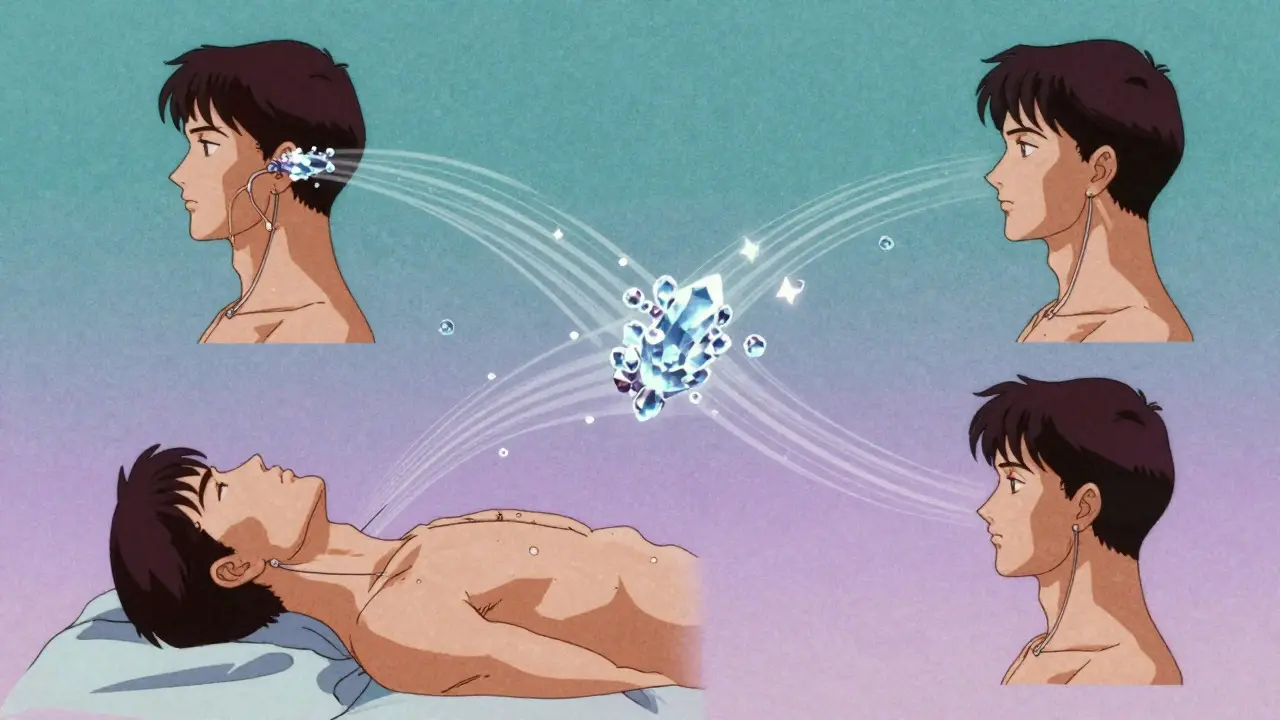
To understand BPPV, you first need a quick look at your inner ear. Your vestibular system helps you balance. It contains fluid-filled semicircular canals that detect rotational movement. Inside these canals, tiny calcium carbonate crystals called otoconia are normally housed in a structure called the utricle. When you move your head, these crystals shift slightly, sending signals to your brain about gravity and motion.
In BPPV, some of these otoconia break loose from the utricle and drift into one of the semicircular canals. Most often (80-90% of cases), they end up in the posterior canal. Because the crystals are heavier than the fluid, they don't move smoothly with your head. Instead, they lag behind, creating abnormal fluid flow. Your brain interprets this as spinning, even when you're just tilting your head to look at a shelf.
There are two main mechanisms at play:
- Canalithiasis: The crystals are free-floating in the canal. This is the most common type.
- Cupulolithiasis: The crystals stick to the cupula (the sensory hair bundle) at the end of the canal. This is rarer and often causes longer-lasting symptoms.
BPPV is considered "benign" because it doesn't indicate a stroke or tumor. However, it is not harmless in terms of quality of life. Episodes typically last between 5 and 30 seconds, though they can occasionally reach a minute. The dizziness is triggered by specific positions, such as looking up, bending down, or rolling over in bed.
Recognizing the Symptoms: More Than Just Spinning
The hallmark symptom is paroxysmal vertigo-a sudden, intense sensation of spinning triggered by head position changes. But BPPV rarely comes alone. Most patients experience a cluster of accompanying symptoms that can make the condition feel much worse than the brief spin itself.
According to clinical data, here is what else you might feel:
- Nausea: Reported in nearly 78% of cases. It often peaks during the vertigo episode but can linger for hours.
- Nystagmus: Involuntary eye movements. While you might not see this yourself, a doctor will notice it during testing. It usually has a delay of 2-10 seconds after the head movement and fades with repeated testing.
- Unsteadiness: About 65% of patients report feeling off-balance even when the spinning stops.
- Vomiting: Occurs in roughly 32% of severe episodes.
A critical distinction is duration. If your vertigo lasts for minutes or hours, it is likely not BPPV. Central causes like strokes or vestibular neuritis present differently. BPPV is short-lived. Also, if you have hearing loss, ringing in the ears (tinnitus), or fullness in the ear, consider Meniere's disease instead. BPPV does not affect hearing.
Diagnosis: The Dix-Hallpike Maneuver
You might expect a doctor to order an MRI or CT scan. For typical BPPV, imaging is usually unnecessary and often misleading. An MRI has less than a 5% diagnostic yield for BPPV because the crystals are too small to be seen clearly on standard scans. Instead, diagnosis relies on a physical exam.
The gold standard test is the Dix-Hallpike maneuver. Here’s how it works:
- You sit upright on an examination table.
- The clinician turns your head 45 degrees toward the affected side.
- You quickly lie back, extending your neck so your head hangs slightly off the edge of the table.
- The clinician watches your eyes for nystagmus (involuntary movement).
If you have posterior canal BPPV, you will likely feel vertigo within 2-10 seconds of lying back. Your eyes will jerk upward and then twist toward the healthy ear. This response confirms the diagnosis. The test has high sensitivity (around 79%) and specificity (75%) when performed correctly.
For horizontal canal BPPV (less common, 5-10% of cases), doctors use the Supine Roll Test. They turn your head left and right while you lie flat. Nystagmus that gets stronger when the affected ear is down indicates this variant.

Treatment: Canalith Repositioning Procedures
Once diagnosed, the treatment goal is simple: get those stray crystals out of the canal and back into the utricle where they belong. This is done through canalith repositioning procedures (CRPs). These are physical maneuvers that use gravity to guide the particles along a specific path.
Medication is generally not the first line of defense. Vestibular suppressants like meclizine may help with nausea temporarily, but they don't fix the underlying mechanical problem. In fact, long-term use can hinder your brain's ability to adapt to the imbalance.
The Epley Maneuver
The Epley maneuver is the most widely used technique for posterior canal BPPV. It involves a series of four head positions held for about 30 seconds each. The sequence moves the head from sitting, to lying back with the head turned, to rolling onto the opposite shoulder, and finally to sitting up. When performed correctly, it has an effectiveness rate of 80-90%. Many patients feel immediate relief after the first session.
The Semont Maneuver
An alternative is the Semont maneuver, also known as the liberatory maneuver. It involves a rapid, large-amplitude movement from sitting to lying on the unaffected side, holding for 30 seconds, then swinging across to the other side without sitting up. It is equally effective but requires more space and coordination from the patient and clinician.
The Lempert Roll
If your BPPV affects the horizontal canal, the Epley won't work. Instead, clinicians use the Lempert roll (or barbecue roll). You lie on your back, and your head is rolled 120 degrees to the affected side, then to the opposite side, and back to center. This maneuver has a success rate of around 75% for horizontal canal BPPV.
| Maneuver | Target Canal | Effectiveness Rate | Complexity |
|---|---|---|---|
| Epley Maneuver | Posterior | 80-90% | Moderate |
| Semont Maneuver | Posterior | 85% | High |
| Lempert Roll | Horizontal | 75% | Moderate |
Can You Do It At Home?
Many people wonder if they can perform these maneuvers themselves. The answer is yes, but with caution. Self-administered Epley maneuvers have shown a 72% success rate when guided by video instructions, compared to only 45% with written instructions alone. This highlights the importance of visual guidance.
If you choose to try it at home, follow these tips:
- Use a Video Guide: Find a reputable medical source showing the exact angles and timing.
- Clear Your Space: Ensure you have enough room on the floor or a sturdy bed to move safely.
- Have Someone Nearby: A partner or family member can watch for safety and provide reassurance.
- Be Patient: You might need to repeat the maneuver twice a day for several days if the first attempt doesn't fully resolve the issue.
However, if you have neck pain, spinal issues, or severe anxiety, it is safer to have a professional do it. Clinicians can adjust the angles to accommodate your comfort level and ensure the crystals are moved effectively.
Recurrence and Long-Term Management
Getting relief is great, but BPPV can come back. Recurrence rates are estimated at 15% within one year, 35% within five years, and 50% within ten years. This doesn't mean you'll suffer forever; it just means the crystals can dislodge again due to trauma, aging, or unknown factors.
Some research suggests a link between vitamin D deficiency and BPPV recurrence. A study published in the Journal of Neurology found that supplementing with 1,000 IU of vitamin D daily reduced recurrence by 24% in deficient patients. While not a cure-all, maintaining adequate vitamin D levels might be a smart preventive step, especially for older adults.
When BPPV returns, the same repositioning maneuvers usually work again. The good news is that many patients find their symptoms milder upon recurrence, possibly due to habituation-your brain learns to ignore the erroneous signals faster.
When to See a Doctor
While BPPV is benign, not all dizziness is BPPV. You should seek immediate medical attention if your vertigo is accompanied by:
- Hearing loss or sudden deafness
- Weakness or numbness in arms or legs
- Difficulty speaking or swallowing
- Double vision
- Severe headache unlike any you've had before
These could be signs of a central nervous system issue, such as a stroke. Even if you think it's BPPV, a proper diagnosis is crucial to rule out other conditions. Misdiagnosis rates in primary care can be as high as 35%, so seeing a specialist like an ENT (otolaryngologist) or a vestibular therapist can save you time and frustration.
Frequently Asked Questions
How long does it take for BPPV to go away on its own?
Spontaneous resolution occurs in about 40-50% of cases within one month. However, waiting is not recommended because the condition significantly impacts quality of life. Treatment with repositioning maneuvers resolves symptoms in 80-90% of cases immediately or within a few sessions.
Is BPPV dangerous?
No, BPPV is not life-threatening. It is a mechanical issue in the inner ear. However, the risk of falling increases during episodes, so caution is advised, especially for older adults. The term "benign" refers to the absence of serious underlying pathology like tumors or strokes.
Can I exercise with BPPV?
Yes, but modify your activities. Avoid movements that trigger vertigo, such as jumping jacks or yoga poses that involve rapid head changes. Low-impact exercises like walking or stationary cycling are usually safe. Once treated, you can return to normal activity levels.
Do I need an MRI to diagnose BPPV?
Usually, no. Diagnosis is based on history and physical examination, specifically the Dix-Hallpike maneuver. Imaging is reserved for atypical cases where other neurological conditions are suspected. MRIs rarely show the displaced crystals directly.
Why did my BPPV come back?
Recurrence is common, affecting up to 50% of patients over 10 years. Causes include head trauma, aging, viral infections, or vitamin D deficiency. It is not necessarily due to doing something wrong during the initial treatment. Repeat repositioning maneuvers are typically effective for recurrences.