
Clinical Trial Eligibility Calculator
This calculator shows how common clinical trial eligibility criteria affect patient inclusion. Over 80% of patients in real clinics would not qualify for typical clinical trials.
Your Results
Why Clinical Trial Results Don’t Always Match What Happens in Real Life
Imagine a new cancer drug shows a 70% success rate in a clinical trial. You hear the news, hopeful. But when your neighbor starts taking it, they get sicker, not better. Why? Because clinical trial data and real-world outcomes are not the same thing. One is a controlled lab experiment. The other is messy, unpredictable human life.
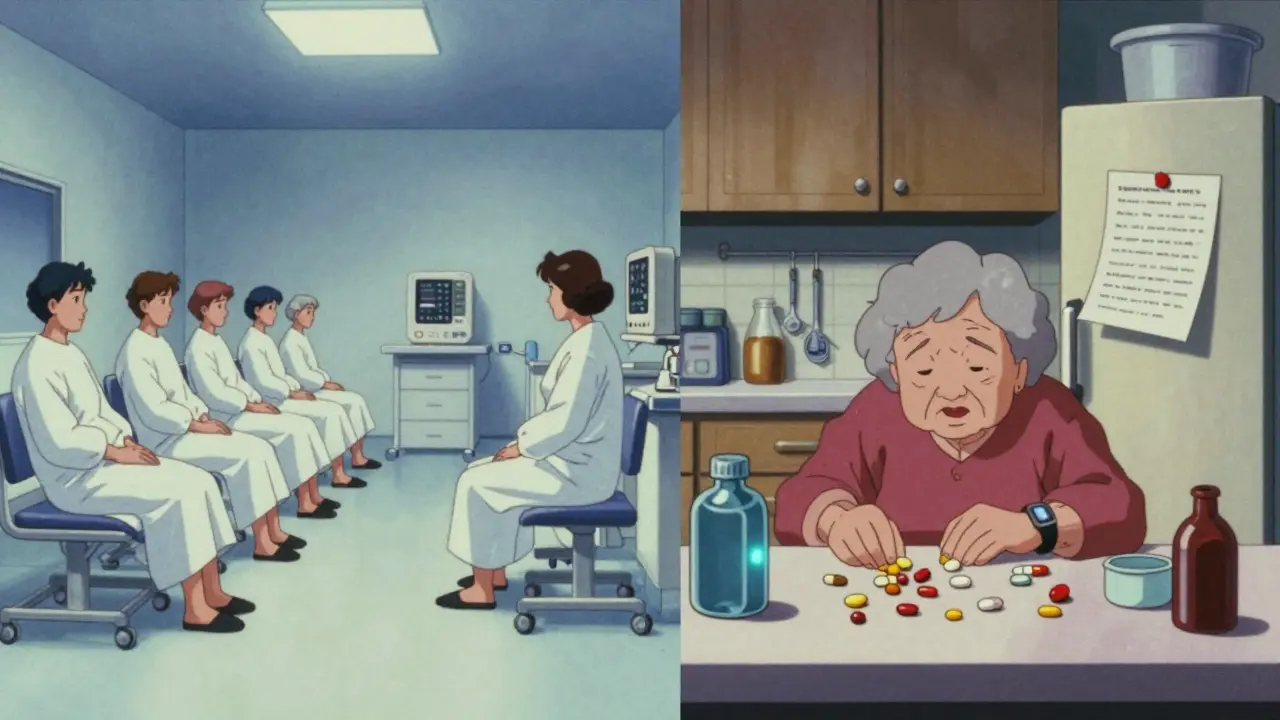
Clinical trials are designed to answer one question: Does this treatment work under perfect conditions? They use strict rules - only patients with one main illness, no other medications, regular check-ins, and healthy volunteers who can travel to hospitals. In fact, studies show that up to 80% of patients in real clinics wouldn’t qualify for these trials. That means the people who benefit in trials are not the same people who end up taking the drug later.
Who Gets Left Out of Clinical Trials?
Clinical trials don’t just exclude people with complex health problems. They also leave out older adults, people with diabetes or heart disease, and racial minorities. A 2023 study in the New England Journal of Medicine found that only 1 in 5 cancer patients in U.S. clinics would be allowed into a typical trial. Black patients were 30% more likely to be turned away - not because their cancer was worse, but because they were less likely to have transportation, time off work, or access to specialized centers.
This isn’t a glitch. It’s built into the system. Trials need clean data. So they filter out anything that might muddy the results. But that means the results don’t reflect reality. If you’re 72, have high blood pressure, and take five pills a day, the trial data won’t tell you how the new drug will affect you. And yet, that’s exactly who ends up using it.
What Real-World Data Actually Shows
Real-world outcomes come from everyday medical records - doctor visits, insurance claims, pharmacy fills, even data from smartwatches. These records include patients with multiple illnesses, different ages, and all kinds of lifestyles. They don’t follow a script. They don’t always show up for appointments. They might skip doses. They might be on other meds that interact with the new drug.
When researchers compared data from 5,700 clinical trial patients with over 23,000 real-world patients with diabetic kidney disease, the differences were stark. Trial data had 92% completeness for key measurements. Real-world data? Just 68%. Measurements in trials happened every three months. In real life? Every five months, on average. And that gap matters. Missing data means missing side effects, missed responses, missed failures.
But here’s the upside: real-world data shows what actually happens. A drug might work great in trials but cause unexpected fatigue or liver issues in older patients. Or it might work better in people who take it with food - something trials don’t test. Real-world evidence doesn’t just confirm trials. It corrects them.

The Cost and Time Gap
Clinical trials are expensive. A single Phase III trial costs an average of $19 million and takes two to three years. Real-world studies? They can be done in six to twelve months, at 60-75% lower cost. Why? Because they use data that already exists - millions of patient records already stored in hospital systems.
Companies like Flatiron Health spent five years and $175 million building a database of 2.5 million cancer patients from 280 clinics. Roche bought it for $1.9 billion. That’s not because they wanted to run more trials. It’s because they wanted to know: Who actually benefits? Who doesn’t? Who has side effects no one saw in trials?
Regulators are catching on. The FDA approved 17 drugs between 2019 and 2022 using real-world data as part of the decision - up from just one in 2015. The European Medicines Agency is even more aggressive, using real-world evidence in 42% of post-approval safety studies. Payers like UnitedHealthcare and Cigna now require real-world proof of cost-effectiveness before covering new drugs.
Why Real-World Data Can Be Misleading
But real-world data isn’t magic. It’s messy. Without randomization, you can’t be sure if a patient got better because of the drug - or because they started eating better, lost weight, or stopped smoking. A 2021 study in JAMA warned that enthusiasm for real-world evidence has outpaced its methods. Some studies have even reached opposite conclusions from clinical trials - not because the data was wrong, but because they didn’t account for hidden factors.
That’s why experts like Dr. Robert Califf, former FDA commissioner, say real-world evidence can’t replace trials. It can only complement them. You need the clean, controlled data of trials to prove a drug works. Then you need real-world data to prove it works for everyone.

The Future: Blending Both Worlds
The smartest companies aren’t choosing between trials and real-world data. They’re merging them. Hybrid trials now exist - part controlled study, part real-world monitoring. Patients enroll in a trial but continue using their regular doctors and wearables. Data flows in from both sides.
AI is helping too. Google Health’s 2023 study showed algorithms could predict treatment outcomes from electronic records with 82% accuracy - better than traditional trial analysis. That means we’re getting closer to knowing, before a patient even starts treatment, whether it’s likely to help them.
And regulators are adapting. The FDA’s 2023 Real-World Evidence Framework now requires drug makers to prove their real-world data is high quality. The U.S. Senate passed the VALID Health Data Act in 2022 to set standards for how this data is collected and used. This isn’t about replacing trials. It’s about making them more relevant.
What This Means for You
If you’re a patient, don’t assume a drug that worked in a trial will work the same way for you. Ask your doctor: “Was this tested on people like me?” If you’re a caregiver, understand that side effects might show up later, or differently, than the brochure says.
If you’re in healthcare, real-world data isn’t just a buzzword. It’s your best tool for spotting problems no trial could catch - like a drug that causes falls in elderly patients, or one that’s ineffective in people with kidney disease. And if you’re in policy or insurance, real-world evidence is how you decide what’s worth paying for.
The truth is simple: clinical trials tell you what a drug can do. Real-world outcomes tell you what it does. Both matter. One without the other is incomplete.
Why This Matters Now
The global real-world evidence market is expected to grow from $1.84 billion in 2022 to $5.93 billion by 2028. That’s not because trials are failing. It’s because we’re finally learning to listen to the people who use these drugs every day - not just the ones who fit the mold.
The future of medicine isn’t about choosing between perfect data and messy data. It’s about using both to make smarter, fairer, more accurate decisions. And that’s something every patient deserves.
Are real-world outcomes more accurate than clinical trial data?
Neither is more accurate - they answer different questions. Clinical trials measure efficacy under ideal conditions. Real-world outcomes measure effectiveness in everyday life. One shows potential. The other shows reality. Together, they give the full picture.
Why are clinical trials so restrictive?
Trials exclude patients with multiple conditions, older adults, or those on other medications to reduce variables and make results clearer. This helps regulators approve drugs faster, but it also means the results don’t reflect most real patients.
Can real-world data replace clinical trials?
No. Real-world data can’t prove a drug works for the first time. That requires the controlled, randomized design of clinical trials. But real-world data can show if it works for people outside the trial - and if it’s safe long-term.
How do doctors use real-world data today?
Doctors use it to understand side effects, predict how a patient might respond based on similar cases, and decide whether a drug is worth prescribing for someone with complex health needs. Hospitals and health systems now use databases like Flatiron Health to compare their patients’ outcomes to larger populations.
Is real-world data biased?
Yes, if not handled carefully. Real-world data comes from uneven sources - some clinics record everything, others skip details. Patients who drop out or miss appointments aren’t counted the same way. That’s why experts use statistical tools like propensity score matching to adjust for these gaps and reduce bias.
Which therapies rely most on real-world evidence?
Oncology leads because trials are expensive and ethical concerns make placebo groups hard to justify. Rare diseases also rely heavily on real-world data since patient numbers are too small for traditional trials. Pain management is another growing area, especially with the push to reduce opioid use.
Lisa Rodriguez
February 2, 2026 AT 09:39Doctors need to stop treating trial data like gospel. We're not lab rats.
Lilliana Lowe
February 3, 2026 AT 17:02vivian papadatu
February 5, 2026 AT 12:08Also, Flatiron Health? That's a game-changer. More of this, please.
Chris & Kara Cutler
February 5, 2026 AT 21:49Rachel Liew
February 5, 2026 AT 22:08Melissa Melville
February 7, 2026 AT 04:34Deep Rank
February 8, 2026 AT 13:01Bob Cohen
February 8, 2026 AT 19:21Aditya Gupta
February 10, 2026 AT 15:05Nancy Nino
February 12, 2026 AT 09:00