

DOAC Dosing & Cockcroft-Gault Calculator
Apixaban (Eliquis)
Enter DataStandard: 5 mg twice daily
Rivaroxaban (Xarelto)
Enter DataStandard: 20 mg once daily
Dabigatran (Pradaxa)
Enter DataStandard: 150 mg twice daily
Edoxaban (Savaysa)
Enter DataStandard: 60 mg once daily
Imagine you have been prescribed a blood thinner to protect your heart from stroke. You take it every day without a second thought. But what if your kidneys are not working at full capacity? For millions of people with chronic kidney disease (CKD), this is not just a hypothetical worry-it is a daily reality that demands precision. Direct Oral Anticoagulants, commonly known as DOACs, have revolutionized how we treat conditions like atrial fibrillation (AFib). Unlike older drugs such as warfarin, they offer predictable protection without constant blood tests. However, this predictability breaks down when the kidneys struggle to filter waste. Getting the dose wrong can lead to two terrifying outcomes: severe bleeding or a life-threatening clot.
The stakes are high. Inappropriate dosing of DOACs carries grim consequences. Too little drug leaves you vulnerable to strokes; too much increases the risk of hemorrhage. As of 2023, DOACs account for 87% of oral anticoagulant prescriptions for stroke prevention, surpassing warfarin. Yet, among patients prescribed these drugs, between 11.5% and 44.6% have some form of kidney disease. This overlap creates a complex clinical landscape where standard doses often fail. Understanding how to adjust these medications based on specific kidney function metrics is not just good practice-it is essential for survival.
Why Kidney Function Matters for Blood Thinners
To understand why dosage adjustments are critical, you need to look at how your body handles these drugs. Most DOACs rely on the kidneys to clear them from your system. When kidney function declines, the drug stays in your bloodstream longer and builds up to toxic levels. This accumulation dramatically raises the risk of major bleeding events, including gastrointestinal bleeds and intracranial hemorrhages.
However, not all DOACs behave the same way. Each medication has a unique pharmacokinetic profile. Some are cleared almost entirely by the kidneys, while others use multiple pathways involving the liver and gut. This variation means you cannot simply swap one DOAC for another without checking the numbers. The key metric here is not just whether you have kidney disease, but exactly how well your kidneys are filtering creatinine. This measurement determines which drugs are safe, which require a lower dose, and which should be avoided altogether.
Historically, doctors relied on estimated glomerular filtration rate (eGFR) to gauge kidney health. While eGFR is useful for staging chronic kidney disease, it is not accurate enough for drug dosing. Regulatory bodies like the FDA explicitly recommend using the Cockcroft-Gault formula (a mathematical equation developed in 1976 to estimate creatinine clearance) for calculating renal dosing. This older method provides a more precise estimate of creatinine clearance (CrCl), which directly correlates with how fast your kidneys can remove the medication. Using eGFR instead of CrCl is a common mistake that leads to significant dosing errors.
Decoding the Cockcroft-Gault Formula
If you are managing your own care or supporting a loved one, you must understand that "kidney function" is not a single number. It is a calculated value derived from several personal factors. The Cockcroft-Gault formula takes into account your age, weight, gender, and serum creatinine level. Why does this matter? Because an elderly person with low muscle mass might have a normal-looking creatinine level, masking poor kidney function. Conversely, a muscular individual might appear to have worse kidney function than they actually do.
Clinicians calculate CrCl to determine the exact milliliters per minute your kidneys can filter. This number dictates the dosing category. For instance, a CrCl above 30 mL/min generally allows for standard DOAC dosing. Between 15 and 30 mL/min requires careful reduction. Below 15 mL/min, many DOACs become contraindicated. Pharmacists report that nearly 28% of calculations in patients over 80 years old require manual adjustment due to issues like low body weight or cachexia. Relying on automated electronic health records without verification can be dangerous. Always ensure your healthcare provider manually verifies the calculation, especially if your physical condition has changed recently.

Dosing Guidelines for Specific DOACs
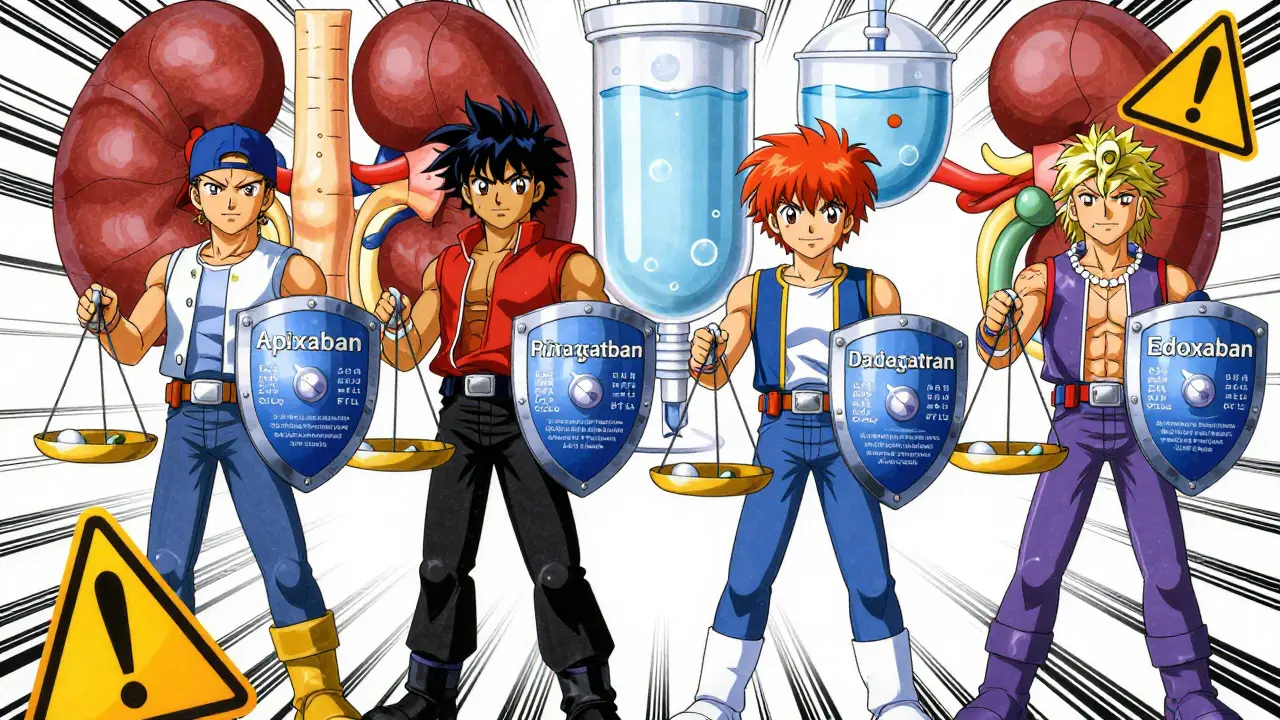
Not all direct oral anticoagulants are created equal when it comes to renal impairment. Each of the four major agents-apixaban, rivaroxaban, dabigatran, and edoxaban-has distinct rules. Misunderstanding these rules is the leading cause of adverse events in this patient population. Let us break down the specifics for each drug.
Apixaban (Eliquis) is often considered the safest option for patients with moderate to severe kidney disease. Its standard dose is 5 mg twice daily. However, you must reduce the dose to 2.5 mg twice daily if you meet at least two of the following three criteria: age 80 years or older, body weight 60 kg (132 lbs) or less, or serum creatinine 1.5 mg/dL (133 μmol/L) or higher. This "ABC" mnemonic (Age, Body weight, Creatinine) is widely taught in medical residency programs. Importantly, apixaban is contraindicated when CrCl falls below 15 mL/min, although some guidelines allow its use in end-stage renal disease (ESRD) under strict supervision.
Rivaroxaban (Xarelto) presents different challenges. It is primarily renally cleared, making it sensitive to kidney function drops. Standard dosing applies for CrCl above 50 mL/min. For CrCl between 15 and 50 mL/min, the dose is reduced to 15 mg once daily. Crucially, rivaroxaban should not be used when CrCl is below 15 mL/min. Major guidelines advise against its use in stage 5 CKD or dialysis patients due to insufficient safety data and higher bleeding risks.
Dabigatran (Pradaxa) requires significant adjustment in renal impairment. The standard dose is 150 mg twice daily. If CrCl drops between 15 and 30 mL/min, the dose must be reduced to 75 mg twice daily. Like rivaroxaban, dabigatran is contraindicated when CrCl is below 15 mL/min. Its capsule also contains tartaric acid, which can cause gastrointestinal irritation, adding another layer of complexity for patients with fragile digestive systems.
Edoxaban (Savaysa) follows a similar pattern to rivaroxaban but with slightly different thresholds. The standard dose is 60 mg once daily. For patients with CrCl between 15 and 50 mL/min, the dose is reduced to 30 mg once daily. Edoxaban is contraindicated when CrCl is below 15 mL/min. Clinical trials, such as the ENGAGE AF-TIMI 48 study, showed that while edoxaban remained effective in those with normal renal function, its efficacy decreased significantly in patients with impaired kidney function.
| Drug | Standard Dose | Reduced Dose Criteria | Contraindicated At |
|---|---|---|---|
| Apixaban | 5 mg twice daily | Meet 2 of 3: Age ≥80, Weight ≤60kg, Creatinine ≥1.5mg/dL | CrCl < 15 mL/min |
| Rivaroxaban | 20 mg once daily | CrCl 15-50 mL/min | CrCl < 15 mL/min |
| Dabigatran | 150 mg twice daily | CrCl 15-30 mL/min | CrCl < 15 mL/min |
| Edoxaban | 60 mg once daily | CrCl 15-50 mL/min | CrCl < 15 mL/min |
Navigating End-Stage Renal Disease and Dialysis
When kidney function fails completely, requiring dialysis, the situation becomes even more precarious. This group, known as having end-stage renal disease (ESRD), faces a dilemma: they are at extremely high risk for stroke, yet they are also at extreme risk for bleeding. Warfarin, the older blood thinner, has shown little proven benefit and a large risk of harm in ESRD patients, including higher rates of vascular calcification and intracranial hemorrhage.
Apixaban currently stands out as the most studied DOAC in this population. A 2020 review in the Journal of the American Heart Association found that apixaban was associated with a lower risk of major bleeding compared to warfarin in patients with advanced CKD or ESRD. Some clinicians successfully use apixaban 2.5 mg twice daily in hemodialysis patients, reporting major bleeding rates as low as 1.8%. However, this is off-label use in many jurisdictions. The AXIOS trial, designed to compare apixaban versus warfarin in hemodialysis patients, was terminated early due to poor enrollment, leaving a gap in definitive evidence.
Despite the lack of large-scale randomized trials, the Kidney Disease: Improving Global Outcomes (KDIGO) 2023 Controversies Conference acknowledged that quality evidence remains lacking. Nevertheless, many nephrologists and cardiologists lean toward apixaban due to its favorable safety profile. Rivaroxaban and dabigatran are generally avoided in dialysis patients because they accumulate rapidly during the intervals between treatments. If you are on dialysis, your care team must monitor your coagulation status closely, potentially using anti-Xa levels to guide therapy, though this testing is not always readily available.
Common Pitfalls and How to Avoid Them
Even experienced physicians make mistakes when prescribing DOACs to patients with kidney disease. A multicenter study published in JAMA Internal Medicine found that 37.2% of DOAC prescriptions in CKD patients contained dosing errors. These errors often stem from relying on outdated lab results or using the wrong formula for kidney function.
One major pitfall is assuming that a stable eGFR means a stable dose. Kidney function can fluctuate rapidly due to dehydration, infection, or changes in other medications. The FDA requires renal function assessment before starting a DOAC and at least annually thereafter, or more frequently if your condition is unstable. Virtual anticoagulation clinics, sometimes called "anticoagulation clouds," have emerged as valuable tools for monitoring these changes. Studies show these remote monitoring programs can reduce adverse events by nearly 23%.
Another common error is ignoring the "ABC" criteria for apixaban. Patients who are elderly, lightweight, or have elevated creatinine often receive the standard 5 mg dose by mistake. This supratherapeutic dosing leads to unnecessary bleeding. Conversely, under-dosing can leave patients unprotected against clots. Always double-check the prescription label against your latest lab results. If you lose weight or age into a new bracket, your dose may need adjustment. Do not wait for your annual check-up; inform your doctor immediately.
Monitoring and Long-Term Management
Managing DOAC therapy in renal impairment is not a "set it and forget it" process. It requires active vigilance. You should schedule regular blood tests to monitor your creatinine levels. Ideally, these tests should happen every three to six months, or sooner if you experience symptoms like fatigue, swelling, or changes in urine output.
Be aware of signs of bleeding. Unexplained bruising, nosebleeds that do not stop, blood in your urine or stool, or severe headaches could indicate that your dose is too high. On the flip side, sudden weakness, slurred speech, or vision changes could signal a clot. Keep a log of your symptoms and share it with your healthcare provider. Communication is your best defense.
As research progresses, we expect clearer guidelines. The RENAL-AF trial, comparing apixaban versus dose-adjusted warfarin in severe renal impairment, is expected to release results in 2025. These findings may refine our understanding of optimal dosing. Until then, sticking to established guidelines, using the Cockcroft-Gault formula, and maintaining open dialogue with your medical team are your best strategies for staying safe.
Should I use eGFR or CrCl to determine my DOAC dose?
You should always use Creatinine Clearance (CrCl) calculated via the Cockcroft-Gault formula. eGFR is used for diagnosing and staging kidney disease but is not accurate enough for drug dosing. Using eGFR can lead to incorrect dosing decisions, increasing the risk of bleeding or clotting.
Can I take apixaban if I am on dialysis?
Apixaban is often used off-label in dialysis patients because it has a better safety profile than warfarin in this group. However, it is technically contraindicated when CrCl is below 15 mL/min according to FDA labeling. Your doctor will weigh the risks and benefits carefully, often prescribing a reduced dose of 2.5 mg twice daily.
What happens if I miss a dose of my blood thinner?
If you miss a dose, take it as soon as you remember on the same day. Do not double up on doses to make up for the missed one. Doubling your dose can spike drug levels in your blood, significantly increasing the risk of serious bleeding. Consult your pharmacist for specific instructions tailored to your medication.
How often should I check my kidney function while on a DOAC?
Guidelines recommend checking kidney function at least once a year. However, if you have chronic kidney disease, your doctor may want to test it every three to six months. More frequent testing is necessary if you have unstable kidney function, recent hospitalizations, or changes in other medications.
Is warfarin safer than DOACs for kidney patients?
Generally, no. Warfarin has a higher risk of intracranial hemorrhage and vascular calcification in patients with severe kidney disease. DOACs like apixaban are often preferred due to their predictable effects and lower bleeding risks, provided they are dosed correctly based on creatinine clearance.