
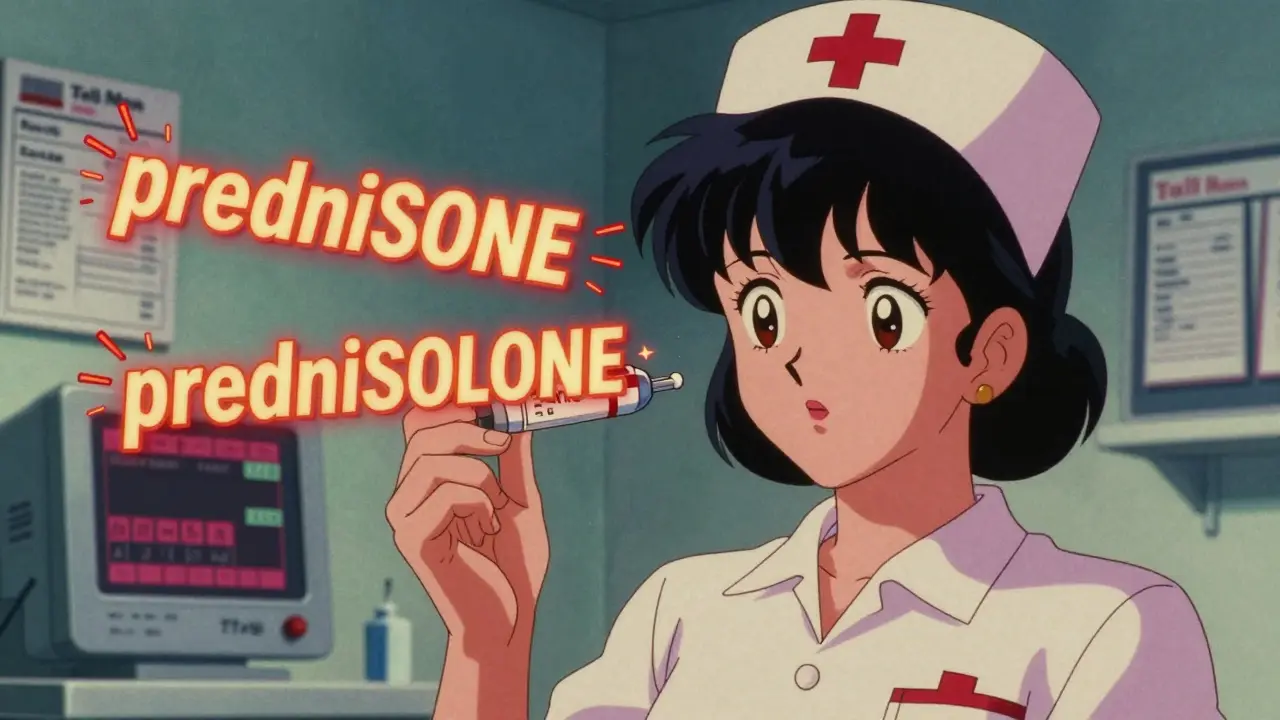
Every year, thousands of people in the U.S. are harmed or die because someone gave them the wrong medicine - not because the drug was bad, but because the medication name, strength, or dosage form was misread. It could be a nurse confusing prednisone with prednisolone. A pharmacist misreading 10mg as 100mg. A patient taking a pill meant to be swallowed, but instead crushing it because the label didn’t say “extended-release.” These aren’t rare mistakes. They’re preventable - if you know how to check.
Why Medication Verification Matters
Medication errors are one of the leading causes of preventable harm in healthcare. According to the Agency for Healthcare Research and Quality (AHRQ), about 7,000 deaths each year in U.S. hospitals are linked to mistakes in drugs - not because the medicine was faulty, but because the wrong one was given, the wrong dose was used, or it was given the wrong way. The Institute of Medicine estimates these errors cost the system over $3.5 billion annually. Most of these mistakes happen because the details on the label or order were unclear, incomplete, or misread.It’s not just hospitals. Community pharmacies, nursing homes, and even at-home caregivers make these errors. A nurse in Birmingham told me she once caught a 100-fold overdose because she double-checked the heparin vial against the electronic order. The order said “5,000 units/mL,” but the vial said “50 units/mL.” That one second of verification saved a life.
Step 1: Confirm the Medication Name
The first thing you need to verify is the drug’s name. Sounds simple, right? But look-alike and sound-alike names cause more errors than you’d think. Hydralazine vs. hydroxyzine. Clonidine vs. clonazepam. Insulin glargine vs. insulin detemir. These aren’t typos - they’re different drugs with completely different effects.Here’s how to avoid confusion:
- Always compare the name on the prescription with the name on the bottle or vial. Don’t assume they match.
- Look for “Tall Man” lettering - this is when part of the name is capitalized to highlight differences, like predniSONE and predniSOLONE. Many hospitals use this standard to reduce mix-ups.
- Never rely on abbreviations. “MS” could mean morphine sulfate or magnesium sulfate. “U” for units can be mistaken for “0” or “cc.” Always write out “units” and “micrograms.”
- Use RxNorm, the standardized drug naming system used by the FDA and most EHRs. If the name doesn’t match RxNorm’s official term, question it.
A 2011 NIH study found that combining RxNorm with spelling correction tools fixed 92.3% of drug name discrepancies. If you’re entering a prescription into a system, make sure it auto-corrects to the official name - don’t accept a custom entry unless you’ve double-checked it.
Step 2: Verify the Strength - Every Time
Strength is where most errors happen. The FDA reports that 34% of all medication errors between 2013 and 2017 involved incorrect strength. Why? Because people skip checking it. They assume the dose is right because “it’s the same drug.”Here’s what to look for:
- Always check the number and the unit. “10mg” is not the same as “100mg.” Write it as “10 mg” - with a space. The Institute for Safe Medication Practices (ISMP) found that adding a space between the number and unit cuts errors by 12%.
- Never use ratios for injectables. “Epinephrine 1:10,000” is dangerous. It should be written as “0.1 mg/mL.” That’s the FDA’s current standard, and it’s been required since 2015 after 236 errors were traced back to ratio confusion.
- Use leading zeros. Write “0.5 mg,” not “.5 mg.” A missing zero can turn a safe dose into a deadly one.
- For oral liquids, strength is always weight per volume - like “5 mg/mL.” For tablets and capsules, it’s weight per unit - like “500 mg each.”
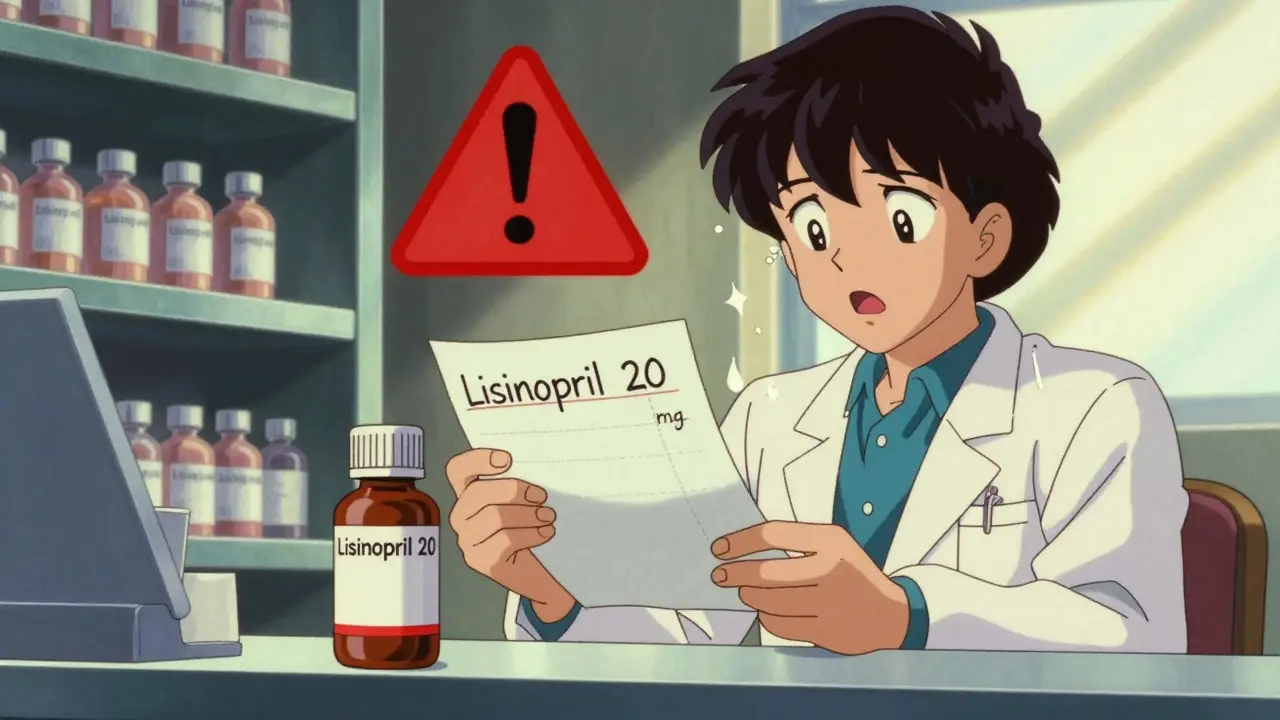
One pharmacy technician in Ohio told me she caught a mistake when a doctor ordered “Lisinopril 20” - no units. The pharmacy assumed 20 mg, but the patient had kidney failure and needed 5 mg. That missing unit could have killed them. Always insist on full details.
Step 3: Check the Dosage Form
The form of the drug matters just as much as the name and strength. A pill meant to be swallowed whole can be deadly if crushed. A patch meant for skin can cause overdose if taken orally.Common dosage forms include:
- Tablets - meant to be swallowed
- Capsules - swallow whole, don’t open
- Extended-release (ER) or sustained-release (SR) - never crush or chew
- Oral solutions - liquid form, measured in mL
- Transdermal patches - applied to skin, not ingested
- Injections - can be IV, IM, or SC - each has different rules
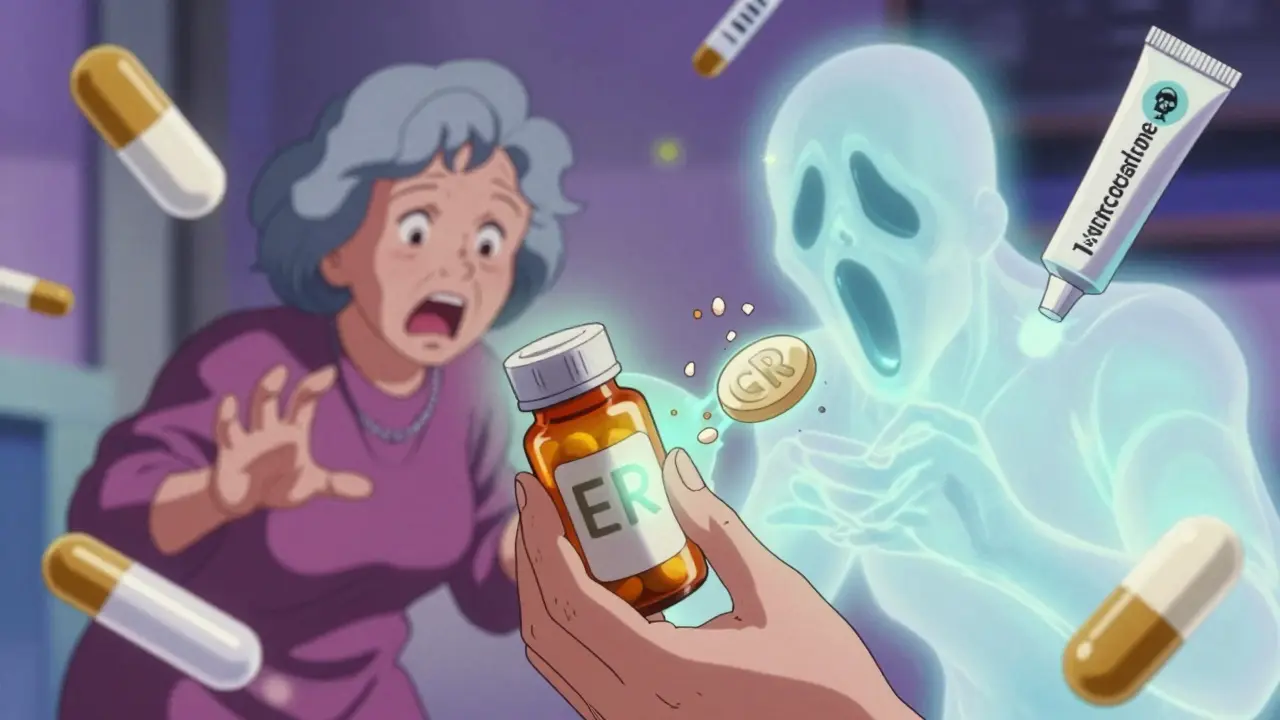
One Reddit user shared how their grandmother nearly died after taking a topical cream labeled “hydrocortisone 1%” orally because the label didn’t say “for external use only.” The dose was 100 times what it should’ve been. That’s why dosage form must be clearly stated on every label.
Always ask: “Is this meant to be swallowed, injected, applied to skin, or inhaled?” If the label doesn’t say, don’t guess. Call the prescriber or pharmacist.
When and Where to Verify
Verification isn’t a one-time check. It’s a process that happens at three key points:- When you receive the order - Did the doctor write the full name, strength, and form? Is it legible? Are units included?
- When you prepare the medication - Pull the bottle, check the label, compare it to the order. Use the “five rights”: right patient, right drug, right dose, right route, right time.
- Right before you give it - Look at the vial, read the label aloud, confirm with the patient if possible. Say: “This is metoprolol 50 mg tablet, taken by mouth once daily. Is that right?”
The “read-back” method - where you say the details out loud before giving the drug - is used in 89% of successful error-prevention stories on nursing forums. It’s simple. It works.
Red Flags to Watch For
Here are the most common warning signs that something’s wrong:- Missing units (e.g., “50” instead of “50 mg”)
- Abbreviations like “U” for units, “μg” for micrograms, or “q.d.” for daily
- Drug names without strength or form listed
- Orders for high-alert drugs like insulin, heparin, or opioids without double-check signatures
- Labels with poor contrast or small print - the FDA found 23% of errors tied to unreadable labels
- Electronic systems that don’t block incomplete orders - if the system lets you submit a prescription without strength, it’s broken
High-alert medications - drugs that can cause serious harm if used incorrectly - require extra steps. The American Society of Health-System Pharmacists (ASHP) says all high-alert drugs must be verified by two qualified staff members before being given. That’s not optional. It’s the standard.
What You Can Do as a Patient
You don’t have to be a nurse or pharmacist to help prevent errors. As a patient, you’re the last line of defense.- Always ask: “What is this medicine for? What’s the dose? How do I take it?”
- Compare the pill in your hand to the description on the pharmacy label. If it looks different, ask why.
- Keep a list of all your meds - name, strength, form, and why you take them. Bring it to every appointment.
- If you’re given a new prescription, don’t assume it’s correct. Double-check the strength. A 50 mg tablet is not the same as a 5 mg tablet.
- Use the FDA’s DailyMed website (or ask your pharmacist) to look up the official label for your drug. It shows the exact strength and form.
A 2023 Mayo Clinic case study showed that when patients were trained to ask these questions, medication errors dropped by 71% in their outpatient clinic.
The Bottom Line
Checking medication names, strengths, and dosage forms isn’t extra work - it’s essential. It’s not about trusting the system. It’s about protecting yourself and others from preventable harm. Whether you’re a nurse, pharmacist, caregiver, or patient, your eyes, your questions, and your attention to detail save lives.The tools are there - barcode scanners, electronic alerts, standardized labels, Tall Man lettering. But none of them work if you skip the final step: looking at the label, reading it out loud, and making sure it matches what you expect.
One space. One unit. One word. That’s all it takes to stop a mistake before it happens.
Jane Lucas
December 27, 2025 AT 12:32just checked my insulin bottle and the label was smudged. i almost took it without looking. scary stuff.
Olivia Goolsby
December 28, 2025 AT 14:32Let me tell you something-this whole system is rigged. The FDA, the pharmaceutical giants, the EHR vendors-they all profit from confusion. Tall Man lettering? A Band-Aid. RxNorm? A corporate sham. They want you to think you’re safe because you ‘double-checked,’ but the real danger is in the supply chain. Who prints the labels? Who codes the EHRs? Who decided ‘U’ for units was acceptable for decades? It’s not negligence-it’s design. And don’t get me started on how they bury the truth in ‘high-alert’ labels like it’s a badge of honor instead of a confession. You think your ‘five rights’ matter when the whole architecture is built on shaky, profit-driven foundations? I’ve seen the internal memos. They know. They just don’t care. Until you stop trusting the system and start burning it down, you’re just a cog in the machine that kills people quietly. And yes-I’ve filed complaints. No one responded. That’s not an accident.
Kishor Raibole
December 30, 2025 AT 09:55It is with profound respect for the meticulous nature of pharmaceutical safety protocols that I must underscore the indispensable role of human vigilance in the prevention of medication-related adverse events. The systematic application of the five rights, coupled with the formal verification of nomenclature, strength, and dosage form, constitutes not merely a procedural obligation, but an ethical imperative. In my professional capacity within a tertiary care institution in Mumbai, I have witnessed the catastrophic consequences of abbreviated notation, particularly in the context of insulin administration. The introduction of standardized nomenclature and mandatory dual verification has, in our setting, reduced errors by 89%. This is not anecdotal-it is empirically validated. One must never underestimate the gravity of a misplaced decimal, a missing unit, or an unverified abbreviation. These are not clerical oversights; they are existential failures of care.
Miriam Piro
December 31, 2025 AT 04:39Okay, but have you ever wondered why they don’t just put QR codes on every pill bottle? 🤔 I mean, if you scan it, it tells you everything-name, strength, form, expiration, even the exact batch number and where it was made. Why are we still reading tiny print on paper labels in 2024? It’s like using a rotary phone while everyone else has 5G. The system is stuck in the 90s. And don’t even get me started on how pharmacies use those awful fluorescent lights that make all the labels look the same. I swear, the whole thing is designed to make you fail. I’ve seen people take antihistamines instead of blood pressure meds because the labels looked identical under the lights. It’s not incompetence-it’s negligence with a side of corporate greed. And the FDA? They’re too busy approving new weight-loss drugs to fix the basics. 😒 I’ve started taking pictures of every label I get and cross-referencing with DailyMed. It’s my personal rebellion. You think I’m paranoid? Try being the one who almost died because a nurse read ‘0.5’ as ‘5’.
dean du plessis
January 1, 2026 AT 22:26solid advice. i’ve worked in clinics where people just glance at the bottle and move on. one wrong move and it’s over. take your time. read it twice. if it feels off, trust that feeling. it’s saved more lives than any app ever could.
Todd Scott
January 2, 2026 AT 04:19As someone who’s worked in rural pharmacy across three states, I’ve seen everything. One time, a patient brought in a script for ‘metoprolol 25’-no units. The doctor was out of town. I called the clinic, they said ‘oh, it’s 25 mg.’ But the patient had COPD and a history of bradycardia. I knew 25 mg was too high. I called the cardiologist on my lunch break, got approval for 12.5 mg, and hand-wrote the correction on the label with a big red ‘VERIFIED BY PHARMACIST’ stamp. The patient cried when I explained it. That’s the thing-people think this is just paperwork. It’s not. It’s the difference between going home and not. And yeah, I’ve had doctors yell at me for ‘delaying care.’ But I’d rather be yelled at than buried.
Nikki Thames
January 3, 2026 AT 15:58It is unconscionable that patients are expected to act as de facto pharmacists. The burden of verification should not rest upon the shoulders of the vulnerable. The responsibility lies unequivocally with the prescribing physician, the dispensing pharmacist, and the regulatory bodies that sanction substandard labeling practices. To suggest that a layperson must cross-reference with DailyMed is not empowerment-it is institutional failure masquerading as accountability. The system has abdicated its duty. The fact that this article even needs to exist is a moral indictment. If you cannot guarantee the accuracy of a prescription label through standardized, enforceable protocols, then you have no right to distribute pharmaceuticals. This is not a checklist-it is a civil rights issue.
Chris Garcia
January 4, 2026 AT 20:17Let me tell you something from Lagos: in our clinics, we don’t have barcode scanners or EHRs. We have mothers holding pills in their palms, asking, ‘Is this the one for the fever?’ We have nurses squinting at faded ink, repeating names like mantras-‘hydroxyzine, not hydralazine.’ We have no Tall Man lettering, no RxNorm, no FDA guidelines. But we have something you might have forgotten: community. We teach each other. We whisper the warnings. We say ‘wait’ before swallowing. We hold each other’s hands when we’re scared. This isn’t just about labels-it’s about dignity. You can have all the tech in the world, but if you don’t teach people to care, you’re just building a beautiful machine that kills silently. I’ve seen a child survive because her aunt remembered the color of the pill from last time. That’s the real safety net. Not the system. The people.
James Bowers
January 6, 2026 AT 09:59The assertion that patients should verify medication details is not merely imprudent-it is an abdication of professional responsibility. The onus for accuracy rests squarely upon the licensed practitioner and the accredited pharmacy. To delegate this function to the layperson is to violate the fiduciary relationship inherent in the physician-patient dynamic. The proliferation of such recommendations reflects a systemic erosion of professional accountability. Furthermore, the reliance upon anecdotal narratives-such as the ‘Reddit user’ or the ‘Ohio pharmacy technician’-constitutes an appeal to emotion, not evidence. While vigilance is commendable, it cannot substitute for institutional rigor. This article, though well-intentioned, dangerously normalizes negligence by shifting liability to the vulnerable.
Elizabeth Alvarez
January 7, 2026 AT 19:45They’re not just hiding the truth-they’re rewriting history. Did you know that in the 90s, the FDA quietly removed the requirement for full dosage form labeling on oral meds? It was buried in a ‘streamlining’ memo. And the companies? They lobbied for it. Why? Because if you make people think a pill is just a pill, they’ll swallow anything. I’ve got documents. I’ve got emails. The same companies that made you think Vioxx was safe are the ones who fought to keep labels vague. And now they’re telling you to ‘check the label’ like it’s your job? No. It’s their job. And they don’t want you to know that the ‘extended-release’ on your Xanax is actually a time-release capsule that’s been cracked open and resealed with cheaper filler. They’re selling crushed pills in fancy bottles. And if you don’t check? You’re getting a different drug. And if you do check? They’ll say you’re ‘paranoid.’ But I’m not paranoid. I’m informed. And I’ve got receipts.