

You pick up a bottle of liquid antibiotic for your kid. The label says "Take 5 mL." You grab the little cup from the box, pour it up, and hand it over. Simple, right? Not always. Medication errors involving liquid prescriptions cause roughly 1.3 million injuries in the U.S. every year. Most of these aren't caused by the drug itself, but by how we read the label and measure the dose. If you've ever stared at a tiny decimal point or wondered if a kitchen spoon is close enough, you're not alone. Understanding exactly what those numbers mean is the difference between a safe recovery and an accidental overdose.
Why Milliliters Are the Only Unit That Matters
The first thing to notice on any modern prescription label is the unit of measurement. For years, labels mixed milliliters (mL) with teaspoons (tsp) and tablespoons (tbsp). This was a disaster waiting to happen. A standard teaspoon holds about 5 mL, but household spoons vary wildly. Some hold 2.5 mL, others hold 7.5 mL. That's a huge margin of error when you're dealing with potent medicine.
Milliliter (mL) is now the universal standard mandated by the FDA and recommended by the National Council for Prescription Drug Programs (NCPDP). Using only metric units reduces administration errors by over 50% compared to non-metric systems. When you see "mL" on the label, trust it. Ignore any older instructions that might still mention "teaspoons" unless they explicitly state "5 mL (1 tsp)." Even then, use the mL number. It’s precise. Your silverware drawer isn’t.
Decoding the Concentration: What Does mg/mL Mean?
Next to the dose instruction, you’ll often see something like "240 mg/5 mL." This isn't the amount of medicine you take; it's the strength of the solution. Think of it like coffee concentration. A "double shot" has more caffeine per ounce than a regular brew. Here, the label tells you there are 240 milligrams of active drug in every 5 milliliters of liquid.
This distinction trips people up constantly. If your doctor prescribes a 120 mg dose, and the concentration is 240 mg/5 mL, you don't give 5 mL. You give half that amount-2.5 mL-because that delivers the correct 120 mg. Misreading this ratio is one of the most common causes of pediatric dosing errors. Always check the math if the prescribed dose doesn't match the volume listed in the instructions.
| Concentration | Prescribed Dose | Volume to Administer | Notes |
|---|---|---|---|
| 160 mg / 5 mL | 160 mg | 5 mL | Standard Children's Tylenol strength |
| 160 mg / 5 mL | 80 mg | 2.5 mL | Half the standard dose |
| 250 mg / 5 mL | 500 mg | 10 mL | Double the standard volume |
| 100 mg / mL | 50 mg | 0.5 mL | Highly concentrated; requires syringe |
Reading the Numbers: Leading Zeros and Decimal Points
Precision matters when doses are small. Look closely at the font size and spacing. Proper labeling uses a leading zero before decimal points for values less than one. So, you should see "0.5 mL," not ".5 mL." Why? Because a missing dot can turn 0.5 into 5. A fivefold increase in dosage can be dangerous, especially for infants.
Conversely, you should never see trailing zeros after a decimal point. A dose should read "5 mL," not "5.0 mL." Trailing zeros can be misread as ten times the intended amount if the decimal point shifts or is obscured. These formatting rules, established by safety organizations like the Institute for Safe Medication Practices (ISMP), are designed to prevent visual misinterpretation. If you see "5.0 mL" on a label, ask your pharmacist if it’s a typo or just old formatting habits.
Choosing the Right Measuring Device
Here is a hard truth: your kitchen cutlery is not a medical device. Studies show that parents using household spoons are twice as likely to measure incorrect doses compared to those using proper tools. The variability is shocking. One study found household teaspoons ranging from 2.5 mL to 7.5 mL. That’s a tripled dose risk.
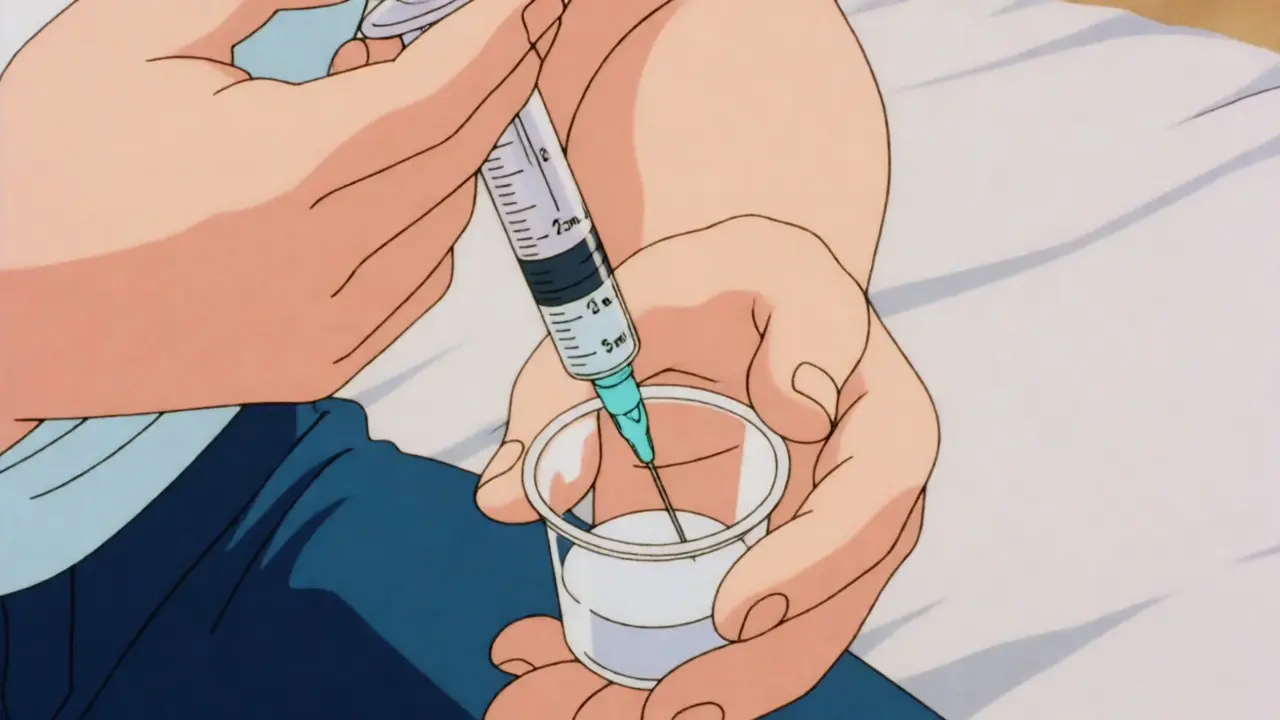
Always use the device provided with the medication. If it’s missing, buy one. Oral syringes are generally more accurate than cups, especially for doses under 5 mL. Cups have wide bases where the meniscus (the curve of the liquid) is harder to read at eye level. Syringes allow you to push the plunger to exact lines marked in 0.1 mL increments.
- Oral Syringes: Best for doses under 10 mL. No markings for "tsp" or "tbsp"-only mL.
- Dosing Cups: Acceptable for larger volumes (10 mL+), but must be used on a flat surface.
- Droppers: Often lack clear volume markings. Never assume a dropper equals 1 mL unless stated.
- Kitchen Spoons: Avoid completely. They are decorative objects, not measuring tools.
Total Volume vs. Single Dose: Don't Get Confused
Another frequent mix-up involves the total container size versus the single dose. A bottle might say "118 mL" on the front. That’s the total amount of liquid inside. It does not mean you drink 118 mL at once. The actual dose will be much smaller, like 5 mL or 10 mL, repeated several times a day.
Check the expiration date too. Liquid medications degrade faster than pills. Once opened, some antibiotics last only 7-10 days in the fridge, while others are stable for months. If the label doesn't specify storage after opening, ask the pharmacist. Writing the discard date on the bottle immediately helps prevent giving spoiled medicine later.

The Teach-Back Method: Confirming You Understand
If you’re unsure about any part of the label, do the "teach-back." Tell your pharmacist exactly what you plan to do. "I’m going to give 2.5 mL every 6 hours using this syringe." If they nod, you’re good. If they stop you, listen. Pharmacists are trained to catch these specific types of errors. In fact, patients who receive a demonstration of proper measuring techniques make significantly fewer mistakes than those who just read the paper leaflet.
Health literacy plays a big role here. Many adults struggle with basic decimal concepts. There’s no shame in asking for help. Pharmacies are required to provide counseling, so use that service. Bring the bottle to the counter. Point to the line you think is the dose. Let them verify it. It takes thirty seconds and could save a hospital visit.
Frequently Asked Questions
Can I use a regular teaspoon instead of the measuring cup?
No, you shouldn't. Household teaspoons vary greatly in size, holding anywhere from 2.5 mL to 7.5 mL. A medical teaspoon is standardized at 5 mL, but your kitchen spoon likely isn't. This inconsistency leads to significant dosing errors. Always use the oral syringe or dosing cup provided with the medication or purchased separately.
What does "mg/5 mL" mean on my child's fever reducer?
This indicates the concentration of the medication. It means there are a specific number of milligrams (mg) of the active ingredient in every 5 milliliters (mL) of liquid. For example, "160 mg/5 mL" means each 5 mL dose contains 160 mg of acetaminophen. To calculate a different dose, you adjust the volume proportionally. If you need 80 mg, you would give 2.5 mL.
Why does the label say "0.5 mL" instead of ".5 mL"?
Safety standards require a leading zero before decimal points for numbers less than one. This prevents misreading. Without the zero, ".5" can easily look like "5" if the decimal point is faint or missed. A dose of 5 mL is ten times higher than 0.5 mL, which can be dangerous, especially for infants. The leading zero acts as a visual safeguard against 10-fold dosing errors.
My pharmacy didn't give me a measuring device. What should I do?
You should request one immediately. Most pharmacies provide oral syringes or dosing cups for free with liquid prescriptions. If they don't have stock, buy a dedicated oral syringe from the same pharmacy or a reputable retailer. Ensure it is marked in milliliters (mL). Do not rely on the cap of the bottle, as these are notoriously inaccurate.
How long are liquid medications good after opening?
It depends on the specific drug. Some antibiotics expire within 7-10 days of mixing, while cough syrups may last until the printed expiration date. Always check the label for "Discard after" instructions. If none are given, ask your pharmacist. Writing the discard date on the bottle with a marker is a best practice to avoid using spoiled medication.