
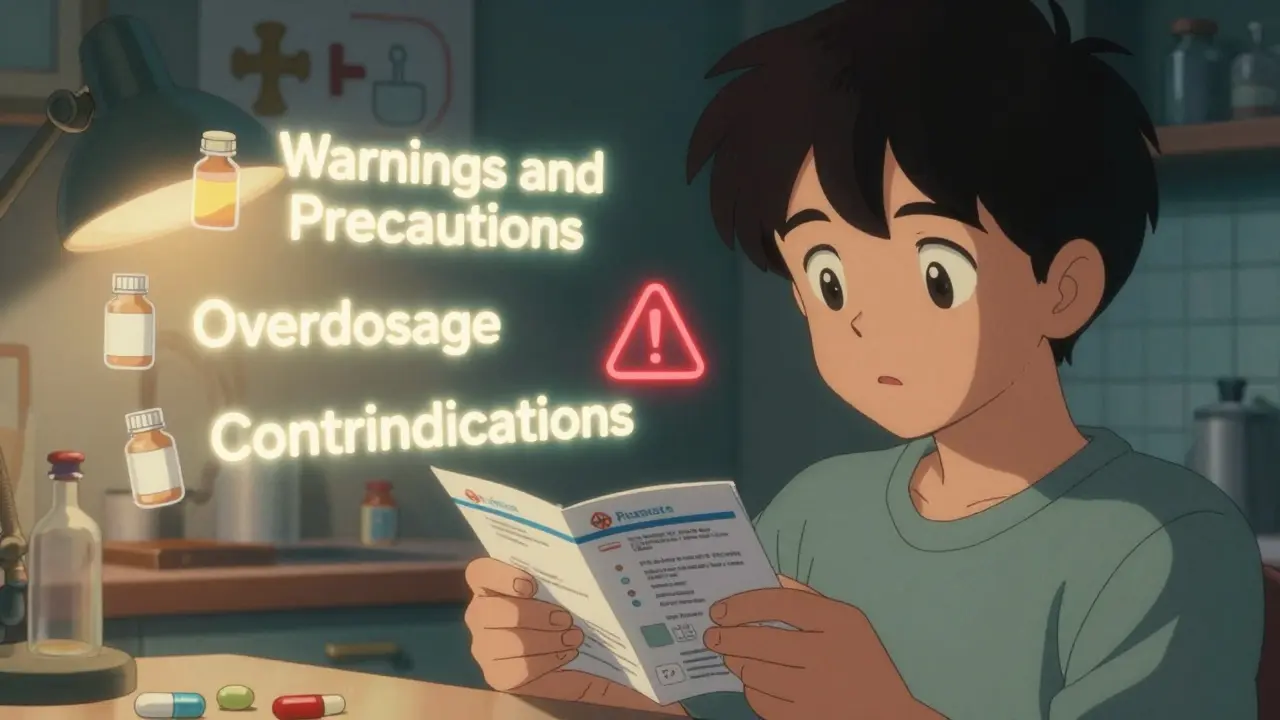
Every time you pick up a new prescription, you get a small booklet-usually folded, sometimes stapled-that comes with your pills. Most people glance at it, tuck it into a drawer, and forget about it. But that booklet? It’s your first line of defense against accidental overdose. It’s not just paperwork. It’s a survival guide written in plain language by experts who’ve seen what happens when things go wrong.
Where to Find the Overdose Information
Don’t flip through the whole thing looking for bold letters that say “OVERDOSE.” That’s not how it works. The key sections are always in the same place, no matter the drug. Look for three headings:
- Warnings and Precautions
- Overdosage
- Contraindications
These aren’t random titles. They’re required by the U.S. Food and Drug Administration (FDA) for all prescription medications. If your guide doesn’t have them, it’s either outdated or not the full version. The Overdosage section is where you’ll find exact numbers: how many pills can cause harm, what happens at different doses, and what to do next. This section is often overlooked because it sounds technical-but it’s the most important part for safety.
Understanding the Language
Medication guides don’t say “You might die if you take too much.” They use specific terms you need to learn:
- Acute toxicity = immediate danger from a single high dose
- Chronic overdose = harm from taking too much over days or weeks
- Therapeutic index = the gap between a helpful dose and a dangerous one
For example, if a guide says “The therapeutic index for oxycodone is narrow,” that means the difference between a safe dose and a deadly one is small. You don’t need to know the math-but you do need to know what it means: be extra careful.
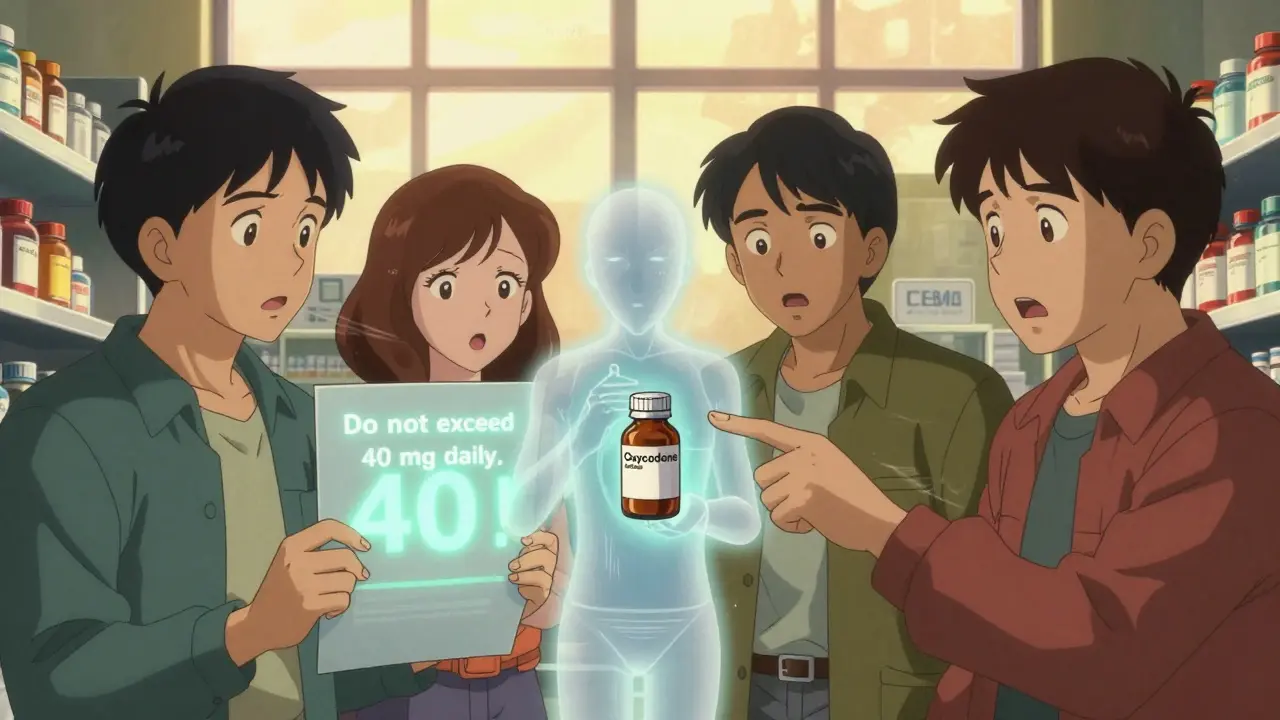
Another phrase you’ll see: “Do not exceed 40 mg daily.” That’s not a suggestion. That’s a hard limit. If you’re prescribed 10 mg four times a day, you’re at the edge. Add an extra pill because you’re still in pain? You’re crossing into danger.
Antidotes: What They Are and Where They’re Listed
An antidote is a medicine that reverses the effects of an overdose. Not every drug has one. But when it does, it’s clearly stated in the Overdosage section. For example:
- Naloxone reverses opioid overdoses (like oxycodone, fentanyl, heroin)
- N-acetylcysteine is used for acetaminophen (Tylenol) overdose
- Flumazenil counters benzodiazepines (like Xanax, Valium)
Here’s the catch: the guide won’t tell you how to give the antidote. It’ll say something like: “Naloxone may be administered by trained personnel.” That means: call 911 first. You’re not expected to be a doctor. But you are expected to know that an antidote exists-and that it’s time-sensitive.
Some guides mention antidotes under “Treatment of Overdose.” That’s where you’ll find details like: “Naloxone may be repeated every 2-3 minutes if respiratory depression returns.” That’s critical. One dose isn’t always enough. Especially with strong opioids like fentanyl.
Red Flags in the Guide
Not all warnings are obvious. Here’s what to watch for:
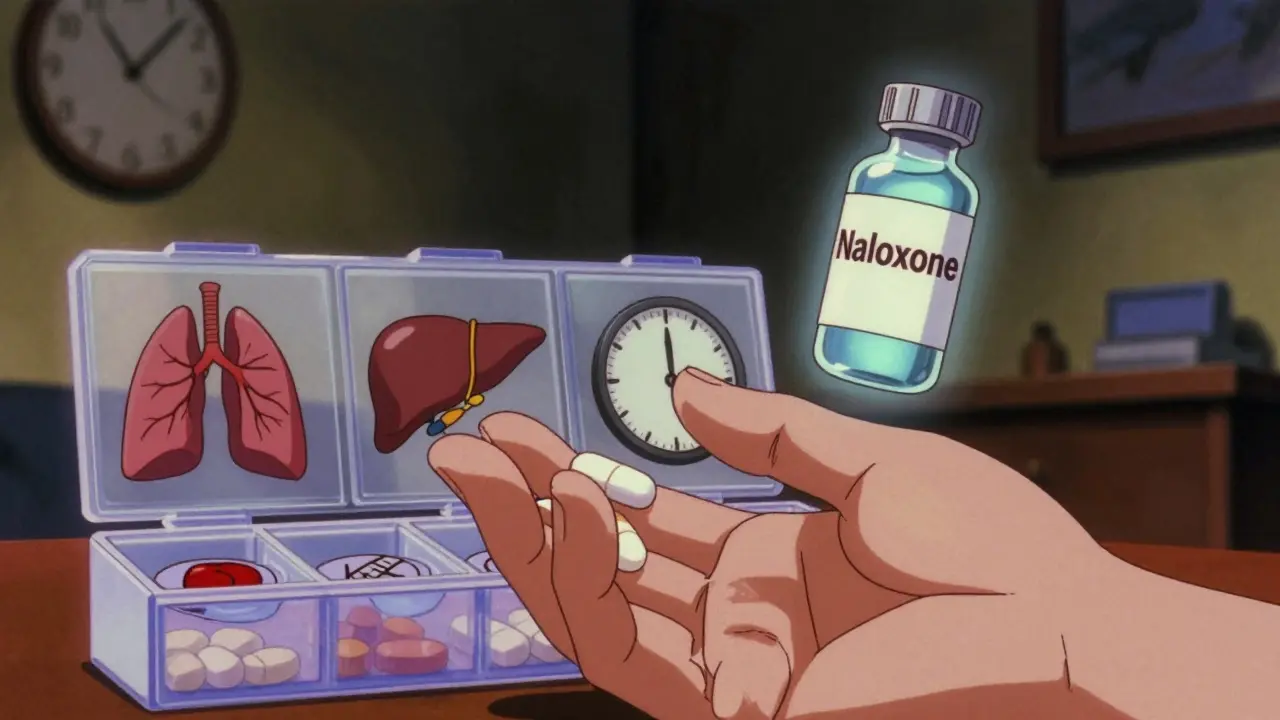
- “May cause respiratory depression” = your breathing can slow or stop. This is the #1 cause of death in overdoses.
- “Avoid alcohol” = even one drink can turn a safe dose into a lethal one. Many people don’t realize this.
- “Use with caution in elderly patients” = older adults process drugs slower. A dose that’s fine for a 30-year-old can be deadly for a 70-year-old.
- “Contraindicated in severe liver disease” = your liver can’t break down the drug. It builds up. Slowly. Dangerously.
If you see any of these, don’t ignore them. Write them down. Show them to your pharmacist. Ask: “What happens if I miss a dose and take two later?”
Real-Life Scenarios You Should Know
Let’s say you’re on gabapentin for nerve pain. Your guide says: “Overdose may cause drowsiness, dizziness, double vision, and slurred speech.” You think: “I’ve felt that after a long day. Not a big deal.” But if you take 10 pills instead of 3? Those symptoms become life-threatening. Your breathing slows. You pass out. No one finds you for hours.
Or you’re on hydrocodone after surgery. You’re told not to take more than 6 tablets a day. You’re in pain. You take 8. You feel dizzy. You lie down. You wake up 12 hours later with no memory of the last few hours. That’s not “just tired.” That’s a warning sign your body couldn’t handle the load.
Another common mistake: mixing meds. Your guide for tramadol says: “Avoid concurrent use with SSRIs.” But your antidepressant’s guide doesn’t mention tramadol. That doesn’t mean it’s safe. The interaction can cause serotonin syndrome-a rare but deadly condition. You have to read both guides. Together.
What to Do When You’re Unsure
You don’t need to be a pharmacist. But you do need to ask the right questions:
- Is there an antidote for this drug?
- What happens if I take too much?
- What should I do if someone I know takes too much?
- Are there other drugs I’m taking that could make this dangerous?
Call your pharmacist. They’re trained to explain this stuff. No judgment. No rush. They’ve seen this a hundred times. Or use the FDA’s Drugs@FDA database-search your drug name. The full prescribing info is there, with the same sections you’d find in your guide.
Why This Matters More Than You Think
Overdose isn’t just about street drugs. Nearly 70% of overdose deaths in the U.S. involve prescription medications. Many of those people weren’t “addicts.” They were someone’s parent, neighbor, coworker-people who took their meds as directed, then added one extra pill because they were still hurting.
Reading your medication guide isn’t about fear. It’s about control. It’s knowing what to watch for. Knowing when to call for help. Knowing that the antidote exists-and that time matters.
Keep your guide with your pills. Not in a drawer. Not in a box. Next to the bottle. Flip it open every time you refill. You’ll be surprised how often the warning changes. New studies come out. New risks get added. Your guide updates. You should too.
Can I rely on the pill bottle label instead of the medication guide?
No. The pill bottle label only shows your name, the drug name, dosage, and how often to take it. It doesn’t include overdose risks, antidotes, or interactions. The medication guide contains critical safety information the label leaves out.
What if I lost my medication guide?
You can get a new copy from your pharmacy-they’re required to provide one. Or visit the FDA’s Drugs@FDA website, search your drug name, and download the full prescribing information. Look for the “Patient Counseling Information” section-it’s the same content.
Do over-the-counter drugs have overdose warnings too?
Yes. Even common painkillers like acetaminophen (Tylenol) or ibuprofen (Advil) have overdose risks. The packaging usually lists maximum daily doses. But the full guide-often available online-explains how liver damage can happen slowly, even if you don’t feel sick right away.
Are antidotes always available in emergency rooms?
Most hospitals stock naloxone, N-acetylcysteine, and flumazenil. But availability can vary by region. That’s why knowing your drug’s antidote matters: if you tell EMS or ER staff what you took, they can act faster. Say: “She took oxycodone-need naloxone.” That speeds up treatment.
Can I keep naloxone at home if I’m not on opioids?
Yes. Naloxone is safe for anyone to carry. It only works on opioids and won’t harm someone who hasn’t taken them. Many pharmacies sell it without a prescription. If someone in your home takes pain meds, antidepressants, or sleep aids, keeping naloxone on hand is a smart precaution.
Miranda Anderson
February 28, 2026 AT 09:42Been reading these guides for years now, and honestly? The biggest thing I’ve learned is that the language isn’t meant to scare you-it’s meant to prepare you. I used to think ‘therapeutic index’ was just doctor jargon until my dad had a near-miss with his pain meds. Turns out, a narrow index means even a small mistake can tip the scale. Now I keep the guide taped to the pill bottle. Not because I’m paranoid, but because I’ve seen how quietly these things can go wrong.
And yeah, the ‘avoid alcohol’ note? That’s not a suggestion. My cousin took her anxiety med with one glass of wine. Ended up in the ER. Not because she was ‘abusing’ it. Just because no one told her that the guide doesn’t say ‘don’t drink’-it says ‘may potentiate CNS depression.’ Translation: your brain shuts down faster. I wish someone had explained that to her before it happened.
I don’t think people realize how much the FDA requires these sections to be standardized. It’s not random. Every heading, every phrase, every warning is there because someone died from not knowing. That’s why I always tell people: read it like a map. Not a manual. A map. You don’t need to memorize it. Just know where to find the exits.
And if you’re ever unsure? Call your pharmacist. They’re not there to judge you. They’re there because they’ve seen 20 versions of the same mistake. I’ve called mine at midnight before. They didn’t blink. They just said, ‘Let me pull up your med’s prescribing info.’ That’s the kind of help we need more of.
Also-yes, OTC drugs have guides too. Tylenol’s overdose section? It’s terrifying. Liver damage doesn’t come with a siren. It comes with fatigue. Nausea. A vague feeling you just need more sleep. By the time you feel ‘sick,’ it’s too late. That’s why I print the full guide for every prescription-even the ones I’ve had for years. Things change. Risks get updated. Your body doesn’t. Neither should your awareness.
Jimmy Quilty
March 2, 2026 AT 07:21lol so the fda says ‘overdosage’ not ‘overdose’ so now i’m supposed to trust these things? they can’t even spell right. also i read that naloxone is for opioids but my doc gave me oxycodone and said ‘if you overdose just call 911’-so why is the guide talking about ‘trained personnel’? sounds like they’re hiding something. also why is there no warning about how pharma companies pay for these guides? i bet they leave out the worst stuff. my cousin took 10 pills and died and the guide said ‘rarely fatal’-that’s a lie. someone’s lying. someone’s always lying. you think they want you to live? they want you hooked. and paying. always paying.
Sneha Mahapatra
March 4, 2026 AT 01:05I read this and felt a quiet sadness. Not because it’s scary-but because it’s so deeply necessary, and yet so rarely honored.
I’ve sat with elderly patients who didn’t understand why their ‘little blue pill’ had a 30-page booklet. They’d say, ‘I’ve taken it for 12 years. Why now?’ And I’d hold their hand and say, ‘Because your body changes. The risks change. The science changes.’
One woman, 82, had been on gabapentin for nerve pain. She didn’t know that doubling her dose because she ‘felt tired’ was putting her at risk for respiratory depression. She thought fatigue meant she needed more medicine. Not less.
Reading these guides isn’t about fear. It’s about dignity. It’s about honoring your body enough to understand how it works. Not blindly. Not out of panic. But with curiosity. With care.
And yes-naloxone at home? I keep two in my purse. Not because I take opioids. But because my neighbor’s son does. And because love means being ready. Not just hoping.
It’s not about being smart. It’s about being human.
Katherine Farmer
March 4, 2026 AT 13:44This post is so fundamentally flawed it’s almost offensive. First, the FDA doesn’t require ‘Overdosage’ as a heading-it’s the ‘Overdosage’ section in the Prescribing Information, which is separate from the Patient Medication Guide. You’re conflating two documents. The guide is a summary. The full PI has the real data.
Second, ‘therapeutic index’ isn’t something patients need to ‘learn.’ It’s a pharmacokinetic metric calculated by researchers. You don’t need to know the math-you need to know that ‘narrow’ means ‘don’t f*** around.’
Third, N-acetylcysteine isn’t an ‘antidote’ for acetaminophen-it’s a precursor to glutathione synthesis. Calling it an antidote is medically inaccurate. You’re oversimplifying to the point of misinformation.
And don’t get me started on ‘read your guide every time.’ That’s not practical. Most people refill prescriptions online. They don’t get a new guide. They get a QR code. And even if they scan it, the link often goes to the outdated version.
Real solution? Integrate this info into pharmacy apps. Not paper booklets. This post is well-intentioned but dangerously naive.
bill cook
March 5, 2026 AT 08:51so u say read the guide but what if the guide says one thing and ur doctor says another? like my doc told me to take 20mg of oxycodone but the guide says max 15? who do i believe? i think the doc is lying to keep me hooked. or maybe the guide is wrong because the company paid to change it. i dont trust anyone anymore. i think the government is hiding the real doses. they dont want us to know how easy it is to die. i took 18 once. i felt fine. that means its safe right? i think they want us scared so we dont take meds. they’re scared too.
Noah Cline
March 6, 2026 AT 02:35It’s worth noting that the ‘Overdosage’ section is derived from Phase I and Phase II clinical trial data, primarily from healthy volunteers under controlled conditions. What’s rarely discussed is that real-world pharmacokinetics vary significantly due to CYP450 polymorphisms, renal clearance rates, and hepatic enzyme induction/inhibition-especially in polypharmacy patients.
For example, fluoxetine’s inhibition of CYP2D6 can elevate oxycodone plasma concentrations by up to 300%, effectively turning a therapeutic dose into a toxic one. Yet the guide doesn’t mention this because it’s not FDA-mandated to list every possible interaction-only the most clinically significant.
Moreover, the therapeutic index for drugs like warfarin or lithium is so narrow that even 5% deviation can be lethal. The fact that laypersons are expected to interpret these nuances without context is a systemic failure of risk communication, not negligence.
Bottom line: The guide is a starting point, not a solution. Clinical decision support tools integrated into EHRs are what’s needed-not paper pamphlets.
Brandon Vasquez
March 6, 2026 AT 18:38My mom died from an acetaminophen overdose. She didn’t know that 4000mg was the limit. She took Tylenol for her arthritis and added Advil because she thought it would help more. She didn’t feel sick. She just got tired. Then she didn’t wake up.
I didn’t know any of this until it was too late.
I carry naloxone in my wallet now. Not because I use opioids. But because I know how quietly this happens.
Read the guide. Keep it with the bottle. Ask the pharmacist. Don’t assume. Don’t guess.
That’s all.
Ajay Krishna
March 7, 2026 AT 09:06Hey, I’m a pharmacy tech in Bangalore, and I’ve seen this exact thing happen over and over. People think the bottle label is the whole story. It’s not. I always hand out the guide when someone picks up a new script-even if they say they don’t need it.
One guy came in for tramadol. Said his wife took it for back pain. I asked if she was on any antidepressants. He said no. Turned out she was on sertraline. I pulled up the guide. Serotonin syndrome risk. He didn’t know. We called her doctor. She switched meds.
It’s not about being scared. It’s about being informed. And you don’t need a degree to do it. Just take 5 minutes. Read the bold parts. Ask one question.
And yes-naloxone at home? It’s like a fire extinguisher. You hope you never need it. But if you don’t have one? You’re asking for trouble.
Thanks for writing this. More people need to hear it.
Gigi Valdez
March 8, 2026 AT 10:11The structure of the medication guide is intentionally standardized across all prescription drugs in the U.S. This standardization ensures consistency in risk communication regardless of manufacturer or brand. The sections-Warnings and Precautions, Overdosage, Contraindications-are not arbitrary. They are codified under 21 CFR Part 208.
While the language may seem clinical, it is precisely calibrated to convey necessary information without inducing panic. Terms like ‘acute toxicity’ and ‘therapeutic index’ are not jargon-they are established pharmacological classifications used globally in regulatory documentation.
Pharmacists are trained to translate these terms into accessible language. If a patient does not understand a section, they should ask. There is no stigma in seeking clarification.
Furthermore, the FDA’s Drugs@FDA database provides the complete, unedited prescribing information. This is the authoritative source. The patient guide is a summary. Both are important. Neither is sufficient alone.
Responsible medication use requires engagement, not fear. And engagement begins with reading.