

| Feature | Blister Packs | Pill Packs (Bubble Packs) | Traditional Bottles |
|---|---|---|---|
| Visual Tracking | Excellent (Empty foil) | Excellent (Missing pouch) | Poor (Hard to tell) |
| Travel Ease | Low (Carry whole sheet) | High (Detachable pouches) | Medium (Bulky) |
| Ease of Opening | Medium (Press through foil) | High (Tear open) | Low (Screw caps/Child-proof) |
| Flexibility | Low (Fixed layout) | Low (Fixed layout) | High (Easy to change) |
Understanding Blister Packs vs. Pill Packs
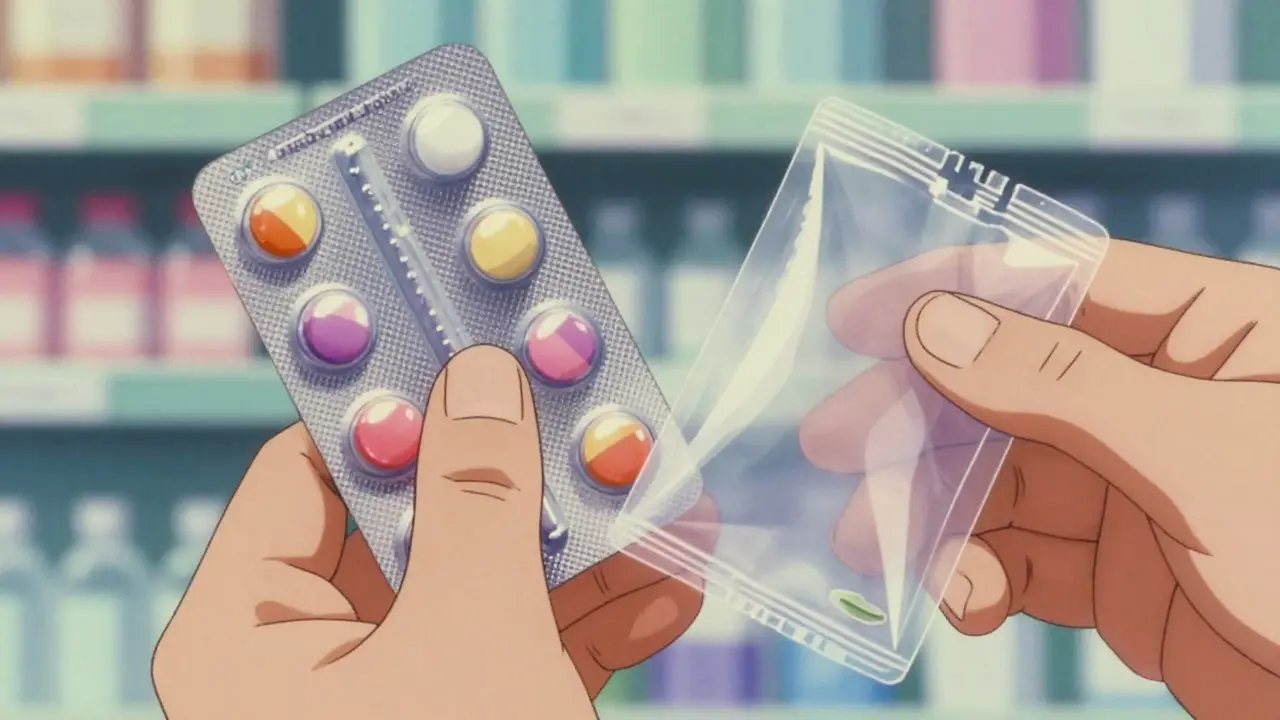
While people often use these terms interchangeably, there is a key difference in how they are built. Blister Packaging is a rigid plastic sheet with foil seals. Imagine a sheet of bubble wrap, but with medicine inside. To get your dose, you press the pill through the foil. These are great for home use because you can see at a glance if Monday morning's dose is still there. On the other hand, Pill Packs (often called bubble packaging or multi-dose pouches) consist of small, connected plastic bags. Each bag is sealed and labeled with the date and time. The biggest win here is portability. If you're going for a weekend trip, you can simply tear off the pouches for Saturday and Sunday and leave the rest of the month at home. Both systems are prepared by a professional pharmacist. This is a huge safety upgrade over DIY pillboxes. When a pharmacy handles the sorting, they check for drug interactions-which can reduce potential medication errors by up to 37%-and ensure the right dose goes into the right slot. This takes the guesswork and the risk of human error out of the equation for the caregiver.How to Start Using These Systems
Switching to a pre-sorted system is straightforward, but it requires a bit of coordination with your healthcare provider. You can't just buy these at a grocery store; they are a service provided by your pharmacy.- Audit Your Medications: List every prescription, including the dose and time of day you take it. Mention any over-the-counter vitamins or supplements you want included in the pack.
- Request the Service: Ask your pharmacist if they offer "blister packing" or "multi-dose packaging." If your current pharmacy doesn't, you may need to transfer your prescriptions to one that does.
- Set Up a Refill Schedule: Unlike bottles, which you can refill one by one, these packs are created as a set. You'll typically need to request your refill 3 to 5 business days before your current pack runs out to give the pharmacist time to sort and seal them.
- The First Dose: Once you receive your pack, identify the current day and time. For blister packs, simply press firmly on the plastic bubble to push the pill through the foil and into your hand.
Who Benefits the Most?
These systems aren't for everyone, but they are life-changing for specific groups. If you are managing five or more daily medications, the cognitive load of tracking them is immense. For seniors with early-stage memory loss, the "visual confirmation" of an empty foil slot removes the anxiety of wondering if they've already taken their meds. Physical accessibility is another factor. About 49% of seniors deal with arthritis, making traditional screw-top bottles a daily struggle. While some users with very limited hand strength might find pressing through foil tricky, many find it far easier than wrestling with a child-proof cap. For those with visual impairments, pharmacies use high-contrast, large-font labeling on these packs, which is much easier to read than the tiny print on a standard bottle label. ## Potential Pitfalls and How to Handle Them No system is perfect. The biggest downside to both blister and pill packs is their rigidity. Once a pharmacist seals a weekly pack, you can't easily change it. If your doctor changes your dosage on Wednesday, you can't just swap a pill in the pack. You'll either have to manually remove the old pill and take the new dose separately or get a replacement pack from the pharmacy. Another challenge is the learning curve. Most people get the hang of it within a few days, but the first week usually requires a caregiver to help them locate the correct day and time slot. It's also worth noting that these services may come with a fee. Some pharmacies include this in their dispensing cost, while others may charge a weekly service fee.
The Future of Medication Management
We are moving toward a world where your packaging actually talks to your doctor. Recent studies into "smart" multidose blister packages show that embedded sensors can track exactly when a compartment is opened. This data can be sent to a healthcare provider or family member in real-time. If a senior misses three doses in a row, the system can trigger an alert, allowing for a quick check-in before a minor mistake becomes a medical emergency. This shift toward digital monitoring is expected to become common, potentially reducing medication-related hospitalizations by nearly 30%. For now, even the non-digital version of these packs provides a level of independence that is empowering. It allows seniors to manage their own health without needing a family member to hover over them three times a day.Do insurance companies cover the cost of blister packaging?
Coverage varies. Many U.S. pharmacies include the cost in their standard dispensing fees. However, some Medicare Part D plans cover these services under "Medication Therapy Management" (MTM) benefits. It is best to ask your pharmacist to check your specific plan's coverage.
What happens if I miss a dose in a blister pack?
First, check the time. If it's almost time for your next dose, consult your doctor or pharmacist about whether to skip the missed one. Because the pack provides a clear visual record, you can easily tell the pharmacist exactly which dose was missed, making it easier for them to give you safe advice.
Are blister packs safe for medications that must be kept refrigerated?
Generally, no. Most blister and pill pack materials are designed for room-temperature storage. Medications requiring refrigeration should remain in their original pharmacy containers and be managed separately from the pack.
Can I use these if I have severe arthritis in my hands?
Many people with arthritis find them easier than bottles, but some struggle to push the pill through the foil. If this happens, pill pouches (the tear-open kind) are often a better alternative. You can also use a small tool or a pill pusher to help get the medication out.
How do I handle a medication change mid-week?
Since you can't easily change a sealed pack, contact your pharmacist immediately. They can either provide a new updated pack or instruct you on how to supplement the current pack with the new dosage until the next cycle begins.
Mary Johnson
April 12, 2026 AT 18:31You really think it's a coincidence that the pharmacies are pushing these"smart" packages now?
They just want a direct digital line into your home to track every single move you make under the guise of health care. It's just another way for big pharma to monitor our biological data in real-time and sell it to insurance companies to jack up your premiums the second you miss a dose. Wake up and realize that giving them this kind of control over your medication access is a nightmare waiting to happen.
john chiong
April 13, 2026 AT 16:10absolute madness that we let our elders rot in a sea of orange plastic bottles when these elegant solutions exist it is a moral failure of the highest order to not implement this for every single person in assisted living
Princess Busaco
April 15, 2026 AT 05:05While everyone is blindly praising these little plastic pouches, I find it absolutely laughable that we assume a pharmacist's automated machine is somehow more 'safe' than a human being taking ownership of their own health, and frankly, the idea that we should just outsource our cognitive functions to a piece of foil is a slippery slope toward complete mental atrophy that most of you are too blind to see because you're obsessed with convenience over actual wellness and spiritual presence in one's own aging process.
Tabatha Pugh
April 16, 2026 AT 17:56Actually, most people don't realize that these systems can cause issues with light-sensitive medications, which is why I always tell people to keep the packs in a dark drawer, though I'm sure most of you aren't thinking about the chemical degradation of the active ingredients since you're just looking at the convenience factor.
Haley Moore
April 17, 2026 AT 19:30Ugh, I can't even imagine the sheer aesthetic nightmare of having these tacky little bags all over the house 🙄 honestly who cares if it's 'organized' if it looks like a pharmacy exploded in the kitchen? So basic. 💅
melissa mac
April 17, 2026 AT 20:25I think it's wonderful to see so many options available for different needs, and for those who might be intimidated by the process, just remember that your pharmacist is there to help you through it step by step.
Rim Linda
April 19, 2026 AT 17:47Omg my grandma tried this and she accidentally tore the wrong one and had a total meltdown!! 😱 It was such a disaster for like an hour but then we figured it out lol!! ❤️