

You pour yourself a cup of kava, hoping for that familiar wave of calm. It’s a popular choice for easing anxiety without the stigma of prescription pills. But if you are also taking sedatives, benzodiazepines, or other central nervous system depressants, that drink might be more than just relaxing-it could be dangerous. The combination of kava (Piper methysticum) and sedative medications creates a double threat: severe liver stress and potentially life-threatening sedation.
This isn’t just theoretical caution. We have real-world data showing how these two substances clash in your body. Whether you are managing anxiety with alprazolam or using diazepam for muscle spasms, adding kava to the mix changes how your liver processes drugs and how your brain receives signals. Let’s break down exactly what happens when these interact, why the risk is so high, and what you need to watch out for.
The Double Hit: How Kava and Sedatives Interact
To understand the risk, we first need to look at what kava actually does. Kava contains compounds called kavalactones. These are the active ingredients responsible for its effects. In traditional Pacific Island cultures, kava is prepared by mixing root powder with water. This method typically yields a beverage containing 150-250 mg of kavalactones per serving. However, commercial supplements often use alcohol or acetone extracts, which can pack up to 300 mg of kavalactones into a single dose.
When you take kava alone, it works by inhibiting voltage-gated sodium and calcium channels in your brain. This produces a sedative effect within 30 minutes, peaking at about 90 minutes. Now, imagine adding a prescription sedative like alprazolam (Xanax) or diazepam (Valium). Both kava and these medications target the central nervous system (CNS). When combined, they don’t just add up; they multiply. This is known as synergistic sedation.
A case study from Sacramento County in 2023 highlights this danger perfectly. A 42-year-old patient took 300 mg of kava daily alongside 2 mg of alprazolam. Within 90 days, they developed jaundice and their ALT levels-a marker of liver health-skyrocketed to 2,840 U/L. Another patient combining kava with diazepam required hospitalization due to coagulopathy, where the blood fails to clot properly because the liver is too damaged to produce necessary proteins. These aren’t rare outliers; they are warnings written in medical records.
| Substance | Primary Mechanism | Onset Time | Key Interaction Risk |
|---|---|---|---|
| Kava | Inhibits sodium/calcium channels | 30-90 mins | Synergistic CNS depression |
| Alprazolam | Enhances GABA activity | 1-2 hours | Respiratory depression when mixed |
| Diazepam | Enhances GABA activity | 30-60 mins | Prolonged sedation & liver strain |
| Combined Use | Multiplicative effect | Variable | High risk of overdose symptoms |
The Liver Connection: Why Hepatotoxicity Happens
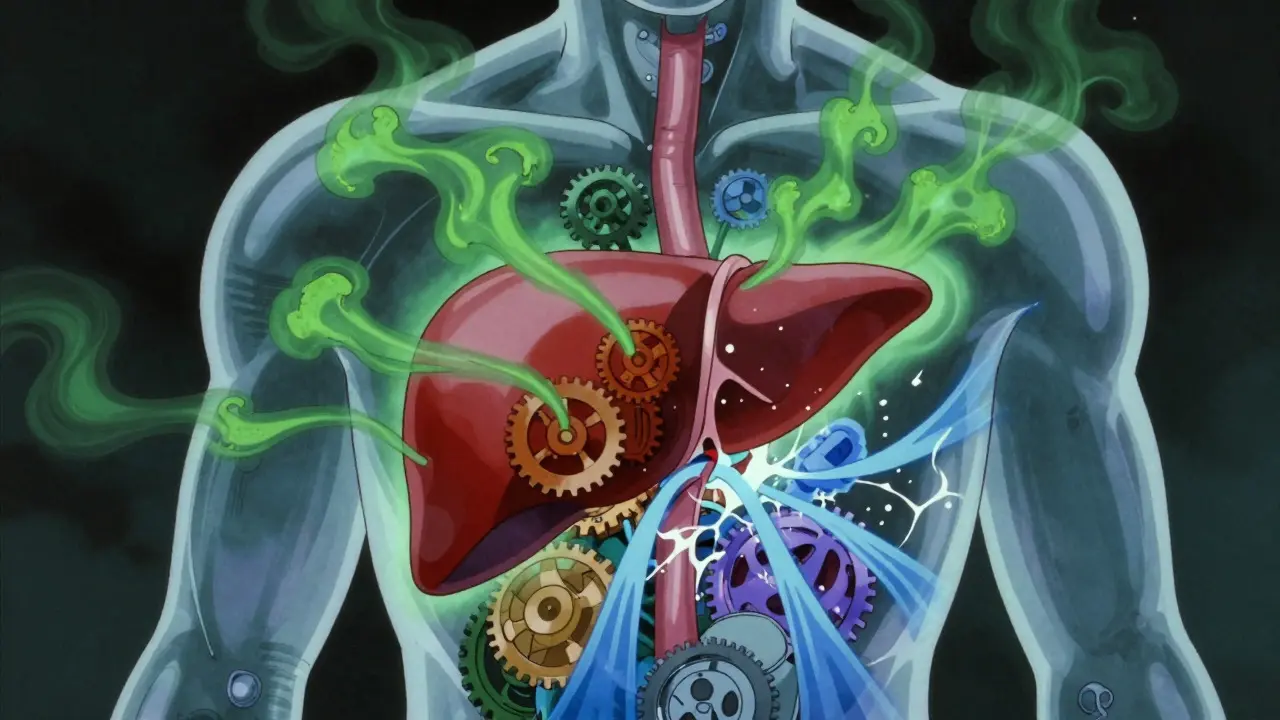
Your liver is the body’s filtration plant. It uses enzymes to break down toxins and medications. Specifically, a family of enzymes called Cytochrome P450 (CYP450) handles most drug metabolism. Here is where kava gets tricky. Research from the California Department of Public Health (2024) shows that kava can inhibit three major enzymes: CYP2D6, CYP2C9, and CYP3A4.
When kava blocks these enzymes, your body cannot process other medications efficiently. If you are taking a sedative metabolized by CYP3A4, such as midazolam, kava can increase the drug’s concentration in your blood by up to 27%. This means you get a stronger, longer-lasting dose than intended, increasing the risk of accidental overdose. At the same time, the liver is working overtime to handle the kavalactones themselves.
The U.S. Food and Drug Administration (FDA) issued a warning back in March 2002 after reports of severe liver injury linked to kava. Since then, over 25 international adverse event reports have documented cases requiring liver transplantation. While the exact mechanism of liver damage remains debated, the outcome is clear: acute liver failure. Symptoms often appear subtly at first-fatigue, nausea, and dark urine-before progressing to jaundice (yellowing of the skin and eyes).
It is worth noting that not all experts agree on the cause. Dr. J. Christopher Gorski suggests that past cases might involve other factors. However, the European Medicines Agency (EMA) maintains a stricter view. Their 2015 assessment concluded that kava’s risk-benefit profile is unfavorable compared to prescription anxiolytics. Consequently, kava was banned as an over-the-counter product for anxiety in the European Union, Canada, the United Kingdom, and Switzerland in 2002. In the U.S., it remains available as a dietary supplement under the Dietary Supplement Health and Education Act of 1994, but the FDA’s warning stands.
Who Is Most at Risk?
Not everyone who takes kava will experience liver failure or extreme sedation. However, certain groups face significantly higher risks. Understanding where you fall on this spectrum is crucial for making safe decisions.
- Patients with Pre-existing Liver Conditions: If you have hepatitis, cirrhosis, or fatty liver disease, your liver has less reserve capacity. The CDC recommends avoiding kava entirely in these cases.
- Users of Multiple CNS Depressants: Combining kava with alcohol, opioids, antihistamines, or benzodiazepines creates a compounding sedative effect. Reddit user u/KavaCaution reported being unable to stand for eight hours after mixing kava with lorazepam, experiencing confused speech and extreme drowsiness.
- Long-term High-Dose Users: Taking more than 250 mg of kavalactones daily increases the likelihood of hepatotoxicity. Australia’s Therapeutic Goods Administration notes that while the risk is low, it is "not negligible" with long-term high-dose use.
- Those Using Commercial Extracts: Traditional water-extracted kava beverages have a lower incidence of adverse events (0.8 per 100,000 servings) compared to commercial alcohol-based extracts (7.3 per 100,000 servings), according to the World Health Organization’s 2023 Monograph.
Signs You Should Stop Immediately
If you are using kava alongside any medication, you need to monitor your body closely. The American Association for the Study of Liver Diseases recommends immediate cessation of kava if your ALT levels rise above three times the upper limit of normal. But since you likely won’t have lab results every day, watch for these clinical signs:
- Persistent Fatigue: Feeling unusually tired even after a full night’s sleep occurs in 89% of kava-induced liver injury cases.
- Nausea and Loss of Appetite: Gastrointestinal distress is one of the earliest indicators, appearing in 76% of cases.
- Jaundice: Yellowing of the whites of the eyes or skin is a late-stage symptom but requires emergency care. It appears in 63% of documented liver injury cases.
- Excessive Drowsiness: If you find yourself nodding off during conversations or having trouble staying awake while driving, the sedative effect is too strong.
In mild cases, stopping kava leads to resolution within 60 days in 92% of patients, according to LiverTox data. However, waiting until symptoms become severe can lead to permanent damage. Do not guess. If you feel off, stop the supplement and consult your doctor.

What Healthcare Providers Are Saying
There is a gap between how doctors perceive kava and how patients use it. A 2023 study found that only 22% of patients voluntarily disclosed kava use when presenting with liver symptoms. Many assume it is "natural" and therefore harmless. This assumption is dangerous.
Dr. Jay H. Hoofnagle, Editor of LiverTox, states clearly that "at least a dozen instances of acute liver failure have been reported in patients taking kava." This led to bans in multiple countries. Yet, in the U.S., 41% of naturopathic doctors still recommend kava for anxiety, compared to only 3% of board-certified psychiatrists. This disconnect puts patients at risk of receiving conflicting advice.
If you see a provider, be honest about your supplement use. Pharmacists should screen for 14 major drug interactions involving kava, including haloperidol (which increases QT prolongation risk) and ropinirole (which increases hypotension risk). Your healthcare team cannot protect you from interactions if they don’t know what you are taking.
Safer Alternatives and Practical Steps
If you are seeking relief from anxiety or insomnia, there are safer paths than combining kava with sedatives. First, consider sticking to one modality. If you are prescribed a medication like buspirone or a benzodiazepine, follow the dosage strictly and avoid adding herbal sedatives unless approved by your doctor.
Second, if you choose to use kava, opt for traditional water preparations rather than concentrated alcohol extracts. The WHO data supports this distinction. Limit your intake to no more than 70 mg of kavalactones daily if you are taking other medications, and undergo biweekly liver function monitoring as suggested by CDC guidance for high-risk users.
Finally, explore non-pharmacological options. Cognitive Behavioral Therapy (CBT) has robust evidence for treating anxiety without physical side effects. Mindfulness practices and regular exercise also modulate the nervous system without stressing the liver. The goal is calm, not chemical overload.
Can I take kava with Xanax (alprazolam)?
Combining kava with alprazolam is considered a 'Major' interaction by WebMD's Drug Interaction Checker. Both substances depress the central nervous system. Mixing them can lead to excessive drowsiness, confusion, respiratory depression, and increased liver strain. Case studies show patients developing acute liver failure within 90 days of this combination. It is generally advised to avoid this mix unless under strict medical supervision.
Is kava bad for the liver if taken alone?
Yes, kava carries a risk of hepatotoxicity even when taken alone. The FDA has warned of liver-related injuries since 2002. While the estimated rate of severe injury is low (less than 1 in 1,000,000 daily doses), underreporting is suspected. Symptoms include fatigue, nausea, and jaundice. Those with pre-existing liver conditions should avoid kava entirely.
How long does it take for kava to affect my liver?
Liver issues from kava typically appear 1 to 4 months after initiation. Early signs are subtle, such as persistent fatigue and nausea. By the time jaundice appears, significant damage may have already occurred. Regular monitoring of liver enzymes (ALT, AST) is recommended for long-term users.
Why is kava banned in Europe but sold in the US?
The European Medicines Agency determined that kava’s risk-benefit profile was unfavorable due to unpredictable liver damage risks, leading to bans in the EU, UK, Canada, and Switzerland in 2002. In the US, kava is regulated as a dietary supplement under the DSHEA of 1994, which allows sale without pre-market safety approval, though the FDA maintains a public warning about liver toxicity.
Does kava interact with alcohol?
Yes, kava and alcohol have a synergistic hepatotoxic effect. Combining them significantly increases the risk of liver damage and enhances sedation. User reports indicate severe drowsiness and coordination issues when mixing the two. The CDC advises against combining kava with alcohol.