

Imagine standing in the bathroom, holding a small plastic bottle of pills. The label is tiny, the font is microscopic, and your hands are shaking slightly from fatigue. You squint, moving the bottle closer to your face, but the words blur into an unreadable mess. For millions of people with low vision, this isn't a hypothetical scenario-it’s their daily reality. Taking the wrong medication, at the wrong time, or in the wrong dose isn’t just inconvenient; it can be life-threatening.
This is where accessible prescription labels come in. They are not merely a convenience feature offered by progressive pharmacies; they are a critical safety tool mandated by law in many regions. Whether you need large print, Braille, or audio support, understanding your options can transform your relationship with your medications. Let’s look at what these tools are, how they work, and exactly how to get them.
Why Standard Labels Fail Visually Impaired Patients
Standard prescription labels are designed for efficiency, not accessibility. They pack dosage instructions, refill dates, pharmacist names, and warnings onto a small adhesive sticker. For someone with normal vision, this might take two seconds to scan. For someone with moderate visual impairment, it can be impossible.
The stakes are high. According to the American Foundation for the Blind (AFB), visually impaired individuals often end up taking the wrong medication, the wrong amount, or at the wrong time simply because they cannot read the container. This leads to missed doses, accidental overdoses, and dangerous drug interactions. Research published in the National Center for Biotechnology Information (PMC4860753) highlights that improving legibility directly enhances correct medication use and adherence. It’s not about being "helpful"; it’s about preventing medical errors that send people to the emergency room.
Are pharmacies legally required to provide large print labels?
In the United States, yes. The FDA Safety and Innovation Act (Public Law 112-144) enacted in 2012 mandates that pharmacies provide accessible labeling options. Failure to do so can constitute a violation of the Americans with Disabilities Act (ADA). In the UK, while specific federal mandates differ, NHS guidelines and health equity standards strongly encourage accessible formats to ensure patient safety.
Types of Accessible Labeling Solutions
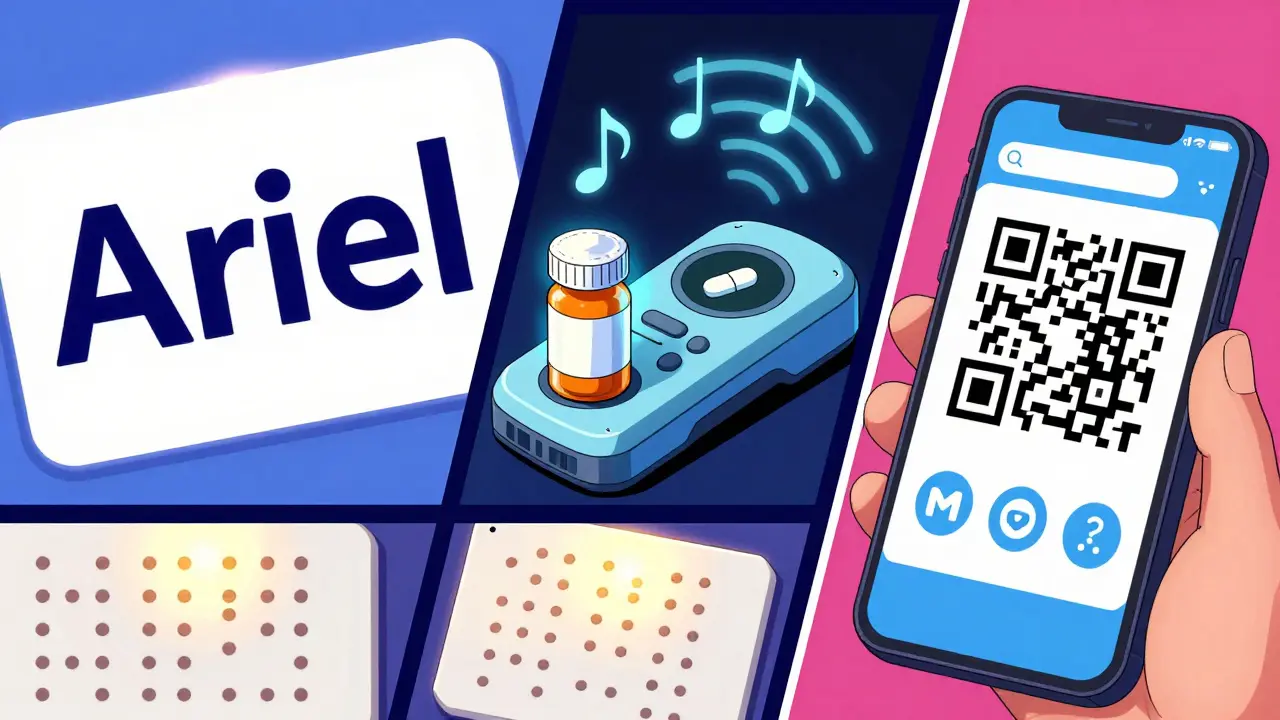
There is no one-size-fits-all solution because visual impairments vary widely. Some people have partial sight and need larger text; others are blind and rely on touch or sound. Here are the primary methods available today.
1. Large Print Labels
This is the most common request. However, "large print" has specific technical requirements to be effective. It’s not just about making the font bigger until it fits.
- Font Size: The AFB recommends a minimum of 18-point font. Studies show that fonts smaller than 14 points are unreadable for most people with moderate visual impairment.
- Font Style: Use sans-serif fonts like Arial, Verdana, or APHont (developed by the American Printing House for the Blind). These lack decorative strokes that blur together when magnified.
- Contrast: High contrast is non-negotiable. Saturated black text on a white background is standard. Avoid gray text or colored backgrounds unless specifically requested.
- Duplicate Labels: Because standard bottles rarely fit all information in 18-point type, pharmacists often print a "duplicate label." This is a separate sheet of paper with the full details, attached to the bottle with a colored sticker or clip.
2. Audible Labels (ScripTalk)
For those who cannot read even large print, audible technology is a game-changer. ScripTalk is a leading system used by major chains like CVS and Walgreens. It uses Radio Frequency Identification (RFID) technology.
Here’s how it works: Your prescription bottle has a special RFID tag. When you place it on a compatible reader device (often provided by the pharmacy), the bottle speaks out loud. It tells you the medication name, dosage, frequency, and any warnings. It’s like having a personal pharmacist reading the label to you every time you reach for your pills.
3. QR Code and App-Based Solutions
Newer systems, like UK HealthCare’s ScriptView, bridge the gap between physical and digital. The label includes a QR code. You scan it with your smartphone, and the app reads the medication details aloud or displays them in a customizable, high-contrast format. This is particularly useful if you already use screen readers like VoiceOver or TalkBack on your phone.
4. Braille Labels
Braille remains essential for the roughly 10% of visually impaired individuals who are proficient Braille readers. While less common due to the specialized printing equipment required, it provides tactile independence. If you read Braille, explicitly ask for it. Do not assume the pharmacy will offer it automatically.
Comparing Accessible Label Options
To help you decide which method suits your needs, here is a comparison of the key features.
| Feature | Large Print | Audible (ScripTalk) | QR Code/App | Braille |
|---|---|---|---|---|
| Best For | Partial sight, macular degeneration | Total blindness, severe low vision | Tech-savvy users, smartphone owners | Proficient Braille readers |
| Technology Needed | None (visual only) | RFID Reader Device | Smartphone + App | None (tactile only) |
| Cost to Patient | Usually Free | Free service, hardware may vary | Free (if you have a phone) | Usually Free |
| Availability | Widespread (98% of major chains) | Major chains (CVS, Walgreens) | Growing (Hospital systems) | Limited (Specialized requests) |
| Key Limitation | Space constraints on bottle | Requires carrying a reader device | Requires battery/internet | Low literacy rate among VI community |
How to Request Accessible Labels: A Step-by-Step Guide
Many patients don’t know they can ask for these services. Pharmacists are trained to provide them, but they often wait for the customer to initiate the request. Here is how to navigate the process.
- Identify Your Needs: Before you go to the pharmacy, decide what works best. Can you see 18-point text? Do you prefer hearing the instructions? Be clear about your preference.
- Contact Your Pharmacy Early: Don’t wait until pickup day. Call ahead or use the pharmacy’s online portal. Ask specifically: "Do you offer large print, audible, or Braille labels?"
- Specify the Format: If you want large print, specify the font size (e.g., "I need 18-point Arial"). If you want audio, ask if they have ScripTalk or a similar RFID system.
- Verify at Pickup: When you pick up your meds, check the label immediately. Is the text clear? Does the audio player work? If not, ask for a reprint on the spot. It takes them less than a minute.
- Update Your Profile: Most pharmacy management systems (like Epic Systems) allow you to set a permanent preference. Ask the pharmacist to note "Large Print Required" in your patient profile so you never have to ask again.
Challenges and What to Do If Your Pharmacy Says No
While major chains like CVS, Walgreens, and Walmart have high adoption rates (over 90% of locations), independent pharmacies may lag behind. Some pharmacists claim they lack the equipment or training. Others simply aren’t aware of the mandate.
If your local pharmacy refuses or seems confused:
- Cite the Law: Politely mention the FDA Safety and Innovation Act or the ADA Title III requirements. Often, this prompts them to check with their manager or corporate compliance officer.
- Ask for a Duplicate Label: If they can’t print a large label on the bottle, ask for a printed sheet of paper with the info clipped to the bottle. This is a low-tech workaround that almost anyone can do.
- Switch Pharmacies: If a pharmacy consistently fails to meet your accessibility needs, consider switching. Your safety is worth more than loyalty to a store that doesn’t serve you.
- File a Complaint: If you believe you are being discriminated against, you can file a complaint with the Department of Justice or your state’s Board of Pharmacy. In 2022 alone, there were multiple settlements related to inaccessible healthcare services.
The Future of Medication Accessibility
The landscape is shifting rapidly. By 2026, the FDA expects mandatory implementation of accessible labeling in electronic prescriptions and patient portals. We are seeing AI-powered solutions emerge, such as the "Be My Eyes" integration, which connects users with sighted volunteers via video call to read labels in real-time.
Pharmacies are also investing heavily. CVS announced a $15 million investment to expand ScripTalk to all its US locations. This trend indicates that accessible labeling is moving from a "special request" to a standard of care. As the population ages-with 8.2 million Americans aged 65+ experiencing vision impairment-the demand will only grow.
You don’t have to struggle with unreadable labels. Independence in managing your health starts with clear communication. Know your rights, know your options, and don’t hesitate to ask for the tools you need to stay safe.
Is there a cost for large print or audible labels?
In most cases, no. Major pharmacy chains and hospital pharmacies typically provide large print, duplicate labels, and audible services like ScripTalk free of charge as part of their compliance with accessibility laws. However, some independent pharmacies may charge a small fee for custom printing or specialized hardware, so it is always best to ask upfront.
What font size is considered "large print" for prescriptions?
The American Foundation for the Blind (AFB) recommends a minimum of 18-point font. Research indicates that fonts smaller than 14 points are difficult for most people with moderate visual impairment to read. Sans-serif fonts like Arial or Verdana are preferred for clarity.
How does ScripTalk work?
ScripTalk uses RFID (Radio Frequency Identification) technology. Each prescription bottle has a unique tag. When placed on a compatible reader device, the system identifies the medication and audibly plays back the dosage instructions, warnings, and refill information. It ensures you hear the exact details without needing to see them.
Can I get Braille labels at any pharmacy?
Not necessarily. Braille labels require specialized embossing equipment that many standard pharmacies do not have. While major chains may offer this upon request, it is less common than large print or audio options. If you are a Braille reader, it is advisable to confirm availability with your specific pharmacy location beforehand.
What should I do if my pharmacist doesn't know about accessible labels?
Politely inform them that accessible labeling is a legal requirement under the FDA Safety and Innovation Act and the ADA. Ask to speak with the pharmacy manager if necessary. You can also request a simple duplicate label printed on standard paper as an immediate workaround while they research their capabilities.
Cecilia McGuinness
June 14, 2026 AT 21:04honestly this is such a relief to read because i was so confused about why my local spot kept giving me tiny labels and i just assumed it was normal lol thanks for breaking it down simply
shreya sinha
June 16, 2026 AT 06:45It is profoundly disheartening to observe that in the twenty-first century, individuals with visual impairments are still forced to navigate a healthcare system that appears to have been designed with deliberate indifference toward their basic safety needs, particularly when one considers that the legislative mandates intended to protect these vulnerable populations have been in place for over a decade yet compliance remains sporadic and inconsistent across various jurisdictions and pharmacy chains which suggests a systemic failure of accountability rather than mere oversight.
Lee Coates
June 17, 2026 AT 17:29yeah well if you cant read the label maybe you shouldnt be taking pills in the first place :P but seriously its not like the government is gonna fix everything for us we gotta do our own homework here folks
Sherry Wheeler
June 19, 2026 AT 00:57Oh my goodness, this is absolutely vital information that every single person needs to know right now! I am literally shaking with excitement because this guide could genuinely save lives and prevent so much unnecessary stress for families who are struggling daily. We have to spread this word far and wide because ignorance is truly dangerous when it comes to medication safety and accessibility. Imagine the peace of mind knowing you can actually verify your dosage without guessing or relying on someone else’s help every single time. It is empowering beyond words to realize that these tools exist and are legally mandated for your protection. Let us all take a moment to appreciate the progress being made while also pushing for even better implementation everywhere. You deserve to feel safe and independent in managing your health without fear or confusion. This post is a beacon of hope and practical advice wrapped into one beautiful package!
Ganesh Honikol
June 20, 2026 AT 04:28I must commend the author for providing such a comprehensive and meticulously detailed overview of the available options for accessible prescription labeling, as it is evident that considerable effort has been invested in researching the legal frameworks and technological solutions currently at our disposal, thereby enabling patients to make informed decisions regarding their healthcare needs with greater confidence and clarity than they might otherwise possess.
Callie Skipper
June 21, 2026 AT 18:45i tried asking for large print once and the guy behind the counter looked at me like i asked him to fly to the moon so yeah its definitely an uphill battle sometimes but good to know im not crazy for wanting it
AnneKatherine Stiekes
June 21, 2026 AT 22:05it really makes sense that different people need different things like audio vs braille vs big text because everyone sees differently or doesnt see at all so having choices is super important for independence
Daniella Renzon
June 23, 2026 AT 04:26this is really helpful stuff especially since i live in south africa where access to these specific tech solutions like scriptalk is pretty limited compared to the us but knowing what exists gives me hope that maybe things will improve here too eventually