
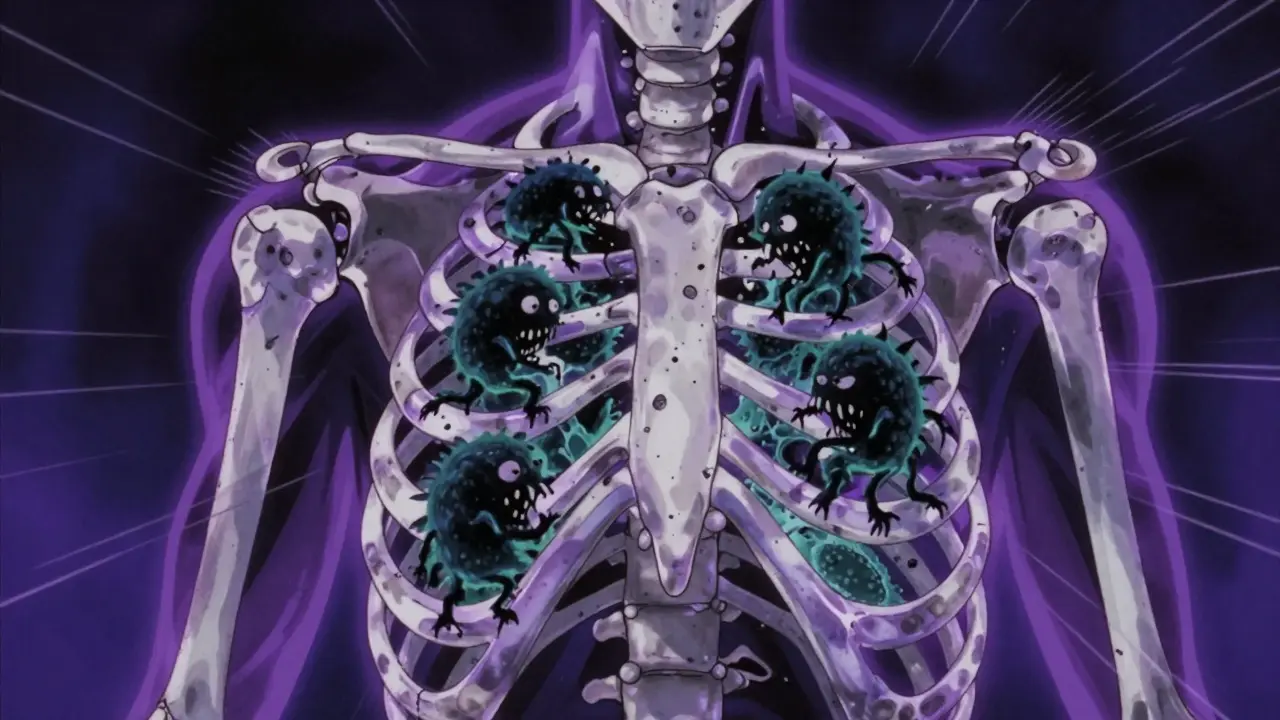
Imagine your bones are not just breaking; they are being actively dismantled from the inside out. For patients with Multiple Myeloma, a cancer of plasma cells in the bone marrow, this is a harsh reality. More than 80% of patients develop myeloma bone disease (MBD), a condition where tumors eat away at bone tissue faster than the body can repair it. This isn't just about pain or fractures; it’s a vicious cycle where bone destruction fuels tumor growth, and tumor growth accelerates bone loss.
For decades, treatment focused on stopping the bleeding-literally and figuratively. But recent breakthroughs in understanding the molecular pathways behind MBD have opened the door to novel therapeutic agents. These new drugs don’t just protect existing bone; some aim to rebuild it. Here is what you need to know about how these treatments work, their real-world impact, and what the future holds for managing myeloma bone disease.
The Vicious Cycle of Myeloma Bone Disease
To understand why new drugs are necessary, we first need to look at what goes wrong in the bone marrow. Healthy bone is dynamic. It constantly breaks down old tissue (resorption) via cells called osteoclasts and builds new tissue (formation) via osteoblasts. In multiple myeloma, this balance is shattered.
Myeloma cells release signals that supercharge osteoclasts while simultaneously shutting down osteoblasts. This results in purely osteolytic lesions-holes in the bone that appear as "punched-out" spots on X-rays. The key driver here is the RANK/RANKL/OPG pathway. Think of RANKL as an accelerator pedal for bone-eating cells, and OPG as the brake. In myeloma patients, the ratio of RANKL to OPG is three to five times higher than in healthy individuals. The accelerator is stuck to the floor, and the brakes are cut.
Furthermore, myeloma cells secrete inhibitors like DKK1 (Dickkopf-1) and sclerostin. These proteins block the Wnt signaling pathway, which is essential for building new bone. Studies show that patients with high levels of DKK1 (>48.3 pmol/L) suffer from 3.2 times more bone lesions. This uncoupling means that even if you stop the breakdown, the bone doesn’t heal naturally. It just stays broken.
Standard Care: Bisphosphonates and Denosumab
Current standard care focuses on inhibiting osteoclast activity to prevent Skeletal-Related Events (SREs). SREs include pathological fractures, spinal cord compression, and hypercalcemia. They occur in a significant portion of patients and drastically reduce quality of life.
| Feature | Bisphosphonates (Zoledronic Acid) | Denosumab |
|---|---|---|
| Mechanism | Inhibits osteoclast function directly | Blocks RANKL signal (antibody) |
| Administration | Intravenous infusion (IV) | Subcutaneous injection (under skin) |
| Dosing Frequency | Monthly initially | Monthly |
| Renal Toxicity Risk | Higher (requires monitoring) | Lower (safer for kidney issues) |
| Cost per Dose | ~$150 (generic) | ~$1,800 (brand) |
| SRE Reduction | 15-18% vs placebo | Similar efficacy, better convenience |
Zoledronic acid and pamidronate are the backbone of therapy. They are effective but come with drawbacks. Renal toxicity is a concern, affecting about 27% of patients on zoledronic acid. Additionally, there is a risk of Medication-Related Osteonecrosis of the Jaw (MRONJ), occurring in roughly 42% of long-term users according to patient surveys. Denosumab offers a convenient alternative as a monthly shot and is gentler on the kidneys, but its high cost limits access in many regions. While both drugs reduce SREs by about 15-18%, neither promotes new bone formation. They simply pause the destruction.
Novel Agents: Targeting the Root Causes
The next generation of therapies aims to break the vicious cycle by targeting specific molecular pathways beyond just osteoclast inhibition. These agents are currently in various phases of clinical trials and represent a shift from "bone protection" to "bone healing."
- Anti-Sclerostin Antibodies (Romosozumab): Sclerostin is a protein produced by osteocytes that stops bone formation. By blocking it, romosozumab allows the Wnt pathway to activate again. In the 2021 STRUCTURE trial, patients saw a 53% increase in bone mineral density at the lumbar spine. This is significant because it suggests actual bone rebuilding, not just preservation.
- Anti-DKK1 Therapies (DKN-01): Since DKK1 blocks bone formation, neutralizing it could restore osteoblast function. Early phase Ib/II trials showed a 38% reduction in bone resorption markers, indicating a positive shift in bone turnover.
- Gamma-Secretase Inhibitors (Nirogacestat): These target the Notch pathway, which myeloma cells use to communicate with bone cells and stimulate destruction. Preclinical models showed a 62% reduction in osteolytic lesions, though human trials are still in early stages due to side effects like rash.
Dr. Evan Winter from the Mayo Clinic notes that the bone microenvironment is an active participant in disease progression. Therefore, treating the bone is not optional; it is integral to controlling the cancer itself. However, Dr. Kenneth Anderson from Dana-Farber cautions that while these novel agents improve bone markers, large-scale survival benefits have yet to be proven in Phase III trials.
Real-World Challenges and Patient Experiences
Data from clinical trials often looks cleaner than daily life. A survey by the International Myeloma Foundation involving over 1,200 patients revealed that bone complications remain a major burden. Bone issues were the second leading cause of hospitalization (32.7%), with an average stay of 8.3 days per admission.
Patient forums highlight persistent challenges. Despite standard therapy, 68% of patients report ongoing bone pain. Side effects from current treatments are also significant. Hypocalcemia (low calcium) affects nearly 19% of patients, requiring careful supplementation. Acute phase reactions-fever, fatigue, and muscle pain after IV infusions-affect over 30% of those on bisphosphonates.
Convenience plays a huge role in adherence. In a Mayo Clinic study, 74% of patients preferred denosumab’s subcutaneous injection over IV bisphosphonates. However, cost remains a barrier. With denosumab costing around $1,800 per dose compared to $150 for generic zoledronic acid, insurance coverage and regional guidelines heavily influence treatment choices. In Asia, for example, bisphosphonates still dominate usage at 89%, while denosumab adoption is lower in Europe (42%) compared to the US (78%).

Implementation Guidelines and Monitoring
The International Myeloma Working Group (IMWG) updated its guidelines in 2022 to emphasize early intervention. All newly diagnosed patients should undergo a baseline skeletal survey plus whole-body low-dose CT or PET-CT. Bone-modifying agents should start immediately upon diagnosis and continue during active treatment.
Implementing novel agents requires specific monitoring protocols:
- Calcium Levels: Anti-sclerostin agents carry a risk of hypocalcemia (12.3% incidence). Monthly calcium monitoring is essential.
- Dental Health: Due to MRONJ risk, patients must have a dental evaluation within 30 days of starting any bone-targeting therapy. Extracting teeth after starting treatment can lead to severe jaw necrosis.
- Renal Function: For bisphosphonates, creatinine clearance must be checked regularly. About 22% of patients require dose adjustments if kidney function declines.
- Dermatological Checks: Gamma-secretase inhibitors may cause rashes in up to 68% of patients, necessitating regular skin assessments.
Coordination between hematologists, orthopedic surgeons, and dentists is critical. Fragmented care leads to missed opportunities for prevention and delayed management of fractures.
The Future of Myeloma Bone Management
The global market for myeloma bone therapeutics is growing, projected to reach $5.1 billion by 2028. This growth reflects the urgent need for better solutions. Recent developments include the FDA’s approval of a lower-toxicity formulation of zoledronic acid (Zometa-LD) and the launch of the BONE-HEAL Phase III trial for romosozumab.
Future directions point toward personalized medicine. Researchers are exploring RNA-based therapies to silence DKK1 expression and bispecific antibodies that target both myeloma cells and bone microenvironment factors. The goal, as predicted by experts, is to move from merely preventing destruction to actively healing lesions by 2030. Until then, a combination of targeted anti-myeloma therapy and robust bone support remains the best strategy to maintain mobility and quality of life.
What are the most common symptoms of myeloma bone disease?
The most common symptoms include deep, dull bone pain (often in the back or ribs), frequent fractures from minor injuries (pathological fractures), height loss due to vertebral compression, and high calcium levels in the blood (hypercalcemia), which can cause nausea, confusion, and excessive thirst.
How does denosumab differ from bisphosphonates?
Denosumab is a monoclonal antibody given as a monthly under-the-skin injection, whereas bisphosphonates like zoledronic acid are given intravenously. Denosumab works by blocking the RANKL protein, while bisphosphonates bind directly to bone tissue to inhibit osteoclasts. Denosumab is generally safer for patients with kidney impairment but carries a higher risk of jaw necrosis and is significantly more expensive.
Can novel agents like romosozumab cure bone damage?
Novel agents like romosozumab aim to promote bone formation rather than just stopping breakdown. Clinical trials have shown significant increases in bone mineral density, suggesting they can help rebuild bone. However, they are not a "cure" for myeloma itself and are used in conjunction with other cancer treatments. Long-term data on complete healing of lesions is still being gathered.
Why is dental care important before starting bone therapy?
Bone-targeting therapies like bisphosphonates and denosumab increase the risk of Medication-Related Osteonecrosis of the Jaw (MRONJ). If you have dental infections or need extractions, these should be resolved before starting treatment. Once therapy begins, invasive dental procedures can lead to poor healing and exposed bone in the jaw, causing severe pain and infection.
What is the "vicious cycle" in myeloma bone disease?
The vicious cycle refers to the interaction between myeloma cells and bone. Myeloma cells cause bone destruction, releasing growth factors stored in the bone matrix. These growth factors then feed the myeloma cells, helping them grow and multiply, which in turn causes more bone destruction. Breaking this cycle requires treating both the cancer and the bone environment.