

NSAID Kidney Risk Estimator
Select the options that apply to you to calculate your potential risk level.
Your Estimated Risk Level
Select Options
Please select your details above to see your risk assessment.
Risk Scale:
Low
High
Disclaimer: This tool is for educational purposes only and does not constitute medical advice. Always consult a doctor before starting new medications.
Please select your details above to see your risk assessment.
You pop two pills for a stiff back or a pounding headache. It’s routine. You’ve done it for years. But what if that simple habit is quietly straining your kidneys? For millions of people, nonsteroidal anti-inflammatory drugs (NSAIDs) are the go-to solution for pain. Yet, these powerful medications carry a hidden risk: acute kidney injury (AKI), a sudden loss of kidney function that can be permanent if ignored.
The link between NSAID use and kidney damage isn’t new, but it is often misunderstood. Many believe that because ibuprofen or naproxen are available over-the-counter, they are harmless in any dose. The reality is starkly different. Recent data suggests that NSAIDs contribute to 1-5% of all hospitalizations for acute kidney injury. This article breaks down exactly how these drugs affect your kidneys, who is most at risk, and-most importantly-how you can protect yourself without giving up pain relief entirely.
How NSAIDs Quietly Harm Your Kidneys
To understand the danger, we need to look at what NSAIDs actually do inside your body. NSAIDs (Nonsteroidal anti-inflammatory drugs) work by blocking enzymes called cyclooxygenase (COX-1 and COX-2). These enzymes produce prostaglandins, chemicals that cause inflammation and pain. Blocking them reduces swelling and ache, which is great for your joints. But prostaglandins also have another job: they keep blood vessels in your kidneys relaxed and open.
When you take an NSAID, you block those protective prostaglandins. Without them, the tiny blood vessels leading to your kidney filters constrict. Think of it like turning down the water pressure on a delicate filtration system. In a healthy person with good hydration, the kidneys can usually handle this slight drop in blood flow. But if you are dehydrated, elderly, or already have some kidney strain, that reduced blood flow can cause tissue damage. This is known as hemodynamically-mediated AKI, and it accounts for about 70-80% of NSAID-related kidney issues.
There is a second, less common pathway called acute interstitial nephritis (AIN). This is an allergic-like reaction where the immune system attacks the kidney tissue. It’s rarer (5-15% of cases) but serious, often showing up with fever, rash, and high levels of protein in the urine. Unlike the blood flow issue, AIN doesn’t always happen immediately; it can develop after weeks or months of use.
The 'Triple Whammy': A Dangerous Combination
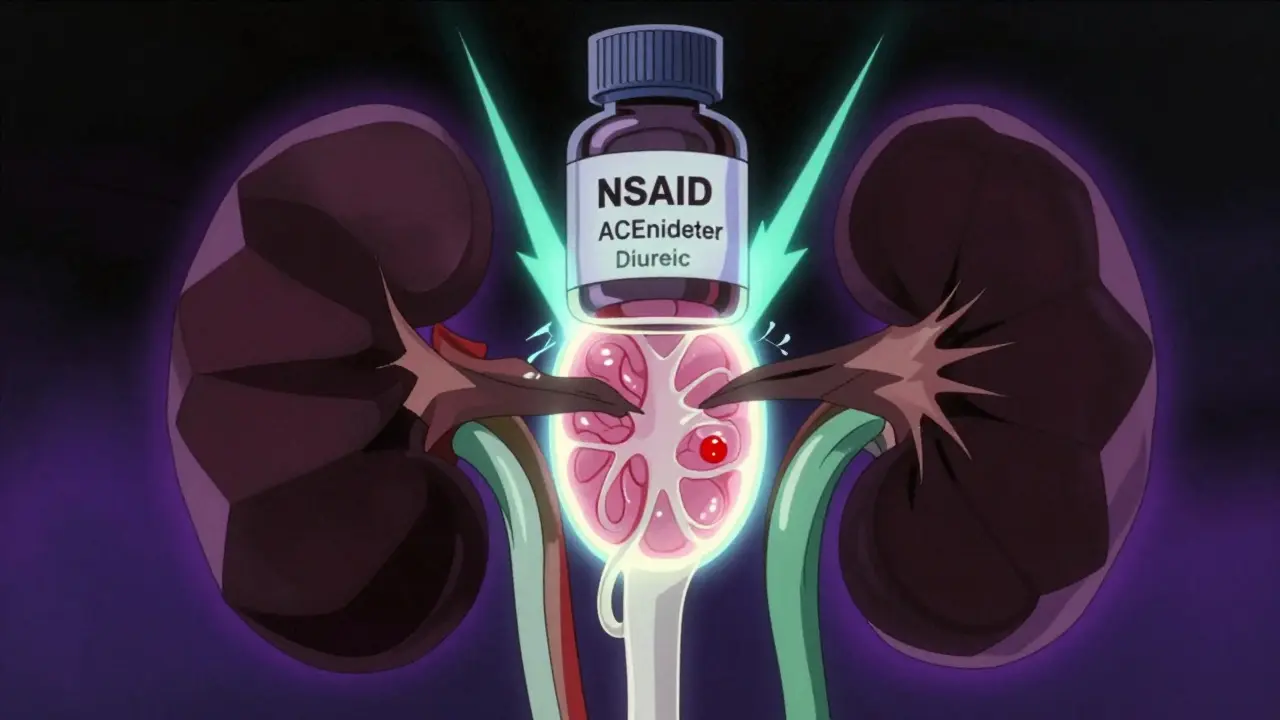
If there is one concept every patient needs to know, it is the "triple whammy." This term describes a specific combination of three medications that dramatically increases the risk of kidney failure. It happens when a patient takes:
- An NSAID (like ibuprofen, naproxen, or diclofenac)
- An ACE inhibitor or ARB (common blood pressure meds ending in -pril or -sartan)
- A diuretic (water pill, like furosemide or hydrochlorothiazide)
Each drug affects kidney blood flow differently. The diuretic lowers blood volume. The ACE inhibitor relaxes the exit vessel of the kidney filter. The NSAID constricts the entry vessel. Together, they crush the pressure needed for the kidneys to filter waste. Studies show this combination increases the risk of AKI by 31%, with the highest danger occurring in the first 30 days of starting the mix. If you take blood pressure medication, ask your doctor before adding any NSAID to your routine.
Who Is Most at Risk?
Not everyone who takes an occasional Advil will hurt their kidneys. However, certain groups face significantly higher risks. The American College of Rheumatology warns against NSAID use in patients with an estimated glomerular filtration rate (eGFR) below 30 mL/min/1.73m². Even those with eGFR between 30 and 60 should use extreme caution.
Beyond existing chronic kidney disease (CKD), other major risk factors include:
- Age: Older adults naturally have fewer functioning kidney units. A study noted that 72-year-olds with mild baseline kidney reduction developed severe AKI within 72 hours of starting high-dose ibuprofen.
- Dehydration: Whether from illness, heat, or exercise, low fluid volume makes the kidneys rely heavily on prostaglandins to maintain flow. NSAIDs remove that safety net.
- Heart Failure: Patients with heart issues often have reduced blood flow to the kidneys already, making them vulnerable to further constriction.
- Long-term Use: Chronic users face a 24% increased risk of developing CKD and a 50% higher chance of progressing existing kidney disease.
Signs That Your Kidneys Are Under Stress
Kidney injury is often silent in its early stages. Dr. George Lucas, a nephrology specialist, notes that serum creatinine levels-a common marker for kidney function-may remain normal in up to 30% of early AKI cases. Don’t wait for lab results to notice something is wrong. Watch for these physical signs:
- Decreased Urine Output: Reported in 78% of AKI cases. If you’re drinking normally but barely urinating, seek help.
- Swelling (Edema): Fluid builds up when kidneys can’t filter it out. Look for puffiness in ankles, feet, or around the eyes.
- Unexplained Fatigue: As toxins build up in the blood, energy levels plummet. This affects 52% of patients with emerging kidney issues.
- Nausea or Confusion: Late-stage symptoms indicating significant toxin accumulation.
If you experience these after starting a new pain medication, stop taking it and contact your healthcare provider immediately.
Safer Alternatives for Pain Management
Does this mean you must live in pain? Absolutely not. The goal is to manage pain without sacrificing kidney health. Here are safer strategies discussed in recent clinical guidelines:
| Option | Kidney Risk | Best For |
|---|---|---|
| Acetaminophen (Paracetamol) | Low (40-50% lower AKI risk than NSAIDs) | Mild to moderate pain, headaches, fever |
| Topical NSAIDs | Very Low (70-80% less systemic absorption) | Joint pain, arthritis, localized muscle soreness |
| Celecoxib (COX-2 Inhibitor) | Moderate (20-30% lower risk than traditional NSAIDs) | Patients needing strong anti-inflammatory effect with slightly better GI/kidney profile |
| Physical Therapy | None | Chronic back pain, sports injuries, long-term mobility |
Acetaminophen is often the safest first line for general pain, though it lacks anti-inflammatory properties. For joint pain, topical gels containing diclofenac offer targeted relief with minimal absorption into the bloodstream, drastically reducing kidney exposure. A 2024 JAMA Internal Medicine trial confirmed these topicals carry 40-50% lower AKI risk than oral versions.

Practical Steps to Protect Your Kidneys
Prevention is straightforward if you follow a few key rules. The KDIGO 2023 Clinical Practice Guideline recommends a four-step approach for anyone considering regular NSAID use:
- Get Baseline Tests: Before starting chronic therapy, ask for an eGFR and urine albumin-to-creatinine ratio test. Know your numbers.
- Avoid the Triple Whammy: Never combine NSAIDs with ACE inhibitors/ARBs and diuretics without explicit doctor supervision.
- Limit Duration: Use NSAIDs for no more than 7-10 days for acute pain. If you still hurt, see a doctor instead of extending the course.
- Stay Hydrated: Especially during exercise or hot weather. Aim for 5-10 mL/kg of body weight of fluid 2-4 hours before activity. Proper hydration maintains urine specific gravity below 1.020, which helps flush toxins and supports blood flow.
If you are over 60 or have existing health conditions, consider using the lowest effective dose for the shortest time possible. The American Geriatrics Society Beers Criteria advises avoiding NSAIDs entirely if your eGFR is below 30, and limiting use to three days a week maximum if it’s between 30 and 60.
Future Outlook: Personalized Risk Assessment
Medicine is moving toward precision care. In 2023, the American Society of Nephrology launched the NSAID-RF Risk Calculator, a tool that uses 12 variables-including age, blood pressure, and current meds-to predict your 30-day AKI risk with 87% accuracy. Meanwhile, researchers are exploring genetic markers in the PTGS2 gene that might identify people who are naturally more susceptible to kidney damage from these drugs.
Newer treatments are also in development. Phase 2 trials are underway for combinations like ibuprofen-acetylcysteine, designed to provide pain relief while neutralizing oxidative stress in kidney tissue. Until then, awareness remains our best defense. Your kidneys work silently, but they don’t have to fail silently. By understanding how NSAIDs interact with your body, you can make informed choices that keep both your pain under control and your kidneys healthy.
Can one dose of ibuprofen cause kidney failure?
For a healthy, well-hydrated individual, a single dose is unlikely to cause permanent damage. However, in susceptible individuals-such as those who are dehydrated, elderly, or taking other kidney-stressing medications-even a single dose can trigger acute kidney injury. It is not about the number of pills alone, but the context of your body's current state.
Is acetaminophen safe for people with kidney disease?
Yes, generally. Acetaminophen (paracetamol) does not inhibit prostaglandins in the same way NSAIDs do, so it has a much lower risk of causing hemodynamic kidney injury. It is considered the preferred analgesic for patients with chronic kidney disease, provided it is taken within recommended dosage limits to avoid liver toxicity.
What are the symptoms of NSAID-induced kidney damage?
Early symptoms can be subtle or absent. Common signs include decreased urine output, swelling in the legs or feet (edema), unexplained fatigue, nausea, and confusion. In cases of acute interstitial nephritis, you might also experience fever, rash, or eosinophilia (high white blood cell count).
Can topical NSAIDs harm my kidneys?
The risk is significantly lower. Topical NSAIDs like diclofenac gel have 70-80% less systemic absorption compared to oral tablets. This means far less drug reaches the bloodstream and kidneys, resulting in a 40-50% lower risk of acute kidney injury. They are a safer alternative for localized joint or muscle pain.
How long does it take for kidneys to recover from NSAID injury?
Recovery depends on the type and severity of injury. Hemodynamic AKI often resolves within days to weeks once the NSAID is stopped and hydration is restored. Acute interstitial nephritis may take longer, sometimes requiring steroids. However, repeated episodes can lead to permanent scarring and chronic kidney disease, so prevention is critical.
What is the 'triple whammy' in medication?
The 'triple whammy' refers to the dangerous combination of an NSAID, an ACE inhibitor (or ARB), and a diuretic. This trio severely restricts blood flow through the kidneys, increasing the risk of acute kidney injury by 31%. It is particularly risky in the first month of combining these drugs.
Should I get my kidney function tested before taking NSAIDs?
If you plan to use NSAIDs regularly (more than a few times a week) or have risk factors like high blood pressure, diabetes, or age over 60, yes. A simple blood test for eGFR and a urine test for albumin can establish a baseline and help your doctor determine if NSAIDs are safe for you.
Are COX-2 inhibitors safer for kidneys than regular NSAIDs?
Slightly. Selective COX-2 inhibitors like celecoxib have been shown to have a 20-30% lower risk of acute kidney injury compared to non-selective NSAIDs like ibuprofen. However, this advantage diminishes in patients who already have reduced kidney function (eGFR <60). They are not risk-free.