
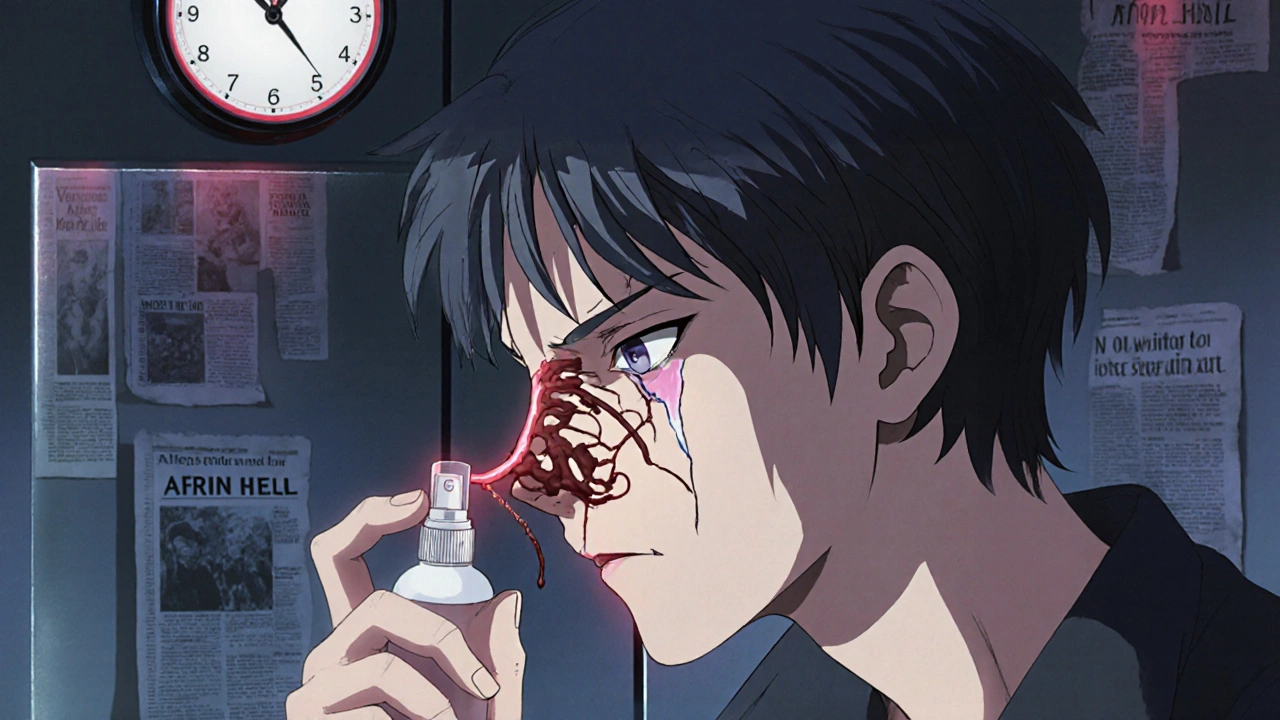
Most people reach for an OTC nasal spray the moment they feel that stuffy, blocked-up feeling. It’s quick. It’s easy. And it works-right away. You spray, and within minutes, your nose opens up like a window on a crisp morning. But here’s the catch: if you keep using it past three days, that relief turns into a trap. Your nose gets worse-not because your cold is getting worse, but because the spray itself is causing it.
What Is Rebound Congestion?
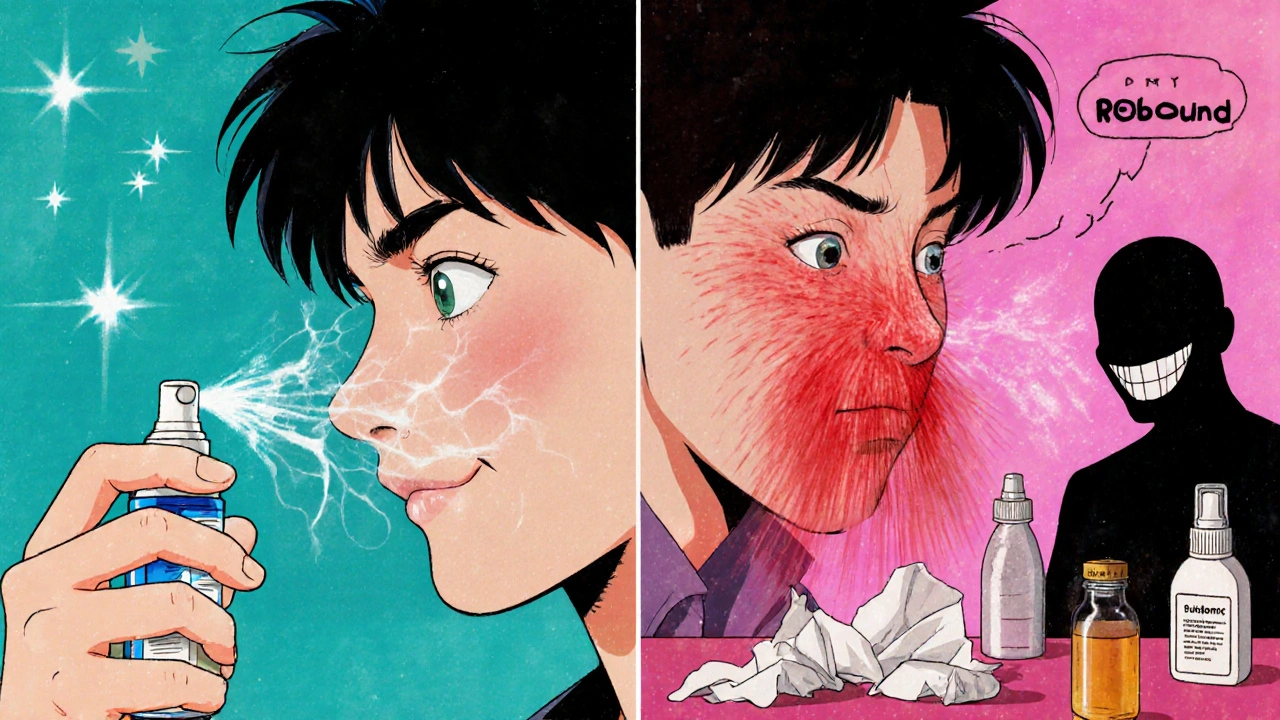
Rebound congestion, also called rhinitis medicamentosa, isn’t just a bad side effect. It’s a cycle. You use a decongestant spray to shrink swollen blood vessels in your nose. The spray works by tightening those vessels, so air flows more freely. But when the effect wears off-usually in 8 to 12 hours-the blood vessels don’t just return to normal. They overcompensate. They swell even more than before. Now your nose feels more blocked than it did before you sprayed. So you spray again. And again. Soon, you’re using it six, eight, even ten times a day just to breathe.This isn’t rare. About 1 to 2% of the general population develops this condition, according to the Cleveland Clinic. And it’s not just people who misuse it for weeks. Some people start seeing symptoms after just three days of daily use. The NIH StatPearls database confirms that nasal decongestant sprays like Afrin (oxymetazoline) and Neo-Synephrine (phenylephrine) can trigger this rebound effect in as little as 72 hours.
How These Sprays Actually Work
The active ingredients in most OTC nasal sprays-oxymetazoline, phenylephrine, xylometazoline-are alpha-adrenergic agonists. That’s a fancy way of saying they mimic adrenaline. They bind to receptors in the blood vessels lining your nose and make them constrict. Less blood flow means less swelling. Less swelling means easier breathing.It’s fast. It’s effective. But it’s temporary. And here’s the problem: your body adapts. After a few days, those blood vessels become less responsive to the spray. You need more of it to get the same effect. Meanwhile, the vessels start to lose their natural ability to regulate themselves. The lining of your nose becomes inflamed, irritated, even damaged. That’s when the congestion becomes chronic-even when you’re not sick.
Some people think newer sprays like oxymetazoline are safer. They’re not. While they’re less likely to cause rebound than old-school ephedrine sprays, the risk is still very real. The NIH and Mayo Clinic both document cases of rebound congestion directly linked to oxymetazoline. Just because a product is sold over the counter doesn’t mean it’s harmless.
Who’s Most at Risk?
Anyone can develop rebound congestion. But some people are more vulnerable:- People who use the spray daily for more than three days
- Those with chronic allergies or sinus issues who rely on sprays instead of treating the root cause
- Individuals with high blood pressure-decongestants can raise blood pressure by 5 to 7 mmHg
- People who’ve used these sprays before and had rebound before
It’s not about how strong your cold is. It’s about how long you keep spraying. Even if you’re only using two sprays per nostril, twice a day, you’re still at risk after day three.
What Does Rebound Congestion Feel Like?
It doesn’t look like a cold. There’s no runny nose. No fever. No sore throat. Just one thing: worsening nasal blockage that gets worse as the spray wears off. You might notice:- Congestion returning within hours after your last spray
- Feeling like you need to spray more often to get relief
- Needing to use it just to sleep
- Feeling like your nose is always blocked-even when you’re not sick
Many people think their allergies are getting worse. Or that they’ve caught a new virus. But if your congestion started after using a nasal spray-and got worse over time-it’s likely rebound.
How to Break the Cycle
Stopping the spray cold turkey sounds brutal-and it can be. But there’s a smarter way.Here’s what works, based on guidance from ENT specialists and clinical protocols:
- Start a steroid nasal spray-like Flonase Sensimist (fluticasone)-at least two days before you plan to quit the decongestant. These take 3 to 5 days to work, but they reduce inflammation without causing rebound. They’re safe for long-term use.
- Use saline rinses-like NeilMed Sinugator-four to six times a day. Saline flushes out irritants, keeps the lining moist, and helps your nose heal. It won’t give you instant relief, but it prevents drying and crusting.
- Taper the spray-don’t quit cold turkey. Reduce usage by one spray per nostril every 48 hours. If you were using it four times a day, go to three, then two, then one, then none.
- Use oral decongestants only as a backup-like pseudoephedrine (Sudafed). But be careful: these can raise your blood pressure and cause jitteriness or trouble sleeping. Don’t use them if you have heart issues or high blood pressure.
Recovery takes time. Most people feel better in 7 to 21 days with this approach. Without it, symptoms can drag on for 4 to 6 weeks. Reddit threads like “Afrin hell” are full of people who tried to quit cold turkey and ended up miserable for weeks. You don’t have to go through that.
What to Use Instead
You don’t need decongestant sprays to feel better. Here are safer, long-term options:- Saline nasal sprays-100% salt water. Zero risk. Zero rebound. Great for daily use, especially in dry climates or during flights.
- Flonase, Nasacort, or other steroid sprays-OTC since 2014. They take a few days to kick in, but they treat the inflammation behind allergies and chronic congestion. No dependency. No rebound.
- Ipratropium bromide (Atrovent)-if your main issue is a runny nose, not congestion. It dries up excess mucus without affecting blood vessels.
- Humidifiers and hydration-dry air makes congestion worse. Drink water. Use a humidifier at night.
Decongestant sprays are for emergencies-not maintenance. If you’re using one every day for more than a week, you’re treating the symptom, not the cause. Allergies? Asthma? Sinus infections? Those need different treatments.

Why Do People Keep Using Them?
It’s not stupidity. It’s psychology. The relief is so immediate that your brain associates the spray with survival. When the congestion comes back, you panic. You think, “I need this.” You don’t realize the spray is the problem.Studies show 38% of users ignore the “Do not use for more than 3 days” warning on the bottle. Why? Because they don’t believe it applies to them. Or they think, “I’m only using it a little.” But the science doesn’t care how little. Three days is the line.
Even the packaging can be misleading. Some brands say “long-lasting relief,” which sounds good-but doesn’t mention the cost. The cost is your nose’s ability to heal itself.
What’s Being Done About It?
The FDA has required the three-day warning on all OTC nasal sprays since 2002. But it’s not enough. In 2023, the FDA discussed adding graphic warnings-images of damaged nasal tissue-to make the risk harder to ignore. Nothing’s changed yet.Meanwhile, ENT specialists in the U.S. handle 12,000 to 15,000 rebound congestion cases every year. That’s not a small number. And according to Healthline’s 2021 survey, nearly 1 in 4 adults have experienced it at least once.
The market for these sprays is huge-$1.2 billion in the U.S. alone in 2022. But that doesn’t mean they’re safe. It just means they’re popular.
Final Advice: Use Smart, Not Often
If you have a cold, flu, or sinus infection, go ahead and use the spray. But set a timer. Mark your calendar. Three days. That’s it. If you’re still congested after that, see a doctor. There’s a reason your nose is blocked-and it’s probably not just a virus.Don’t wait until you’re stuck in a cycle. Don’t think, “I’ll just use it one more day.” That’s how it starts. One day turns into two. Two turns into a week. And then you’re spending weeks trying to undo what you did in three days.
Your nose is not a machine you can fix with a quick fix. It’s living tissue. Treat it with care. Use the spray like a bandage-not a crutch.
Can I use OTC nasal sprays every day for allergies?
No. Daily use of decongestant sprays like Afrin or Neo-Synephrine for allergies will lead to rebound congestion within days. Instead, use steroid nasal sprays like Flonase or Nasacort, which are designed for daily, long-term use and don’t cause dependency. Saline sprays are also safe for daily use.
How long does rebound congestion last after stopping the spray?
Without treatment, rebound congestion can last 4 to 6 weeks. With proper management-using steroid sprays and saline rinses-it typically improves within 7 to 21 days. The key is starting steroid treatment before quitting the decongestant. Abruptly stopping without support often leads to prolonged discomfort.
Is rebound congestion permanent?
In most cases, no. With proper care, your nasal lining can fully recover. But if you’ve used decongestant sprays daily for six months or longer, there’s a risk of permanent damage to the nasal mucosa, including thinning of tissue or even septal perforation. Early intervention is critical.
Can children use OTC nasal decongestant sprays?
Most OTC decongestant sprays are not recommended for children under 6 years old. For older children, use should be limited to no more than 3 days and only under a doctor’s guidance. Saline sprays are the safest option for kids. Always check the label or consult a pediatrician before use.
Why do some people say oxymetazoline is safe for longer use?
Some manufacturers or websites claim oxymetazoline has a lower risk of rebound, but clinical evidence contradicts this. The NIH and Mayo Clinic both document cases of rhinitis medicamentosa caused by oxymetazoline. The risk may be slightly lower than with older ingredients, but it’s still real. The 3-day rule applies to all OTC decongestant sprays.
What should I do if I’ve been using nasal spray for weeks and can’t stop?
Don’t panic. You’re not alone. Start using a steroid nasal spray like Flonase twice daily and saline rinses 3-4 times a day. Reduce your decongestant spray by one spray every 48 hours. If symptoms don’t improve in 7-10 days, see an ENT specialist. Prescription options like oral steroids or specialized nasal therapies may be needed for severe cases.
dace yates
November 10, 2025 AT 19:13I used Afrin for like 10 days last winter thinking it was just a stubborn cold. Ended up worse than before. Had to go to an ENT who told me my nasal passages looked like they’d been sandblasted. I cried in the office. Never again. Saline rinses and Flonase saved me. Took 3 weeks but I can breathe through both nostrils now. 😭
Arpita Shukla
November 10, 2025 AT 22:49Actually, the NIH study from 2021 showed that 68% of rebound cases occur in users who thought they were "just using it lightly." The 3-day limit isn't arbitrary-it's pharmacokinetic. Oxymetazoline has a half-life of 12 hours, and receptor downregulation begins at 48 hours. You're not being paranoid, you're being scientifically literate.
Benjamin Stöffler
November 11, 2025 AT 22:28Let’s be honest: we live in a society that rewards quick fixes, and nasal sprays are the pharmaceutical equivalent of a sugar rush. We don’t want to treat the root cause-we want to silence the symptom. But your nose isn’t a broken pipe you can unclog with drain cleaner. It’s a living, breathing, self-regulating organ. And like any organ, it will retaliate when abused. The real tragedy? Most people don’t realize they’ve become addicted until they’re in withdrawal… with a Q-tip and a prayer.
Mark Rutkowski
November 12, 2025 AT 09:47There’s a quiet beauty in letting your body heal itself. We’ve been taught to fight every sniffle like it’s a war-but sometimes, the bravest thing you can do is just… stop. Let your nose breathe. Let it remember how to work without a chemical crutch. It’s not weakness to pause. It’s wisdom. And yeah, it sucks for a few days. But you’ll come out of it with something better than a clear nose-you’ll come out with respect for your own body. 🌿
Ryan Everhart
November 12, 2025 AT 13:10So you’re telling me the same people who buy $12 herbal detox teas are also using Afrin like it’s candy? Interesting. The market’s not broken. It’s working exactly as designed. Profit > health. Always has been. And the FDA’s warning? A footnote on a bottle no one reads. We’re not patients. We’re consumers. And consumers don’t care about long-term consequences-they care about right now. 😏
David Barry
November 13, 2025 AT 07:07Rebound congestion isn't even the real problem. The real problem is that 90% of users who develop it never consult a doctor. They just switch brands. New spray, same active ingredient. They think they're being clever. They're not. They're just delaying the inevitable. And then they wonder why their ENT says "you've damaged your turbinates."
Alyssa Lopez
November 14, 2025 AT 21:20Yall need to stop coddling your noses. Back in my day, we just blew our noses till they bled and kept going. If you can't handle a 3 day detox, maybe you shouldn't be breathing air. This is America. We don't cry over nasal passages. We fix them. Or we don't. Either way, stop whining.
Alex Ramos
November 16, 2025 AT 01:53Just wanna say I followed the taper + Flonase + saline method after 6 weeks of Afrin hell. Day 1-3: absolute nightmare. Day 7: started noticing air. Day 14: woke up and realized I hadn't sprayed in 24 hrs. I cried again-but this time happy tears 😅 Seriously, this works. Don't quit cold turkey. Taper. It's not sexy, but it's science.
edgar popa
November 17, 2025 AT 16:18Used it for 2 weeks. Stopped. Felt like I was suffocating. Did the saline thing. 10 days later, I’m good. Don’t be dumb like me. Just say no to the quick fix.
Eve Miller
November 18, 2025 AT 01:58It's not just about the spray-it's about the lack of basic medical literacy. The warning is printed in bold, 12-point font on every bottle. Ignorance is not an excuse. People who ignore clear, evidence-based instructions are not victims-they are negligent. And their nasal mucosa pays the price.
Chrisna Bronkhorst
November 18, 2025 AT 12:08Rebound congestion is just capitalism in your sinuses. You buy a product that creates the problem it solves. Classic. The FDA won't ban it because it's too profitable. The solution? Stop buying. But people won't. Because they're addicted. To the spray. And to the illusion of control.
Amie Wilde
November 20, 2025 AT 11:06Saline spray for life. No drama. No regret. Just clean air. I use it before bed, after flying, even when I'm not congested. My nose loves me. 🤗
Gary Hattis
November 20, 2025 AT 20:08As a South African who moved to the U.S., I was shocked how casually people treat nasal sprays here. Back home, we use saline, steam, and honey-water if we’re desperate. No one thinks a spray is a daily vitamin. Maybe we’re just more in tune with our bodies-or maybe we just don’t have enough shelf space for 17 different nasal products. Either way, your nose isn’t a vending machine. Don’t keep pressing the button hoping it’ll give you something better.