
Medication Dose Adjustment Calculator
How Smoking Affects Your Medications
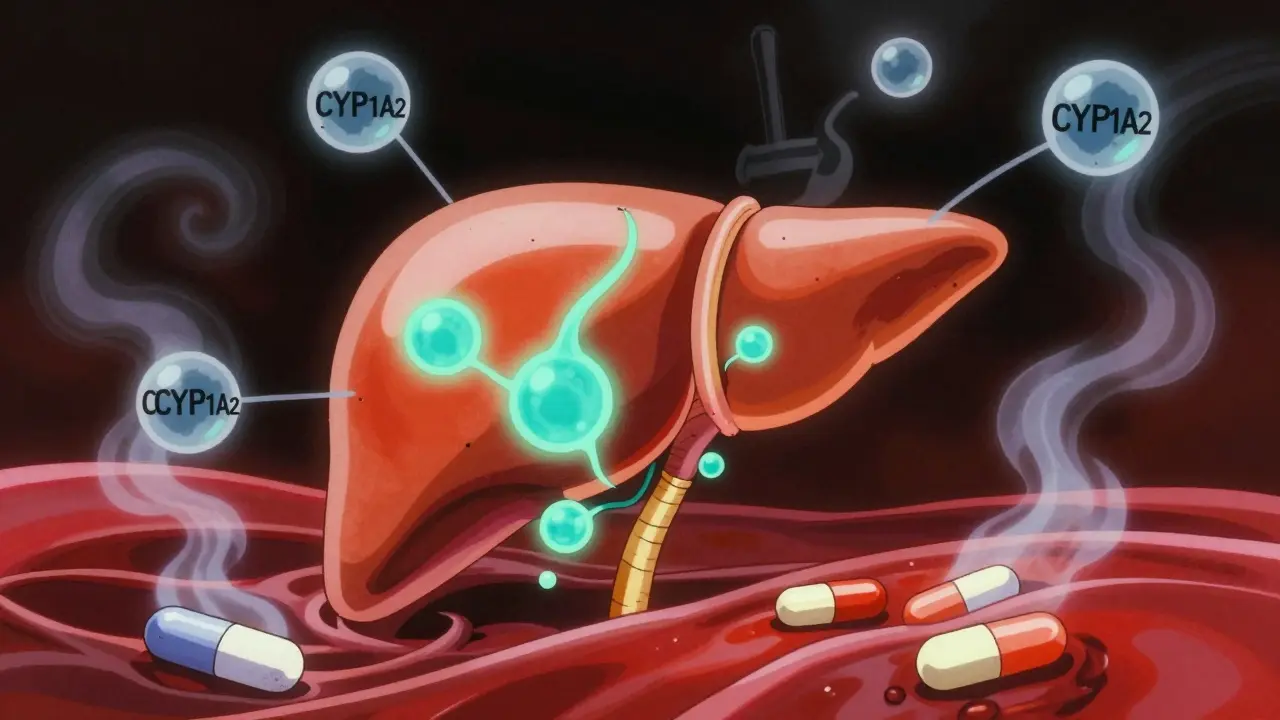
When you smoke, your liver produces more CYP1A2 enzymes that break down certain medications faster. When you quit, these enzyme levels gradually decrease over 2-4 weeks, causing your medication levels to rise. This can lead to toxicity without dose adjustment.
When you smoke, your body doesn’t just absorb nicotine. It also kicks off a chain reaction that changes how your body handles almost every medication you take. This isn’t theory. It’s measurable, predictable, and often dangerous if ignored. For people on medications like clozapine, theophylline, or olanzapine, smoking can cut drug levels in half. When they quit, those same levels can spike into toxic range - all without changing the pill count.
Why Smoking Changes Drug Levels
Tobacco smoke isn’t just tar and nicotine. It contains chemicals called polycyclic aromatic hydrocarbons (PAHs). These trigger a biological switch in your liver. They activate a receptor called AhR, which tells your liver to make more of certain enzymes - especially CYP1A2, CYP1A1, and CYP2E1. These enzymes break down drugs. More enzymes mean drugs get cleared faster. That’s why smokers often need higher doses to feel the same effect.It’s not instant. It takes about two weeks of regular smoking for enzyme levels to peak. But the reverse is even more dangerous. When you quit, those enzymes don’t vanish overnight. They fade over 2-4 weeks. During that time, your body suddenly holds onto more drug than it used to. A dose that was perfectly safe while smoking can become toxic after quitting.
Medications Most Affected
Not all drugs are affected equally. Some are barely touched. Others? They’re completely upended.- Clozapine: Used for treatment-resistant schizophrenia. Smokers need up to 50% more than non-smokers to reach therapeutic levels. After quitting, levels can jump 70-100% within days. There are over 140 documented cases of clozapine toxicity in the FDA database after smoking cessation - most within two weeks.
- Theophylline: Used for asthma and COPD. Smokers clear it 63% faster. Half-life drops from 8 hours to under 3 hours. When they quit, levels can soar into the toxic range, causing seizures or heart rhythm problems. One pharmacist on Reddit reported a patient hospitalized for theophylline toxicity just 10 days after quitting.
- Olanzapine: Another antipsychotic. Smokers have 98% higher clearance. Their blood levels are nearly half of non-smokers on the same dose.
- Duloxetine: An antidepressant. CYP1A2 is its main breakdown path. Smokers may need 20-30% higher doses. Quitting can lead to dizziness, nausea, or serotonin syndrome.
- Pioglitazone: A diabetes drug. Smokers metabolize it faster. Studies show A1C levels can drop from 7.8% to 5.9% within weeks of quitting - not because of better diet, but because the drug stayed in their system longer.
- Mexiletine: Used for irregular heartbeats. Clearance increases 25% in smokers. Half-life drops 36%. Dose adjustments are critical.
Drugs like SSRIs (sertraline, fluoxetine) or beta-blockers like propranolol are also affected, though less dramatically. Propranolol levels drop 25% in smokers. After quitting, blood pressure can spike if the dose isn’t lowered.
What’s NOT Affected
Some drugs don’t care about smoking. If they’re broken down by CYP2D6, CYP3A4, or CYP2C9 - and not CYP1A2 - smoking changes little. That includes:- Many SSRIs (paroxetine, citalopram)
- Most statins (atorvastatin, rosuvastatin)
- Warfarin (though smoking can slightly reduce its effect, it’s not a major concern)
- Insulin and most oral diabetes drugs (except pioglitazone)
But here’s the trap: many patients take multiple drugs. One might be unaffected, but another - say, clozapine - could be dangerously sensitive. You can’t assume safety just because one drug is fine.
What Happens When You Quit
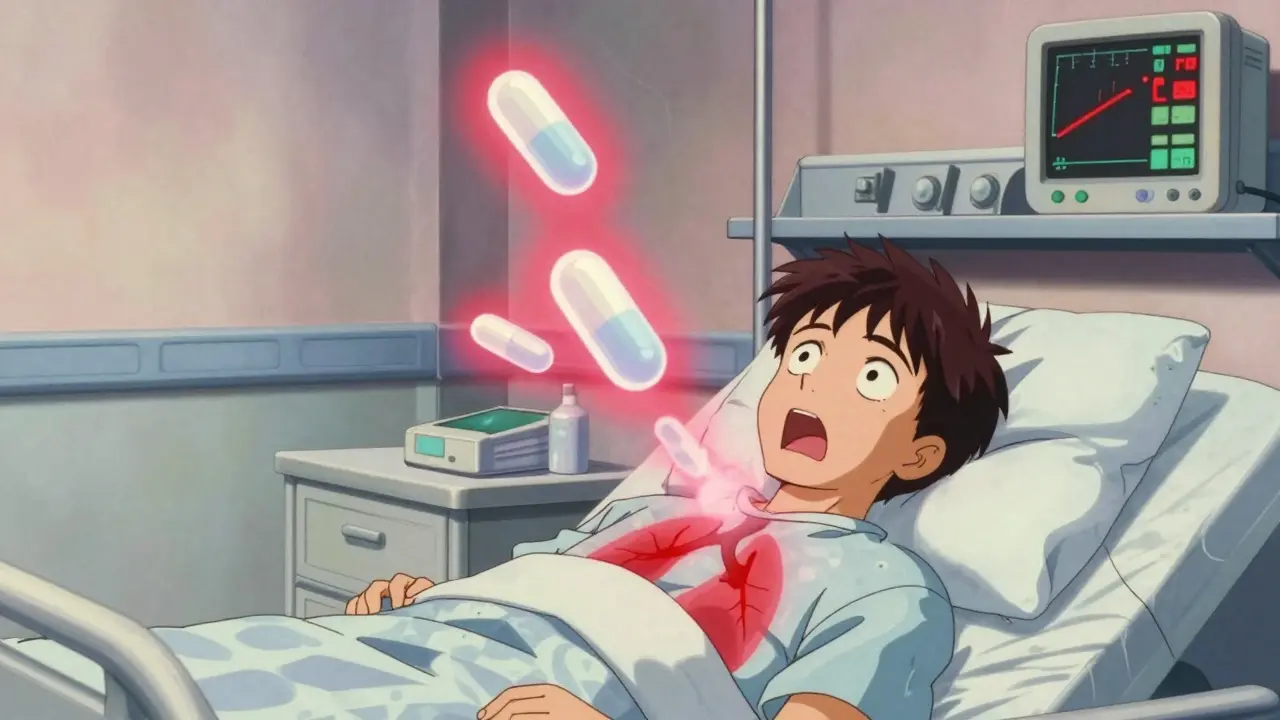
This is where most people get hurt.Doctors rarely warn patients: “When you quit smoking, your meds might start working too well - or too dangerously.” The FDA’s adverse event reports show 89% of clozapine toxicity cases happen within 14 days of quitting. The same pattern shows up with theophylline, olanzapine, and duloxetine.
Why? Because the liver enzymes don’t shut off the moment you stop smoking. They decline slowly. Your body is still used to clearing the drug fast. But now, it’s not. So the drug builds up. You don’t feel sick right away. You feel fine - until suddenly, you’re dizzy, nauseous, or your heart races. By then, it’s too late.
Dr. Neal Benowitz from UCSF says: “About 15% of medication failures in smokers are due to this. But the bigger problem is what happens after they quit.”
What You Should Do
If you smoke and take medication, here’s what you need to do:- Know your meds. Check if your drug is metabolized by CYP1A2. Ask your pharmacist or look up the drug’s prescribing information. If it’s listed as a CYP1A2 substrate, pay attention.
- Tell every doctor and pharmacist you smoke. Even if you only smoke a few cigarettes a week. Even if you think it’s “not a big deal.”
- If you plan to quit - tell your prescriber before you stop. Don’t wait until you’ve quit. Ask: “Will I need to adjust my dose?”
- If you’ve already quit, monitor for side effects. Dizziness, nausea, confusion, rapid heartbeat, or unusual fatigue? These could be signs your drug level is too high. Call your doctor. Don’t wait.
- Get tested if possible. A new test called SmokeMetrix® measures CYP1A2 activity by checking how fast your body breaks down caffeine. It’s now FDA-approved and available in some clinics. It tells you your actual enzyme level - not your guess.
For clinicians: Document smoking status at every visit. Use electronic health record alerts. Adjust doses proactively - don’t wait for a crisis.

Real Stories, Real Risks
A 52-year-old man with schizophrenia had been on 400 mg of clozapine for years. He smoked 15 cigarettes a day. His blood levels were stable. He quit cold turkey. Ten days later, he was rushed to the ER with seizures. His clozapine level was 1,200 ng/mL - nearly triple the safe range. He’d been on the same dose. The only change? He stopped smoking. A 68-year-old woman with COPD took 200 mg of theophylline daily. Her levels were perfect. She quit smoking for her grandchild’s birth. Three weeks later, she had vomiting, tremors, and heart palpitations. Her theophylline level was 32 mcg/mL (toxic >20). Her doctor hadn’t adjusted her dose. These aren’t rare. They’re predictable. And they’re preventable.The Bigger Picture
About 34 million U.S. adults smoke. Nearly half of them try to quit each year. Among people with schizophrenia, over 40% smoke. In COPD, it’s nearly 30%. These are the people most likely to be on drugs affected by smoking.Pharmaceutical companies now have to include smoking interaction data in new drug labels. The FDA requires it. The WHO is pushing to make smoking status a mandatory field in every electronic health record by 2027.
But the biggest gap isn’t in science. It’s in communication. A 2022 survey found only 37% of primary care doctors ask about smoking before prescribing theophylline. That’s not negligence. It’s ignorance. Most doctors never learned this in medical school.
Bottom Line
Smoking doesn’t just hurt your lungs. It rewires how your body handles medicine. If you smoke and take any psychiatric, respiratory, or heart medication - your dose may be wrong. If you’re planning to quit - your dose may become dangerous. This isn’t a minor side effect. It’s a clinical emergency waiting to happen.Don’t assume your doctor knows. Don’t assume your pharmacist knows. Know your drugs. Speak up. Ask: “Does smoking change how this works?” And if you quit - tell them. Right away.
Does smoking affect all medications?
No. Only medications broken down by specific liver enzymes - mainly CYP1A2, CYP1A1, and CYP2E1 - are affected. Common drugs like statins, most SSRIs, and insulin are not significantly impacted. But many psychiatric, asthma, and heart medications are. Always check with your pharmacist.
How long does it take for smoking to affect drug levels?
It takes about 1-3 weeks of regular smoking for enzyme levels to rise fully. You won’t notice changes right away. But if you smoke 10 or more cigarettes daily, your body will eventually clear affected drugs much faster.
What happens if I quit smoking while on medication?
Your body stops clearing the drug as quickly. Drug levels rise - sometimes dangerously. For medications like clozapine or theophylline, this can lead to toxicity within days. Dose reductions of 25-50% are often needed within 3-7 days after quitting. Never assume your dose is still safe.
Can I test if smoking is affecting my drug levels?
Yes. A new test called SmokeMetrix® measures how fast your body breaks down caffeine, which is a marker for CYP1A2 enzyme activity. This gives a direct readout of your enzyme induction level. It’s available in some clinics and can help guide precise dose adjustments.
Should I stop smoking if I’m on medication?
Yes - but not without planning. Quitting smoking is one of the best things you can do for your health. But if you’re on medications like clozapine, theophylline, or olanzapine, you must work with your doctor to adjust your dose before or right after quitting. The risk of toxicity after quitting is real and preventable.
Linda O'neil
January 27, 2026 AT 01:20This is the kind of post that should be mandatory reading for every smoker on meds. I’m a pharmacist and I’ve seen this happen way too often - someone quits smoking, thinks they’re doing the right thing, and then ends up in the ER because their clozapine level went nuclear. No one warned them. No one asked. Just a silent, deadly chemical shift in their liver. Please, if you’re reading this and you smoke - tell your doctor. And if you’re quitting - tell them BEFORE you quit. This isn’t hype. It’s pharmacology.
James Dwyer
January 28, 2026 AT 20:07My uncle took theophylline for COPD and quit cold turkey after his grandkid was born. Three weeks later he was in the hospital with a heart rhythm that looked like a seizure on the monitor. The doctors had no idea why until his daughter mentioned he’d stopped smoking. They didn’t even adjust his dose. He’s lucky he didn’t die.
Mel MJPS
January 30, 2026 AT 02:56I’m so glad someone finally put this out there in plain language. My mom’s on olanzapine and smoked for 30 years. When she quit last year, she started having these terrifying dizzy spells and nausea every morning. We thought it was withdrawal - turns out it was the drug building up. Her psychiatrist didn’t know either. We had to push for a blood test. I wish I’d known this six months ago. You’re not just quitting cigarettes - you’re changing how your whole body handles medicine. Thank you for writing this.
Rhiannon Bosse
January 31, 2026 AT 15:11Let me guess - Big Pharma didn’t want this info out there because if people knew smoking changed their meds, they’d stop smoking AND stop buying pills. Genius. They make you smoke to keep your dose high, then profit when you quit and overdose. It’s all a money scheme. And now they’ve got this "SmokeMetrix" test? Of course they do. Charge you $200 to tell you what your liver’s been doing for free since you were 16. They want you addicted to testing, not quitting. I’m not getting tested. I’m just quitting. And if I die? At least I died free.
Lance Long
January 31, 2026 AT 23:33Look, I’ve been on clozapine for 12 years. I smoke 20 a day. My blood levels are stable. I’ve never felt better. I’m not quitting. Not because I’m weak - because I’m smart. The system wants you to quit so they can re-dose you, re-test you, re-bill you. But here’s the truth: if you’re stable, don’t mess with it. The real danger isn’t smoking - it’s the chaos doctors create when they panic and change your dose without understanding the science. I’ve seen people get hospitalized because their psychiatrist panicked after they quit. Stay the course. If it ain’t broke, don’t let them fix it.
Lexi Karuzis
February 2, 2026 AT 07:07Did you know the FDA has known about this since 1998?!?! And yet they still don’t require EHRs to flag smoking status automatically?!?! And your doctor didn’t learn this in med school?!?! Of course not - because med school is funded by pharma who profit from you being unstable after you quit!!! You think this is about health?!?! NO. It’s about BILLIONS in drug sales. They want you smoking so you need more pills. And when you quit? They want you to need MORE tests, MORE doses, MORE visits!!! They’re not helping you - they’re harvesting you!!!
Brittany Fiddes
February 2, 2026 AT 17:25Frankly, I find it astonishing that Americans still don’t treat smoking like the public health emergency it is. In the UK, we’ve had smoking status flagged in every prescription since 2015. Your entire healthcare system is built on reactive chaos - not prevention. You wait for someone to have a seizure before you ask if they smoke? That’s not medicine. That’s negligence dressed in white coats. And you wonder why your life expectancy is dropping? It’s because you treat symptoms, not causes. Shameful.
Amber Daugs
February 4, 2026 AT 08:01My cousin’s kid took duloxetine and quit smoking. Got dizzy, threw up, cried all day - thought it was depression. Turns out it was serotonin overload. Mom didn’t even tell the doctor. Now the kid’s on a different med and she’s blaming the antidepressant. It’s not the drug - it’s the silence. People don’t talk about smoking like it’s a medical condition. But it is. And pretending it’s not killing people is just as bad as smoking itself.
Robert Cardoso
February 5, 2026 AT 20:39This is a perfect example of why reductionist pharmacology fails. You reduce the body to a chemical factory - CYP1A2 this, enzyme that - but you ignore the existential reality: people smoke because they’re in pain. Trauma. Loneliness. Economic despair. You can’t just say "tell your doctor" and expect change. That’s like telling someone with a broken leg to stop walking. The real issue isn’t enzyme kinetics - it’s a society that gives people cigarettes instead of therapy. So yes, your dose changes when you quit - but why did you need the drug in the first place? The answer isn’t in a lab. It’s in the silence between the pills.