
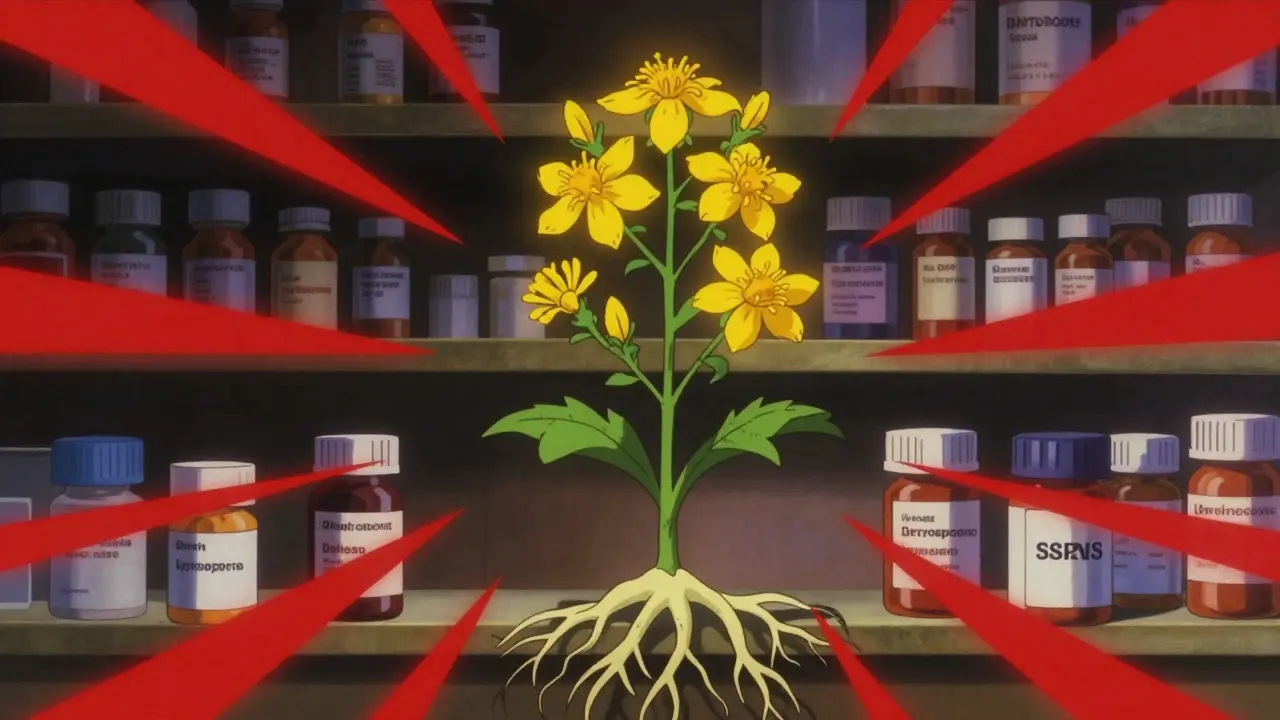
St. John’s Wort looks harmless. It’s sold in health food stores, labeled as "natural," and often promoted as a gentle fix for low mood. But this herb isn’t harmless. It’s one of the most dangerous herbal supplements you can take if you’re on any prescription medication. And most people have no idea.
What St. John’s Wort Actually Does in Your Body
St. John’s Wort (Hypericum perforatum) has been used for centuries to ease sadness and anxiety. Modern studies show it can work as well as some antidepressants for mild to moderate depression. But here’s the catch: it doesn’t just affect your brain. It rewires how your body processes nearly every drug you take.
The culprit is hyperforin - a compound in the plant that turns on a switch in your liver called the pregnane-X-receptor. This switch tells your body to make more enzymes that break down drugs. Specifically, it ramps up CYP3A4 and P-glycoprotein, two systems that flush medications out of your system faster than normal.
That means if you’re taking a pill, and you start St. John’s Wort, your body may start treating that pill like trash - flushing it out before it has time to work. And this doesn’t stop when you quit the herb. The effect can last up to two weeks after you stop taking it.
Warfarin and Blood Thinners: The Silent Risk
If you’re on warfarin (Coumadin) or phenprocoumon (Marcoumar), St. John’s Wort could put you in the hospital - or worse.
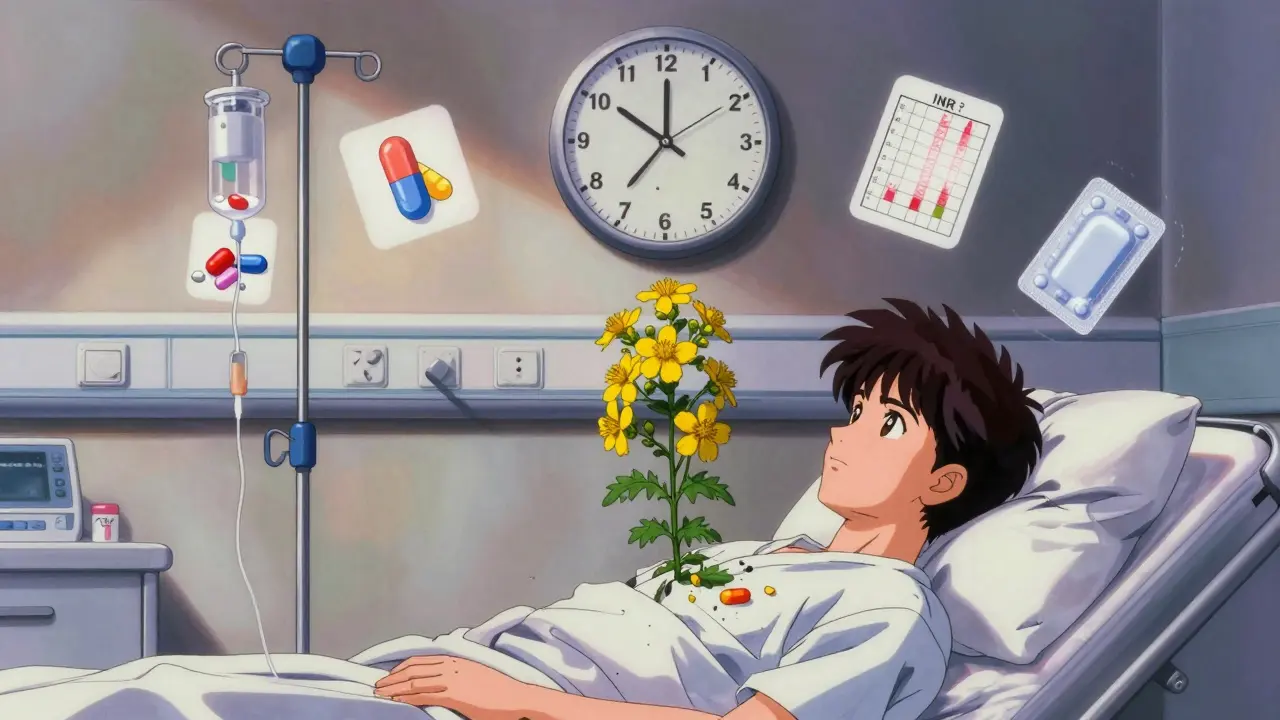
One case from 2000 involved a 62-year-old man on stable warfarin therapy. His INR (a measure of blood thinning) was holding steady at 2.8. After starting St. John’s Wort, his INR dropped to 1.4 in just seven days. That’s not just a number - it means his blood started clotting too easily. He was at risk for a stroke or heart attack.
Between 1998 and 2000, European regulators recorded 22 cases of warfarin interactions with St. John’s Wort. Every single one led to unstable blood clotting. No one died in those reports - but many came close.
It’s not just warfarin. Other anticoagulants like apixaban and rivaroxaban are also affected. If you’re on any blood thinner, St. John’s Wort is not an option.
Organ Transplants: A Life-Threatening Mix
People who’ve had kidney, liver, or heart transplants are especially vulnerable. Immunosuppressants like cyclosporine and tacrolimus keep the body from rejecting the new organ. But St. John’s Wort makes these drugs disappear.
In one 2004 study, 10 kidney transplant patients who added St. John’s Wort saw their cyclosporine levels drop by 54%. Two of them suffered acute organ rejection. One needed emergency treatment. Another lost the transplant.
The European Medicines Agency reviewed 17 similar cases and issued a formal warning in 2007. Since then, doctors have been told to ask every transplant patient: "Are you taking any herbal supplements?" If the answer is yes, they dig deeper - because St. John’s Wort is the most common offender.
HIV Medications: A Recipe for Drug Resistance
St. John’s Wort doesn’t just reduce the effectiveness of HIV drugs - it can make them useless. And that’s dangerous.
A 2004 study showed that St. John’s Wort cut the levels of indinavir, an HIV protease inhibitor, by up to 99% in some people. That’s not a small drop. That’s enough to let the virus replicate freely. When HIV isn’t fully suppressed, it mutates. Those mutations lead to drug-resistant strains - strains that no longer respond to treatment.
The U.S. Department of Health and Human Services explicitly says: "Do not use St. John’s Wort with any HIV medication." One UK patient saw his viral load spike after adding the herb to his regimen. He wasn’t trying to hurt himself. He thought he was helping his mood.
Birth Control: The Overlooked Crisis
Women on the pill may not realize they’re at risk. St. John’s Wort cuts the levels of ethinyl estradiol and levonorgestrel - the hormones in most birth control pills - by 15% to 25%.
The Swedish Medical Products Agency recorded 47 cases of contraceptive failure between 2000 and 2003. Twelve of those led to confirmed pregnancies. GoodRx’s 2022 review of FDA reports found 217 cases of possible birth control failure linked to St. John’s Wort.
And here’s the kicker: most women don’t know. A 2023 Consumer Reports survey found only 32% of supplement users knew St. John’s Wort could make birth control fail. That’s not ignorance - it’s a public health blind spot.
Antidepressants: The Serotonin Syndrome Danger
People often take St. John’s Wort because they’re already on antidepressants. That’s a deadly combo.
When you mix it with SSRIs like fluoxetine or SNRIs like venlafaxine, your brain gets flooded with serotonin. Too much serotonin causes serotonin syndrome - a medical emergency.
Symptoms include:
- Fast heart rate (over 100 bpm)
- High blood pressure
- Heavy sweating
- Muscle spasms or stiffness
- Confusion, agitation, hallucinations
In 2021, an 18-year-old man was rushed to the ER after taking St. John’s Wort with 5-HTP, melatonin, and Adderall. His heart rate hit 128 bpm. He was paranoid and sweating uncontrollably. He needed IV fluids and benzodiazepines to calm down.
The American Psychiatric Association now says: wait at least 14 days after stopping an SSRI before starting St. John’s Wort. And even then - proceed with extreme caution.
Other Dangerous Interactions
St. John’s Wort doesn’t stop at the big ones. It messes with:
- Benzodiazepines like Xanax - reducing their effect by up to 40%, leaving anxiety uncontrolled.
- Digoxin (Lanoxin) - cutting levels by 25%, which can cause heart rhythm problems.
- Phenytoin (Dilantin) - lowering levels by up to 46%, increasing seizure risk. The FDA received 12 reports of breakthrough seizures between 2000 and 2005.
- Statins like atorvastatin - potentially reducing cholesterol control.
- Chemotherapy drugs - some studies suggest reduced effectiveness.
There are 142 documented drug interactions with St. John’s Wort, according to the St. John’s Wort Drug Interaction Checker. That’s more than most prescription drugs.
What’s Being Done About It?
Regulators are finally catching up. In 2021, the European Union required all St. John’s Wort products to carry a bold warning about interactions with HIV meds, birth control, transplant drugs, and antidepressants.
In June 2023, the FDA announced that starting January 2025, every St. John’s Wort product sold in the U.S. must display a "Drug Interaction Alert" symbol on the front label - just like black box warnings on powerful prescription drugs.
Manufacturers have been slapped with 17 FDA warning letters between 2019 and 2023 for failing to warn consumers. Sales are still rising - $187.4 million in the U.S. in 2022 - but awareness is still dangerously low.
What You Should Do
If you’re thinking about taking St. John’s Wort:
- Stop. Talk to your doctor or pharmacist first.
- Make a list of every medication you take - including blood pressure pills, painkillers, thyroid meds, and even over-the-counter drugs.
- Ask them to check for interactions with St. John’s Wort.
- If you’re on birth control, HIV meds, transplant drugs, or antidepressants - don’t take it.
- If you’re already taking it, don’t quit cold turkey. Talk to your provider about how to stop safely.
There’s no such thing as "natural equals safe." St. John’s Wort is a powerful drug. It just doesn’t come in a pill bottle.
Is There a Safer Version?
Researchers are working on it. A new type of St. John’s Wort extract, with hyperforin reduced to less than 0.5%, showed similar antidepressant effects in a 2023 trial - but caused almost no enzyme induction. Its effect on midazolam (a test drug) was only 9% compared to 56% with regular extracts.
The NIH is funding a $2.4 million study to see if this version can be made available safely. But until then - assume every St. John’s Wort product on the shelf carries the same risks.
Can I take St. John’s Wort with my antidepressant?
No. Mixing St. John’s Wort with SSRIs, SNRIs, or MAOIs can cause serotonin syndrome - a life-threatening condition. Even if you feel fine, the risk is real. The American Psychiatric Association recommends waiting at least 14 days after stopping an antidepressant before starting St. John’s Wort - and even then, only under medical supervision.
Does St. John’s Wort affect birth control even if I take it occasionally?
Yes. The interaction doesn’t require daily use. Even short-term use can lower hormone levels enough to cause contraceptive failure. There are documented cases of pregnancy after just one week of use. If you’re on birth control, avoid it completely.
How long does St. John’s Wort stay in my system after I stop taking it?
The enzyme-inducing effects can last up to two weeks after you stop taking it. That means if you’re switching from St. John’s Wort to a prescription antidepressant, or preparing for surgery, you need to wait at least 14 days to be safe. Don’t assume it’s gone just because you stopped.
Are all St. John’s Wort supplements the same?
No. The amount of hyperforin - the compound that causes interactions - varies widely between brands. Ethanol extracts tend to have more hyperforin than CO2 extracts. But unless a label says "hyperforin-free" or lists exact levels, you can’t assume safety. Most products don’t disclose this. Assume all are high-risk.
Why don’t more people know about these risks?
Because the supplement industry isn’t held to the same standards as pharmaceuticals. Labels don’t have to list interactions unless they’re proven deadly. Many manufacturers avoid warnings to keep sales high. A 2023 survey found only 18% of users knew about HIV drug interactions, and 32% knew about birth control risks. The FDA is finally stepping in - but until January 2025, you’re on your own.
What should I do if I’m already taking St. John’s Wort and a prescription drug?
Don’t stop suddenly. Contact your doctor or pharmacist right away. Bring the supplement bottle with you. They can check your medication levels, adjust doses if needed, and help you transition safely. If you’re on warfarin, HIV meds, or transplant drugs, this is urgent.
Branden Temew
December 31, 2025 AT 13:46So let me get this straight - we’re okay with selling a plant that can turn your life-saving meds into expensive paperweights, but we won’t regulate it like actual pharmaceuticals? 🤔
Natural doesn’t mean safe. It just means someone didn’t patent it. I’d rather my doctor prescribe me something that comes with a warning label that actually means something.
Also, if your supplement bottle doesn’t list drug interactions like a DEA report, maybe don’t trust it. Just sayin’.
Deepika D
January 1, 2026 AT 11:48As someone who’s worked with patients on immunosuppressants for over 15 years, I can’t stress this enough - St. John’s Wort is not a harmless herb. It’s a biochemical grenade disguised as a tea bag.
I’ve seen transplant patients lose their organs because they thought "natural" meant "safe." One woman took it for three weeks after her kidney transplant because her cousin swore it helped her anxiety. She didn’t even know she was on a drug that could kill her new kidney.
And it’s not just about the science - it’s about the cultural gap. In many communities, herbal remedies are trusted more than doctors. That’s not wrong, but it’s dangerous when no one’s teaching people how to cross-check interactions. We need community health workers to go door to door with pamphlets, not just rely on FDA labels that won’t appear until 2025.
Also - if you’re on birth control and taking this, please, for the love of all that’s holy, get tested. A pregnancy from a supplement interaction is not a "happy accident." It’s a preventable medical failure.
And yes, the 2023 NIH study on low-hyperforin extracts is promising. But until it’s on shelves, treat every bottle like a loaded gun.
Stewart Smith
January 1, 2026 AT 18:48lol i took this for a month last year because i was "trying to be holistic"
turned out my anxiety meds stopped working and i was sobbing in the shower over a burnt toast
also my cat looked at me like i was a traitor
lesson learned: if your supplement has a vibe, it’s probably trying to kill you
Retha Dungga
January 2, 2026 AT 10:31so like... if nature made it... why is it trying to murder us?? 🤔🤯
also i took this and my period went full chaos mode 😭
no one warned me 🙃
we need a warning label that screams "YOU WILL REGRET THIS" 🚨
Jenny Salmingo
January 2, 2026 AT 12:37I’m from a place where people use herbs for everything. My grandma used St. John’s Wort for sadness. She didn’t know about drugs. She just knew it helped her sleep.
Now I tell everyone - if you’re on medicine, ask your pharmacist before you touch anything from the health store. Even if it’s just a little. It’s not about being scared. It’s about being smart.
And if your doctor doesn’t ask about supplements? Find a new one.
Aaron Bales
January 3, 2026 AT 22:42Stop. Talk to your pharmacist. Now.
If you’re on anything prescription, this herb is not an option. Period.
142 documented interactions. That’s not a coincidence. That’s negligence.
Don’t be the person who almost dies because they thought "natural" meant "safe."
Lawver Stanton
January 5, 2026 AT 17:40Okay, so let me get this straight - we’ve got a $187 million industry selling a plant that can make your birth control useless, your transplant fail, your HIV meds turn into water, and your Xanax stop working… and the FDA’s solution is… a label in 2025?
What are we, in the 1800s? Do you think people read labels? Do you think people even know what "CYP3A4" means? No. They see "natural" and think "good for me."
And the worst part? The companies know this. They’re not stupid. They’re just rich. And they’re banking on your ignorance.
I’ve seen the ads. "Feel better without chemicals!" - yeah, except the chemicals you’re already taking? They’re the only thing keeping you alive.
This isn’t a public health issue. It’s a corporate crime. And the fact that we’re still letting this happen? That’s the real tragedy.
Sara Stinnett
January 6, 2026 AT 00:50How is it even legal to sell this as a "supplement"? By that logic, I could sell cyanide as a "natural mood enhancer" if I call it "Mountain Spring Extract" and slap a leaf on the bottle.
There is no such thing as "natural equals safe." That’s a marketing lie peddled by people who’ve never opened a pharmacology textbook.
The fact that we treat herbal products as if they’re harmless candy is a reflection of our collective intellectual laziness. We want quick fixes without consequences - so we buy into fairy tales written by marketers with degrees in psychology, not medicine.
And let’s not pretend the FDA is the hero here. They’re reacting. They’re not preventing. They’re always five years behind the graveyard.
If you’re still taking this after reading this article, you’re not just uninformed - you’re willfully reckless.
linda permata sari
January 6, 2026 AT 01:11OMG I JUST REALIZED I TOOK THIS FOR TWO WEEKS WHILE ON THE PILL 😭
MY BEST FRIEND GOT PREGNANT LAST YEAR AND SHE SWORE SHE DIDN’T MISS A PILL
WHY NOBODY TOLD US???
WE NEED A MOVIE ABOUT THIS. LIKE A THRILLER. "THE HERB THAT KILLS LOVE" 💔🩸
Brandon Boyd
January 6, 2026 AT 07:01Hey - if you’re thinking about trying St. John’s Wort, pause for a second.
It’s not about being scared. It’s about being informed.
Take five minutes. Write down every pill you take - even the ones you forgot about. Then go talk to your pharmacist. They’re not there to judge you. They’re there to keep you alive.
And if you’re already taking it? Don’t panic. Just reach out. There’s no shame in asking for help. You didn’t know. Now you do. That’s the first step.
You’re not alone. And you’re not weak for needing to check. You’re smart for doing it.
Frank SSS
January 6, 2026 AT 16:26Okay, so I read this whole thing.
And I’m just sitting here wondering… how many people have died from this and no one noticed?
Like, someone’s grandma takes it for "depression" and then has a stroke. The death certificate says "cardiovascular event." No one connects it to the little bottle of brown pills in her nightstand.
And the worst part? The supplement industry is probably laughing right now.
They don’t care if you die. They care if you buy another bottle next month.
So yeah. I’m not mad. I’m just… disappointed.
And honestly? I’m kind of scared for everyone I know who still takes this.