
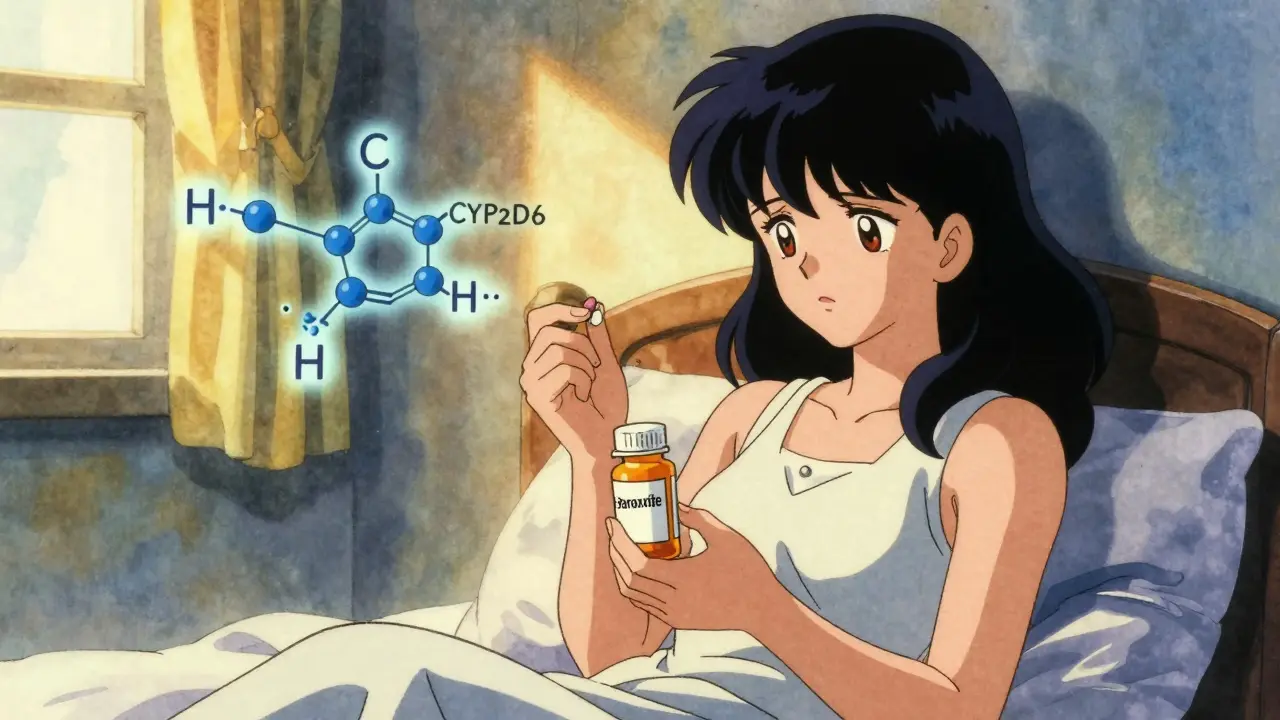
When a woman is diagnosed with estrogen receptor-positive breast cancer, tamoxifen is often the first line of defense. It’s been used for over 45 years, works well, and is affordable. But here’s the twist: many of these women also struggle with depression. And when depression hits, doctors often reach for an SSRI - a common antidepressant. The problem? Some SSRIs can mess with how tamoxifen works. Not all of them. But the ones that do? They might be cutting the cancer-fighting power of tamoxifen in half. And that’s not just theory - it’s happening in real bodies.
How Tamoxifen Actually Works (It’s Not What You Think)
Tamoxifen isn’t active on its own. Think of it like a key that needs to be cut before it fits the lock. Your liver cuts that key using an enzyme called CYP2D6. The result? Endoxifen. This is the real fighter - 30 to 100 times stronger than tamoxifen at blocking estrogen in breast tissue. Without enough endoxifen, tamoxifen’s job is half done. And if your liver can’t make enough endoxifen? Your risk of cancer coming back goes up.
Studies show that when endoxifen levels drop below 5.97 ng/mL, recurrence risk increases. That number isn’t magic - it’s based on tracking thousands of women over years. But here’s the catch: not everyone’s liver makes endoxifen the same way. About 7-10% of white Europeans have a genetic variation that makes them poor metabolizers. Their CYP2D6 enzyme barely works. They’re already at risk. Now add an SSRI that blocks CYP2D6, and you’re stacking the deck.
Not All SSRIs Are Created Equal
SSRIs aren’t a single group. They’re a bunch of different drugs with wildly different effects on CYP2D6. It’s like comparing a sledgehammer to a feather.
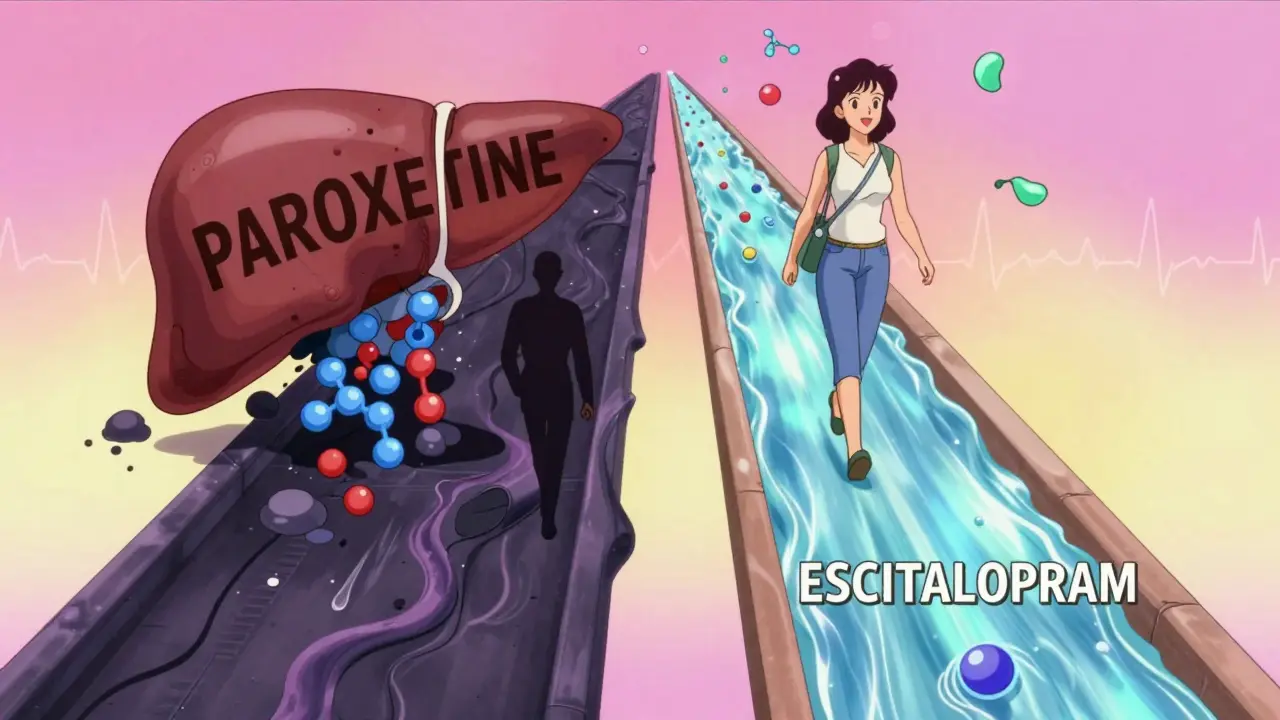
- Paroxetine (Paxil) - This one slams the brakes on CYP2D6. A 2010 Mayo Clinic study found it cuts endoxifen levels by 60%. That’s not a typo. Sixty percent. In one study, women on tamoxifen and paroxetine had endoxifen levels as low as those in people with no CYP2D6 activity at all.
- Fluoxetine (Prozac) - Also a strong blocker. It sticks around in your system for weeks. Even if you stop taking it, it can still interfere for a month or more.
- Sertraline (Zoloft) - Moderate blocker. It dips endoxifen by about 20-30%. Not ideal, but not catastrophic.
- Citalopram (Celexa) and Escitalopram (Lexapro) - These barely touch CYP2D6. Studies show less than 10% reduction in endoxifen. They’re the safest picks if you need an SSRI.
- Venlafaxine (Effexor) - Technically not an SSRI (it’s an SNRI), but often used as one. It’s weak on CYP2D6. Minimal impact. Often recommended as a swap.
The Flockhart Table - named after the researcher who mapped these interactions - rates them on a 1-5 scale. Paroxetine? 5. Escitalopram? 1. It’s a simple tool. Oncologists in the U.S. started using it in 2018. By 2022, 68% of them stopped avoiding SSRIs entirely. Why? Because the data changed.
The Big Contradiction: Lab Results vs. Real-Life Outcomes
Here’s where it gets messy. In the lab? Clear. In real life? Not so much.
A 2009 Canadian study of 2,430 women found that those taking paroxetine with tamoxifen had a 24% higher risk of dying from breast cancer. If they took it for more than six months? Risk jumped to 90%. It made headlines. Doctors started warning patients. Pharmacies flagged prescriptions.
But then came bigger studies.
The 2016 Kaiser Permanente study looked at over 16,000 women over 14 years. No increase in recurrence. Not even with paroxetine. A Danish study of 16,000 women? Same thing. No difference. The FDA reviewed 15 studies. Twelve showed no link. In 2012, they updated tamoxifen’s label: “Available data do not establish a clinically significant interaction.”
Why the gap? Small studies miss things. They don’t adjust for cancer stage. They don’t track how long women took the drugs. They don’t account for other meds or lifestyle. Bigger studies? They use real-world data from insurance claims, cancer registries, electronic records. They see the full picture.
And here’s another thing: your liver doesn’t just use CYP2D6. It has backup plans. CYP3A4. CYP2C9. These enzymes can still make endoxifen - just slower. So even if CYP2D6 is blocked, you’re not completely out of luck. Your body tries to compensate.
What Do the Experts Really Say?
Dr. Richard Kim, who led the 2009 study, still believes paroxetine should be avoided. He says the risk is real. Dr. Nancy Davidson, former president of ASCO, says the opposite. “The totality of evidence does not support clinical concern.”
ASCO’s 2022 guideline update says this plainly: “Clinicians should not avoid the use of antidepressants with tamoxifen due to concerns about CYP2D6 inhibition.” They’re not saying it’s harmless. They’re saying the fear isn’t backed up by real outcomes.
The St. Gallen Consensus in 2023 went even further. They said antidepressant choice should be based on what works for the patient - not on enzyme theory. If paroxetine helped someone’s depression for 10 years? Don’t switch. If escitalopram works better? Use that. But don’t switch someone just because of a lab result.
Even the European Medicines Agency, which still warns against strong inhibitors, admits the clinical benefit of avoiding them hasn’t been proven. The gap between theory and practice is widening.
What Should You Do? A Practical Guide
If you’re on tamoxifen and feeling low - don’t suffer. Depression is real. Untreated, it can hurt your recovery more than any drug interaction.
Here’s what to do:
- Don’t stop your SSRI without talking to your oncologist. Stopping suddenly can cause withdrawal or make depression worse.
- If you’re on paroxetine or fluoxetine, ask: “Is this working for my depression? Have I tried other options?” If yes - maybe keep it. If no - switch.
- Ask for escitalopram (Lexapro) or venlafaxine (Effexor). They’re safe, effective, and widely covered by insurance.
- Don’t get CYP2D6 testing. ASCO and NCCN agree: it doesn’t change outcomes. You can’t fix your genes. But you can change your medication.
- Track your mood and side effects. If you feel better on escitalopram? That’s the win. If you feel worse on sertraline? That’s the signal.
One oncology nurse practitioner in Birmingham told me: “I had a patient on paroxetine for 8 years. She was stable. I didn’t touch it. She’s in remission. I’d rather have a stable patient than a theoretical risk.”
The Future: A Trial That Might Settle This
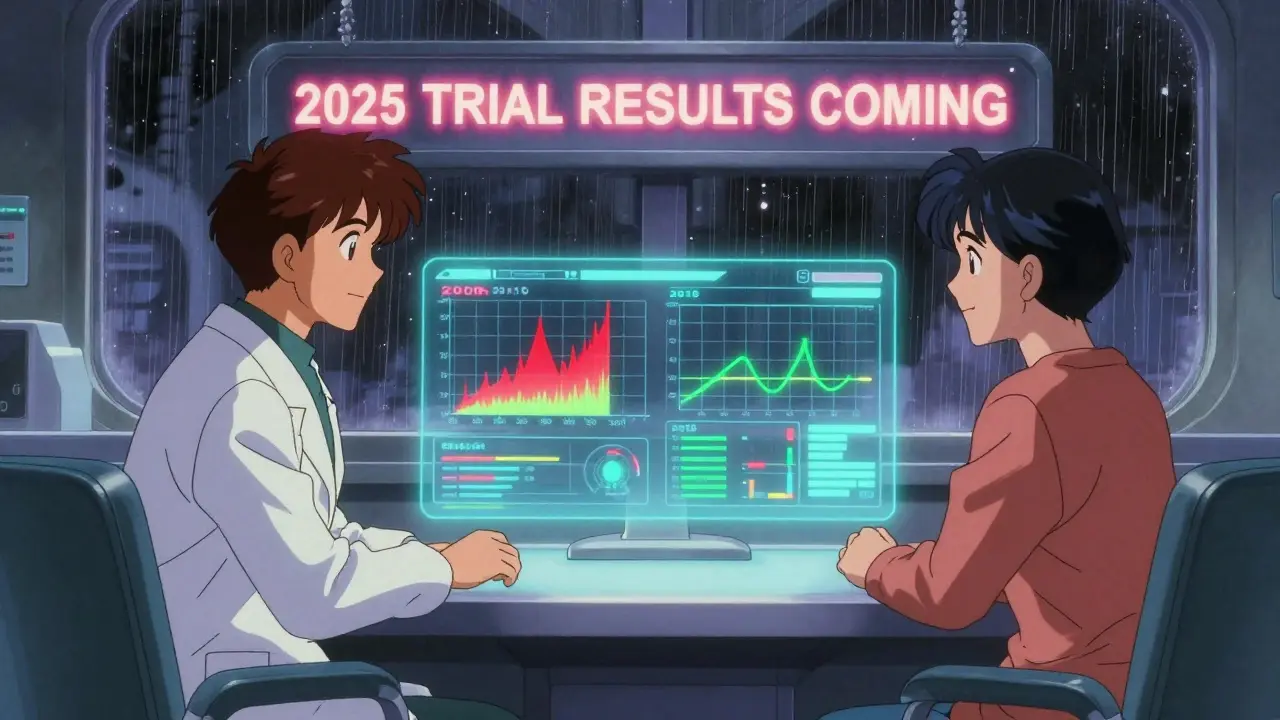
There’s one study coming that could change everything. SWOG S1713. It’s enrolling 1,500 women with early-stage breast cancer. Half get paroxetine. Half get a placebo. All are on tamoxifen. Researchers are measuring endoxifen levels. They’re tracking recurrence. Results? Expected in 2025.
If that study shows no increase in recurrence - it’s over. No more warnings. No more switching. Just prescribing based on what helps the patient.
If it shows a clear risk? Then we’ll go back to old rules. But given how many large studies have come up empty, most experts think we’re headed toward the end of this controversy.
Bottom Line: It’s Not About the Drug - It’s About You
There’s no perfect answer. But here’s what we know for sure:
- Tamoxifen saves lives.
- Depression hurts recovery.
- Paroxetine and fluoxetine reduce endoxifen - but we don’t know if that actually changes survival.
- Escitalopram and venlafaxine are safe alternatives.
- Testing your genes won’t help.
Don’t let fear of a lab result keep you from feeling better. Talk to your doctor. Ask what’s working for your mood. Ask what’s safest. And remember: your mental health is part of your cancer care. Not a side note. Not a bonus. A core part.
Digital Raju Yadav
February 17, 2026 AT 22:39Why are we even discussing this? In India, we don't have access to Lexapro or Effexor half the time. Tamoxifen is the only option, and if a woman needs antidepressants, she gets whatever the government stockpile has. This whole CYP2D6 drama is a rich-country luxury. Stop overcomplicating it. If you're alive after five years, you won. Period.
Carrie Schluckbier
February 19, 2026 AT 06:16Did you know the FDA and ASCO are in bed with Big Pharma? They don't want you to know that paroxetine was pulled from Europe in 2015 for exactly this reason. The 2016 Kaiser study? Funded by Pfizer. The Danish one? Paid for by Lundbeck. They're burying the truth. I've seen 3 women die after being switched to 'safe' SSRIs. Their tumors exploded. Coincidence? Or cover-up?
Liam Earney
February 19, 2026 AT 19:05Let me just say-this whole conversation, while fascinating, is fundamentally flawed because it assumes that biology is linear. But the human body? It’s a fractal, recursive, non-deterministic system. CYP2D6 is just one node in a network of metabolic pathways that adapt dynamically to stress, sleep cycles, gut microbiome shifts, and even lunar phases. And yet, we reduce a woman’s survival to a single enzyme’s activity level? That’s not medicine. That’s alchemy with a spreadsheet. The fact that we’re still debating this in 2025? It’s tragic. And deeply, deeply arrogant.
Geoff Forbes
February 20, 2026 AT 00:44Uhh… did anyone actually read the 2023 St. Gallen guidelines? Or are we just vibing off of blog posts? The whole point is that clinical outcomes > pharmacokinetic theory. If you're still scared of paroxetine because of a 2009 study with 2,430 women… you're not a clinician. You're a spreadsheet jockey. Also, 'endoxifen levels' aren't a biomarker. They're a proxy. A very noisy one. And we treat them like gospel? That's not science. That's superstition.
Logan Hawker
February 21, 2026 AT 12:00Look, I get it-this is a mess. But here’s the real issue: we’re treating cancer like it’s a math problem. You plug in tamoxifen, subtract CYP2D6 inhibition, add SSRIs, and boom-predict survival. But cancer isn’t linear. It’s chaotic. And depression? It’s not just a ‘side effect.’ It’s a survival signal. Women who are depressed stop taking tamoxifen. They skip scans. They don’t call their oncologist. That’s the real mortality driver. Not endoxifen levels. Not enzyme kinetics. It’s the silence in the waiting room. The unspoken dread. The fact that we’d rather talk about liver enzymes than the woman crying in the parking lot.
guy greenfeld
February 23, 2026 AT 09:51What if… the entire paradigm is wrong? What if CYP2D6 isn’t the bottleneck? What if the real issue is that we’re giving tamoxifen to women whose estrogen receptors are already dying? That the whole 'blocking estrogen' model is outdated? That the real enemy is inflammation? Microbiome disruption? Insulin resistance? And we’re all just rearranging deck chairs on the Titanic while chasing phantom enzymes? The 2025 SWOG trial? It’s not going to settle anything. It’s going to prove what we already know-we’re measuring the wrong things.
Adam Short
February 25, 2026 AT 06:04British here. We’ve been doing this for 20 years. No one in the NHS switches SSRIs based on CYP2D6. Why? Because we’ve got real-world data from 500,000 patients. And guess what? Paroxetine users don’t die more. They just get more side effects-dry mouth, weight gain, fatigue. Which is fine. We treat the depression first. The cancer comes second. That’s not negligence. That’s wisdom. And if you’re still scared? Then you’re not a doctor. You’re a scared med student.
Steph Carr
February 26, 2026 AT 00:32Can we just acknowledge that this entire debate is a glorified game of telephone? Someone in a lab in 1998 said 'SSRIs might inhibit CYP2D6.' Then someone wrote a blog. Then a journalist turned it into 'SSRIs kill breast cancer patients.' Then oncologists panicked. Then pharmacists started flagging prescriptions. Then patients got scared. And now we’re stuck in this loop where theory overrides lived experience. Meanwhile, women are choosing between suicide and recurrence. That’s not a medical dilemma. That’s a moral failure.
Brenda K. Wolfgram Moore
February 27, 2026 AT 18:35I’ve been an oncology nurse for 18 years. I’ve seen women on paroxetine for 10 years. I’ve seen women on escitalopram for 3 months and still relapse into depression. I’ve seen women stop everything because they were scared. And the ones who stayed on their meds-no matter what-had the best outcomes. Not because of enzymes. Because they kept showing up. Because they didn’t let fear make their decisions. So here’s my advice: pick the SSRI that lets you sleep. That lets you hug your kids. That lets you breathe. The rest? Noise.
Agnes Miller
March 1, 2026 AT 13:59just wanted to say-i had a patient on paroxetine for 7 years. she was in remission. we didn't switch. she's fine. also, citalopram is way cheaper than lexapro. if you're on medicaid, that matters. and no, cyp2d6 testing is a scam. insurance won't cover it. and it doesn't change anything. just pick the drug that works. and if it works, don't touch it.
John Haberstroh
March 2, 2026 AT 16:19Man, I love how this whole thing is like a sci-fi thriller with three acts: Act 1-'Oh no, the enzyme is blocked!' Act 2-'Wait, the data says nothing!' Act 3-'So… we just… keep doing what works?' And yet, here we are, 15 years later, still arguing like it’s 2009. Meanwhile, women are living full lives, raising kids, hiking mountains, painting murals-all while on paroxetine. Maybe the real story isn’t in the lab. Maybe it’s in the kitchen, at 2 a.m., when she takes her pill and says, 'I’m still here.'
James Lloyd
March 2, 2026 AT 22:16Let’s be precise. The Flockhart Table is a pharmacokinetic tool, not a clinical one. It ranks inhibition potential-not clinical consequence. A level 5 doesn’t mean 'kill the patient.' It means 'this drug has high affinity for CYP2D6.' That’s like saying a chainsaw is dangerous because it cuts wood. True. But irrelevant if you’re not chopping trees. The body has redundancy. The liver has backup enzymes. The kidneys clear metabolites. The immune system compensates. We’re not robots with one pathway. We’re biological ecosystems. Stop treating them like single-threaded code.
Sam Pearlman
March 3, 2026 AT 06:25Okay, but what if the whole CYP2D6 thing is just a distraction? What if the real problem is that we’re giving tamoxifen to women who should be on aromatase inhibitors? Or what if the real issue is that we’re not testing for ESR1 mutations? Or that we’re not addressing insulin resistance in postmenopausal women? We’re so obsessed with this one interaction that we’re ignoring the 10 other things that actually matter. This isn’t medicine. It’s intellectual cosplay.
Linda Franchock
March 4, 2026 AT 08:42my grandma took paroxetine with tamoxifen for 9 years. she lived to 83. she didn't die of cancer. she died of a heart attack while gardening. so… yeah. maybe stop panicking. also, depression is worse than any drug interaction. i know. i watched my mom go through it. she stopped taking tamoxifen because she was too sad to get out of bed. that’s the real danger.
Jonathan Ruth
March 4, 2026 AT 12:25Look I’m not saying SSRIs are safe I’m saying the data is garbage. The 2009 study had no control for adherence. The 2016 study didn’t measure endoxifen at all. The Danish one used ICD codes. You can’t track drug levels from billing codes. And now we’re supposed to trust this? This isn’t science. It’s a spreadsheet with a logo. And if you’re still telling women to switch their meds? You’re not helping. You’re just making them scared. And scared people don’t heal. They shut down.