
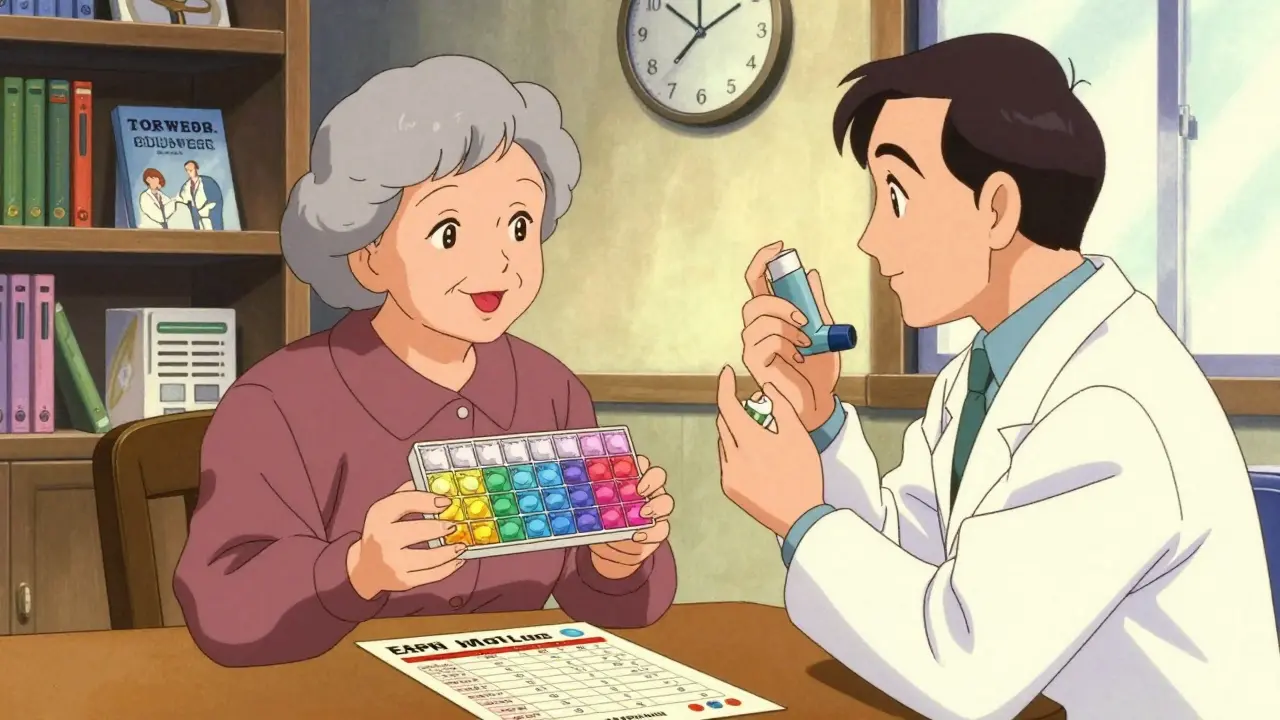
Most people know to ask their doctor about their meds. But far fewer realize their pharmacist is the real expert on how those drugs actually work in your body - and how to take them safely every single day. If you’re on more than one medication, have a chronic condition, or just want to avoid nasty side effects, you need more than a quick verbal rundown. You need clear, written, personalized education materials from your pharmacist.
Why Pharmacist Materials Are Different (and Better)
Pharmacists don’t just hand out pill bottles. They’re trained to break down complex drug info into real-life steps. A 2022 study in the Journal of the American Pharmacists Association found that 87% of patients understood how to use their inhalers, insulin pens, or other tricky devices better after a pharmacist showed them - compared to only 52% after a doctor’s explanation. Why? Doctors focus on diagnosis and overall treatment. Pharmacists live in the details: how to take it, when to take it, and what happens if you forget.What to Ask For - The 7 Must-Have Items
Don’t wait for your pharmacist to offer. Be specific. Here’s what to request every time you pick up a new prescription or refill:- A printed, personalized handout - Not the generic one from the manufacturer. Ask for one tailored to your meds, your routine, and your health. The Patient Education Reference Center (PERC) offers over 15,000 evidence-based handouts that can be customized with your name, dose, and schedule. Make sure it includes: medication name, purpose, dosage, timing, what to do if you miss a dose, side effects, storage, and interactions.
- Demonstration with return demonstration - If you’re using an inhaler, injector, nebulizer, or patch, ask the pharmacist to show you how to use it. Then, let them watch you do it. This isn’t optional - it’s critical. A 2023 Pharmacy Times survey found that 76% of patients who got a live demo and practiced got it right. Only 41% did when they just heard instructions.
- Written instructions in your language - PERC and UpToDate offer materials in over 18 languages, including Spanish, Mandarin, Arabic, and Vietnamese. If English isn’t your first language, say so. You have the right to clear, accurate info in your preferred language.
- A simplified medication schedule - Ask for a chart that matches your daily life. “Take twice daily” means nothing if you work nights or forget meals. A 2023 study in Annals of Pharmacotherapy showed that 73% of patients stuck to their meds better when they got a visual schedule aligned with their routines - like “Take with breakfast” or “Before bedtime.”
- Visual aids for low vision or low literacy - If you’re over 65 or have trouble reading small print, ask for large-font handouts, color-coded pill boxes, or pictures showing pill shapes and sizes. The American Association of Diabetes Educators recommends using numerals (like “2 pills”) instead of words (“two pills”) because they’re easier to understand.
- Documentation in your medical record - Federal law (OBRA ’90) requires pharmacists to document counseling for Medicaid patients. But in 47 states, this applies to everyone. Ask if your counseling was recorded. If not, request it. It protects you if there’s ever a mix-up.
- Information on cost-saving options - Many patients don’t know pharmacists can help with cheaper alternatives. Ask: “Is there a generic version?” “Can I get a 90-day supply to save money?” “Are there patient assistance programs?” Only 18% of pharmacists bring this up - but 62% of patients need it. Don’t be shy. You’re not asking for a favor. You’re asking for your right to affordable care.
How to Ask Without Feeling Awkward
You don’t need to be an expert. Just use this simple script:“I want to make sure I’m taking this right. Can you give me a printed handout that explains what this is for, how to take it, and what side effects to watch for? And could you show me how to use it - then let me try it back?”
That’s it. You’re not being difficult. You’re being smart. Pharmacists are trained to handle this. In fact, the 2025 Pharmacists’ Patient Care Process (PPCP) from the Joint Commission of Pharmacy Practitioners says they’re required to confirm you understand - not just hand you a sheet.
What’s Missing From Most Pharmacies
Here’s the hard truth: most pharmacies aren’t doing this well. A 2024 Consumer Reports survey found that 42% of patients felt rushed. In chain stores like CVS or Walgreens, the average counseling time is just 1.8 minutes. That’s not enough to explain a new heart medication or diabetes regimen.Independent pharmacies often do better - they have more time and build longer relationships. If you’re getting the runaround, try switching. Or ask for a private counseling room. Many pharmacies have them. If they say no, ask why.
Another gap? Materials rarely talk about social factors. If you can’t afford to refrigerate your insulin, if you live alone and forget to take pills, or if you’re scared of needles - your pharmacist should help. But only 28% of current handouts even mention these issues. You have to bring them up yourself.
What to Do If You Get Confusing or Incomplete Info
If you leave the pharmacy still unsure - don’t guess. Call back. Ask for the pharmacist by name. Say: “I didn’t fully understand how to take my new medicine. Can you email or mail me the handout again?”If they refuse or act annoyed, go to another pharmacy. You have options. And under new Medicare Part D rules starting January 2026, pharmacists will be required to provide comprehensive education to all enrollees. That means better access - but only if you push for it now.
Real Stories: What Works
One patient on Reddit, u/HealthyWarrior88, shared how their pharmacist printed a custom handout showing exactly how to rotate insulin injection sites. Their doctor never mentioned it. Adherence jumped from 50% to 95% in two weeks. Another, a 72-year-old woman in Adelaide, asked for a color-coded pill organizer and large-print instructions for her blood pressure and arthritis meds. She now takes them without help - and says, “I finally feel in control.”Final Tip: Use the 7 Essential Questions
Before you leave the pharmacy, run through these. Write them down. Ask them aloud:- What is this medication for?
- How and when should I take it?
- What should I do if I miss a dose?
- What side effects should I expect?
- How will I know if it’s working?
- How should I store it?
- Is there anything else I need to know?
If your pharmacist can’t answer these clearly - you’re not getting the care you deserve. And you have every right to ask for better.
Bobbi-Marie Nova
January 17, 2026 AT 03:14Okay but like… why do we still act like pharmacists are just glorified cashiers? I got my insulin script last week and the tech handed me the box like it was a bag of chips. No demo. No handout. Just ‘have a nice day.’
Pharmacists are the real MVPs. Stop being shy. Ask for the damn paper.
Also-color-coded pillboxes are a game changer. I wish I’d known this 10 years ago.
Allen Davidson
January 18, 2026 AT 10:39Exactly. I used to think doctors were the ones who knew everything. Then I got on five meds after my heart attack. My pharmacist sat me down for 20 minutes. Showed me how to use my inhaler. Drew me a schedule with emojis. I’ve been on track ever since.
Doctors diagnose. Pharmacists keep you alive. Don’t let them rush you. Demand the materials. It’s your right.
john Mccoskey
January 19, 2026 AT 00:15Let’s be brutally honest here: the entire healthcare system is designed to extract profit, not to educate. The fact that you have to beg for basic information about your own medication is a symptom of a broken, corporatized model where efficiency trumps efficacy.
The 1.8-minute counseling statistic isn’t an anomaly-it’s the business model. Chain pharmacies are not healthcare providers; they’re retail outlets with a pharmacy license.
Meanwhile, independent pharmacies survive because they still believe in the Hippocratic Oath, not because they’re profitable. This isn’t about asking nicely-it’s about systemic reform. Until pharmacists are paid for counseling time, not pill counts, nothing changes. And don’t get me started on the fact that 72% of patients don’t even know their own meds are covered under OBRA ’90. The ignorance is systemic. You’re not dumb. The system is rigged.
Ryan Hutchison
January 19, 2026 AT 21:11Y’all are overcomplicating this. In America, you get what you ask for. If you’re too lazy to say ‘Can you show me how to use this?’ then you deserve the side effects.
Also-why are we letting foreigners dictate how we take medicine? If you need it in Mandarin, go to a clinic in Beijing. We’re in the US. Learn English. Or at least get a translator.
And stop treating pharmacists like therapists. They’re not your life coach. They’re the guy who counts pills. Don’t make it weird.
Melodie Lesesne
January 20, 2026 AT 22:11My mom in Ontario just started using a pill organizer with pictures. She’s 78, blind in one eye, and now she takes all her meds without help. She says it’s the first time in years she’s felt like she’s not a burden.
Pharmacists are the unsung heroes. If you’re lucky enough to have one who takes the time-thank them. Bring them cookies. They’re doing the work no one else will.
Corey Sawchuk
January 21, 2026 AT 20:23Been using the 7 questions since last year. Changed everything.
Pharmacist at my local Shoppers Drug Mart actually smiled when I asked for the handout. Said most people just grab the bottle and leave.
Worth the 3 extra minutes. My BP’s better too.
Also-ask for the 90-day supply. Saves money. And hassle.
Rob Deneke
January 23, 2026 AT 19:15I used to skip doses because I didn’t know what ‘twice daily’ meant. Now I have a sticky note on my fridge with pictures of my pills and what time to take them. My pharmacist printed it for me.
It’s not rocket science. Just ask.
They’ll help you if you don’t act like a jerk.
Chelsea Harton
January 24, 2026 AT 23:30my pharmacist gave me a handout with a QR code that links to a video of how to use my inhaler. i didn’t even know that was a thing. now i use it right. thank you internet for making me read this.
also-generic is fine. don’t be proud.
swarnima singh
January 25, 2026 AT 05:44why do americans think they deserve special treatment? in india we just take what we’re given. if you don’t understand, ask your family. if you can’t afford it, don’t take it. no one cares if you’re confused. you’re just lazy.
also-why do you need color coded boxes? just use your brain. this is why your healthcare is so expensive. everyone wants a handout.
Isabella Reid
January 27, 2026 AT 01:56I’m a first-gen immigrant from Nigeria. My pharmacist gave me a handout in Yoruba. I cried. Not because I was sad-because someone finally saw me.
Language isn’t a luxury. It’s survival.
And yes, I asked for it. No one offered. But I asked.
That’s the whole point. You don’t wait for permission to care for yourself.
Also-ask for the cost-saving options. They’ll give you coupons you didn’t know existed. I saved $200/month.