
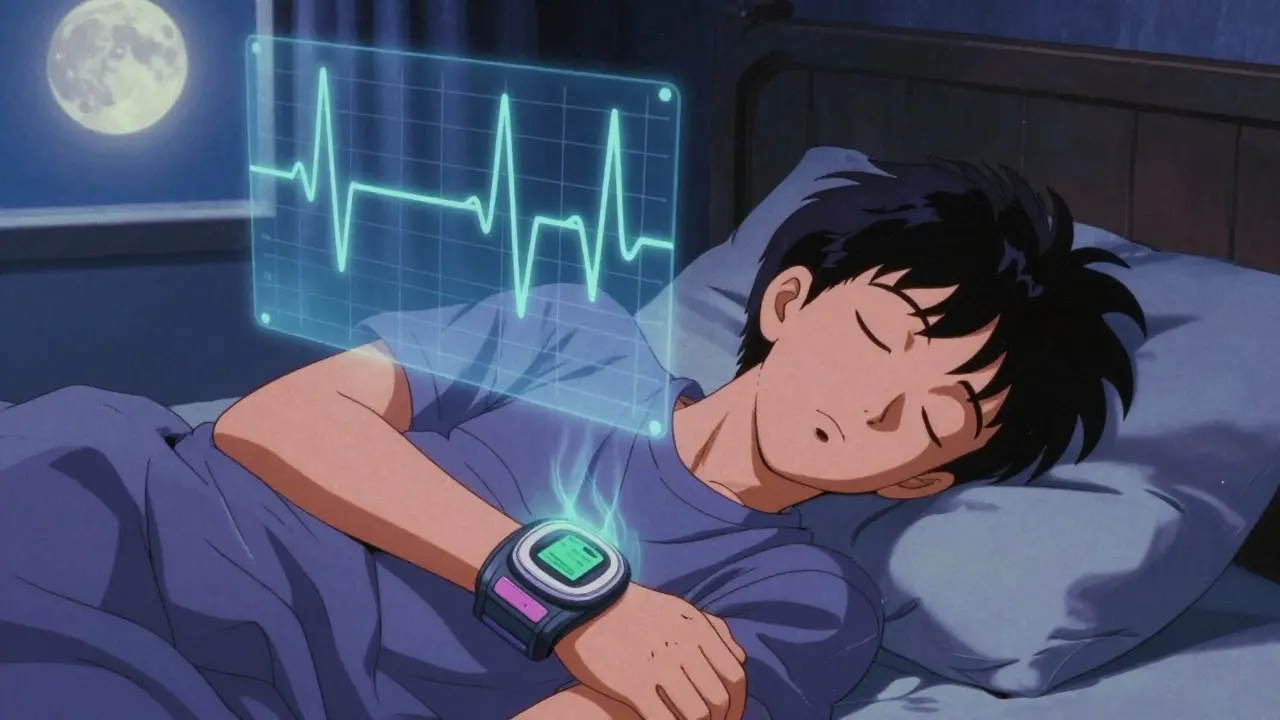
Most people think they know how well they sleep. You lie down at night, wake up tired, and assume you didn’t get enough rest. But what if your brain is lying to you? That’s the hidden problem with insomnia and circadian disorders - your perception of sleep doesn’t match reality. This is where actigraphy comes in. It’s not magic. It’s not a crystal ball. It’s a small device on your wrist that records movement, and from that, it guesses when you’re asleep and when you’re awake. Simple? Yes. Accurate? Sometimes. Powerful? Absolutely.
What Actigraphy Actually Measures
Actigraphy uses a tiny accelerometer - the same kind inside your smartphone - to track motion. It doesn’t measure brainwaves, breathing, or heart rate like a hospital sleep study. It just records how much you move. The logic is straightforward: when you’re asleep, you’re still. When you’re awake, you shift, toss, or roll. Algorithms turn those movements into sleep estimates: how long you slept, how long it took to fall asleep, how often you woke up, and how much time you spent actually sleeping versus lying awake.
Modern devices like the Oura Ring, Fitbit Charge 5, or Philips Actiwatch Spectrum Plus sample movement up to 100 times per second. That’s more than enough to catch a turn over or a foot twitch. But here’s the catch: if you lie perfectly still while awake - staring at the ceiling, worrying about tomorrow - the device thinks you’re asleep. That’s why specificity (the ability to detect true wake time) ranges from just 27% to 80%, depending on the person and the algorithm. It’s not broken. It’s just limited. Actigraphy is great at spotting patterns over days, not perfect at reading single nights.
How It Compares to Hospital Sleep Studies
Polysomnography (PSG) is the gold standard. In a sleep lab, you’re hooked up to wires that monitor brain activity, eye movement, muscle tone, heart rate, and oxygen levels. It’s accurate - 95% or better - but it’s also expensive, invasive, and only lasts one or two nights. Most people sleep worse in a lab than they do at home. That’s why actigraphy is so valuable. It lets you track sleep in your own bed, over weeks, not hours.
Think of it this way: PSG gives you a high-resolution photo. Actigraphy gives you a time-lapse video. One shows you a single moment in perfect detail. The other shows you how your sleep changes over time - which is often more useful. For example, if you keep telling your doctor you’re not sleeping, but actigraphy shows you’re getting 6.5 hours a night, that’s a clue. Maybe you have paradoxical insomnia - where your brain thinks you’re awake even when you’re asleep. That’s real. And actigraphy is one of the only tools that can prove it.
Consumer Wearables vs. Medical Devices
There’s a big difference between the Fitbit on your wrist and the Actiwatch your doctor prescribes. Both use actigraphy. But the medical ones are calibrated for clinical use. They’re validated against lab data. They record raw, unfiltered movement data. They’re FDA-cleared. And they cost between $1,200 and $1,800.
Consumer devices? They’re cheaper - $99 to $299 - and designed for wellness, not diagnosis. They use simplified algorithms. They guess sleep stages (REM, deep sleep) based on movement and heart rate, but those guesses aren’t reliable. A 2022 Stanford study found Oura Ring’s deep sleep estimates were off by 40 minutes on average compared to lab PSG. That’s not a bug. It’s a feature. These devices aren’t meant to replace doctors. They’re meant to make you aware of your habits.
Still, the gap is closing. Garmin’s 2024 algorithm improved wake detection by 16% by adding heart rate variability. Apple’s rumored Sleep Study feature for Watch Series 10 might combine actigraphy with skin temperature and audio to improve accuracy. But right now, if you need a diagnosis, you still need a doctor - and a medical-grade device.

Who Benefits Most From Home Sleep Tracking
Not everyone needs this. But some people get real value from it:
- People with insomnia who think they’re awake all night - actigraphy often proves they’re sleeping more than they realize.
- Shift workers trying to adjust their internal clock - tracking sleep over weeks shows if their schedule is working.
- Travelers with jet lag - Condor Instruments found 82% of frequent flyers improved their sleep schedule after 4 weeks of actigraphy data.
- People with circadian rhythm disorders - like delayed sleep phase syndrome - where bedtime keeps shifting later.
- Patients on sleep medication - to see if the treatment is actually helping over time.
The American Academy of Sleep Medicine says actigraphy has “moderate evidence” for assessing insomnia in adults. But it has “low evidence” for diagnosing sleep apnea, restless legs, or narcolepsy. That’s important. It won’t catch breathing pauses. It won’t detect leg jerks. It won’t tell you if you’re snoring. If you’re waking up gasping, or your partner says you stop breathing, you need a different test.
How to Use It Right - And Avoid the Pitfalls
Just wearing a tracker doesn’t fix your sleep. You have to use it correctly.
- Wear it on your non-dominant wrist. A 2023 study in Nature and Science of Sleep found misplacement cuts accuracy by 22%.
- Wear it for at least 7 days. One night of data means nothing. You need a pattern. 14 days is better.
- Don’t take it off for more than 2 hours a day. ActivInsights says removing it for longer reduces data validity by 18%.
- Focus on trends, not single nights. If you slept 5 hours one night and 7.5 the next? That’s normal. Sleep varies. Don’t panic over 30-minute differences.
- Don’t trust sleep stages. Your Fitbit saying you had 2 hours of deep sleep? Probably not accurate. Ignore it. Look at total sleep time and wake after sleep onset instead.
And don’t fall into orthosomnia - the new sleep disorder caused by obsessing over your tracker. If you’re lying awake stressing because your app says your sleep efficiency is 78%, you’re making it worse. The goal isn’t perfection. It’s awareness.
What the Experts Really Say
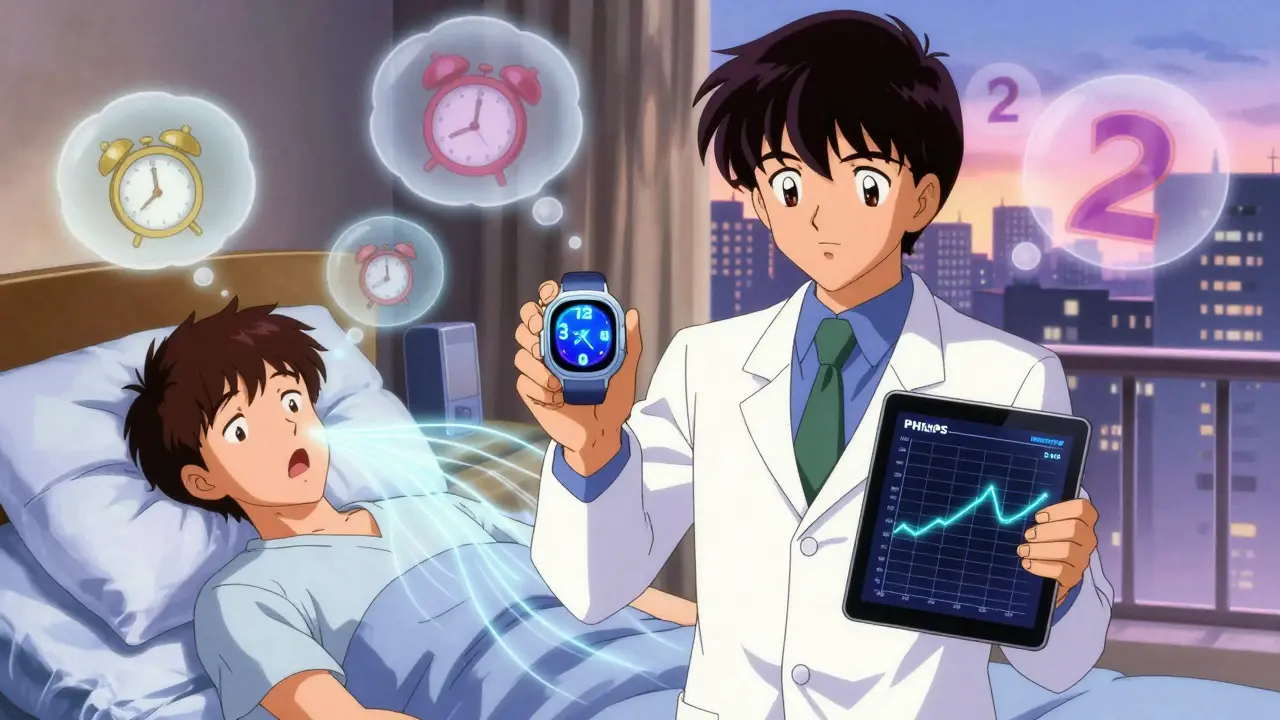
Dr. Cathy Goldstein from the University of Michigan says: “Actigraphy provides valuable real-world data but should complement rather than replace clinical evaluation.” That’s the key. It’s a tool, not a diagnosis.
Dr. Michael Grandner from the University of Arizona says newer consumer devices now match medical-grade wearables 85-90% for total sleep time. That’s impressive. But Dr. Mathias Basner from Penn warns: “Marketing claims often overstate the diagnostic capabilities.” He’s right. You’ll see ads saying “Diagnose sleep apnea at home.” That’s false. No consumer wearable can do that.
The Cleveland Clinic’s 2024 guidelines say actigraphy is best for “treatment monitoring,” not initial diagnosis. Use it to see if your sleep hygiene changes are working. Not to figure out why you’re tired.
Market Trends and What’s Coming
The global sleep tech market hit $7.2 billion in 2023. That’s up 12% from last year. Thirty-eight percent of U.S. adults now track their sleep - up from 19% in 2019. And 72% of sleep specialists use actigraphy in their practice.
What’s next? AI is making algorithms smarter. The NIH funded a $2.8 million project at the University of Michigan to improve wake detection by 27%. Apple, Garmin, and Oura are all adding temperature, light, and audio sensors to better understand sleep context.
But there’s a dark side. Most apps send your raw sleep data without end-to-end encryption. That means your sleep patterns - your most private health data - could be sold, leaked, or used by insurers. Senator Tammy Duckworth raised this in a 2024 Senate hearing. No one’s regulating it yet. Be careful what you share.
Bottom Line: Is It Worth It?
If you’ve been told you have insomnia and you’re skeptical - or if you’ve tried everything and still feel tired - actigraphy can give you answers no self-report can. It’s not perfect. It’s not a doctor. But it’s the best tool we have for seeing your real sleep pattern over time.
For $150, a Fitbit Charge 5 can tell you if you’re sleeping 5 hours or 7. For $1,500, a Philips Actiwatch can give your doctor the data they need to adjust your treatment. Either way, you’re getting closer to the truth.
Don’t use it to obsess. Use it to understand. And if the data doesn’t match how you feel? Talk to a sleep specialist. The numbers are just a starting point. Your experience matters too.
Can actigraphy diagnose sleep apnea?
No. Actigraphy tracks movement, not breathing. It cannot detect pauses in breathing, oxygen drops, or snoring - the key signs of sleep apnea. If you suspect sleep apnea (loud snoring, gasping at night, daytime fatigue), you need a home sleep test that measures airflow and oxygen, or a full polysomnography in a lab.
How accurate are consumer sleep trackers like Fitbit and Oura?
For total sleep time, they’re about 85-90% accurate compared to medical-grade devices. For wake time detection, accuracy drops to 60-75%. Sleep stage estimates (REM, deep sleep) are unreliable - often off by 20-40 minutes. They’re good for spotting trends over weeks, not for precise nightly measurements.
Should I wear my actigraphy device every night?
Yes - but only for the period your doctor or study recommends, usually 7-14 days. Remove it only for showers or swimming (if waterproof). Wearing it inconsistently - like taking it off for 3+ hours a day - reduces data reliability by up to 18%. Consistency matters more than perfection.
Can actigraphy help with jet lag or shift work?
Yes. It’s one of the best tools for tracking circadian rhythm shifts. By showing your sleep-wake pattern over days, it helps you see if your schedule is working. A 2023 study found 82% of frequent travelers improved their sleep timing after using actigraphy for 4+ weeks to adjust their routine.
Is my sleep data safe when I use a wearable?
Not always. Most consumer apps transmit raw actigraphy data without end-to-end encryption. That means your sleep patterns - which reveal stress, depression, or health issues - could be accessed by third parties, advertisers, or even insurers. Check privacy policies. Use devices with local data storage when possible. This is an unregulated risk right now.
What’s the difference between medical and consumer actigraphy devices?
Medical devices (like Philips Actiwatch) record raw, high-resolution motion data and are FDA-cleared for clinical use. They’re used by sleep specialists to support diagnosis and treatment. Consumer devices (Fitbit, Oura) use simplified algorithms, estimate sleep stages, and are sold as wellness tools. They’re cheaper but not validated for medical decisions.
Can actigraphy help if I think I have insomnia?
Yes - especially if you feel like you’re not sleeping at all. Many people with insomnia misperceive their sleep. Actigraphy often shows they’re getting 6-7 hours, not 2-3. This helps doctors rule out paradoxical insomnia and focus on cognitive behavioral therapy instead of medication. It’s a powerful reality check.
How long does it take to see results from using a sleep tracker?
You’ll see patterns after 3-7 days. But real change takes longer. A 2023 Consumer Reports survey found 78% of users felt more motivated to improve sleep after one month. But lasting improvement - like better sleep hygiene or reduced anxiety - takes consistent behavior change over weeks or months, not just data.
If you’re trying to fix your sleep, actigraphy gives you facts instead of feelings. That’s powerful. But facts alone won’t heal you. Action will.
Alexandra Enns
January 25, 2026 AT 05:43Okay but let’s be real - if your Fitbit says you slept 7 hours and you feel like a zombie, it’s LYING. These devices are designed to make you feel better about your sleep so you keep buying their overpriced junk. I’ve seen people cry over their sleep scores like it’s a final exam. Wake up. You’re not a robot. Your body doesn’t need a percentage.
Marie-Pier D.
January 26, 2026 AT 11:25❤️ I just started wearing my Oura ring for 14 days after my doctor suggested it - and honestly? It changed everything. I thought I was sleeping 4 hours a night. Turns out I was getting 6.5 - I just didn’t remember waking up 12 times. No more panic attacks at 3am thinking I’m sleep-deprived. This isn’t about perfection. It’s about peace. 🙏
Anna Pryde-Smith
January 27, 2026 AT 08:16YOU’RE ALL MISSING THE POINT. The real problem isn’t the tech - it’s that we’ve outsourced our intuition to gadgets. We used to know when we were tired. Now we check an app like it’s a fortune teller. And don’t get me started on the data brokers selling your REM cycles to advertisers. This isn’t progress. It’s surveillance with glitter.
Stacy Thomes
January 28, 2026 AT 09:31OMG YES!! I used to stress over my sleep scores so bad I couldn’t even fall asleep. Then I just started ignoring the app. Wore my Fitbit for 2 weeks, then turned off notifications. Suddenly I slept better. The data was useful… but my peace of mind? Priceless. You don’t need to be perfect. You just need to be tired enough to crash. 😴✨
dana torgersen
January 29, 2026 AT 14:52ok so… actigraphy… it’s… like… a motion sensor? right? but like… what if you’re just… lying there… thinking… about your ex… or your taxes… or that weird dream…? does it count as sleep? or is it… like… conscious stillness? because i think… our brains… are… way more… complicated… than… movement… patterns… and… also… why do we trust machines… to tell us… when we’re… asleep…? we can’t even trust ourselves…
asa MNG
January 29, 2026 AT 16:40bro i wore my apple watch for 3 weeks and it said i had 4.2 hours of deep sleep. i was so proud. then i got a real sleep study. turns out i had ZERO deep sleep. just a bunch of micro-awakenings i didn’t even know about. my watch was basically hallucinating. now i just ignore it. also my data was sold to 3 different ad companies. they’re now targeting me with ‘insomnia relief’ ads. i’m not sleeping. i’m being hunted.
Shanta Blank
January 31, 2026 AT 00:30Let me just say this: the entire sleep tech industry is a cult. They sell you a $300 ring, then make you feel guilty when you don’t hit 80% sleep efficiency. Meanwhile, your actual problem is your 10-year-old mattress, your 2am TikTok spiral, or the fact that you’re still processing your divorce. But no - let’s blame the algorithm. Let’s pathologize your rest. Let’s monetize your exhaustion. I’m not mad. I’m just… disappointed.
Tiffany Wagner
January 31, 2026 AT 08:27I’ve been using a Philips Actiwatch for my insomnia treatment. My doctor said it helped confirm I had paradoxical insomnia. I thought I was awake all night. The device showed I was asleep 70% of the time. It didn’t fix me… but it made me stop fighting myself. That’s huge. No drama. Just quiet truth.
Vatsal Patel
February 1, 2026 AT 09:23So you wear a gadget on your wrist to tell you you're sleeping… but you still can't sleep? How is that enlightenment? You're outsourcing your soul to a silicon oracle. The real sleep disorder isn't insomnia - it's the belief that numbers can heal what the mind refuses to face. Wake up. The bed is not a lab. You are not a data point.
Sharon Biggins
February 3, 2026 AT 02:00Just wanted to say thank you for this post. I’ve been struggling for years and didn’t know if I was imagining things. Getting the actigraphy data gave me the courage to finally talk to a specialist. It’s not about the numbers… it’s about knowing you’re not crazy. That’s worth more than any device.