
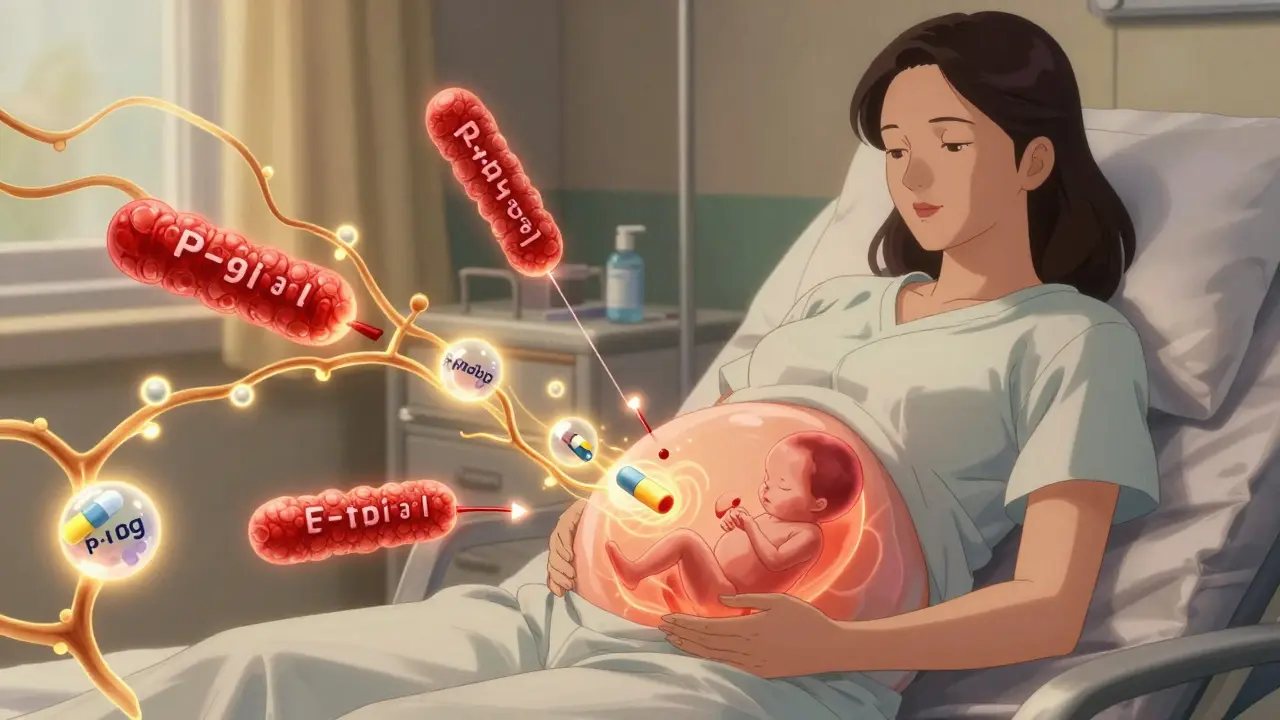
When a pregnant person takes a medication, it doesn’t just stay in their body. It crosses into the bloodstream of the developing fetus - sometimes in surprising amounts. For decades, many assumed the placenta acted like a shield, keeping harmful substances out. But that’s not true. The placenta is more like a smart gatekeeper: it lets some things through, blocks others, and sometimes even pushes drugs back toward the mother. Understanding how this works isn’t just academic - it’s life-or-death for the baby.
The Placenta Isn’t a Wall - It’s a Filter
The placenta is a living organ, about the size of a dinner plate and weighing half a kilogram by the end of pregnancy. It’s not a solid barrier. Instead, it’s made of millions of tiny finger-like projections called villi that float in maternal blood. These villi are where the real exchange happens. Nutrients, oxygen, and yes - drugs - move between mother and fetus across this interface. What crosses depends on a few key factors. First, size matters. Molecules under 500 daltons (Da) slip through easily. Ethanol, at 46 Da, zips across in minutes. Nicotine, at 162 Da, follows the same path. But insulin? At over 5,800 Da, it barely gets through. Less than 0.1% of the mother’s insulin reaches the fetus. Lipid solubility is another big player. Drugs that dissolve well in fat - like many antidepressants and opioids - slip through cell membranes with little resistance. That’s why sertraline and methadone reach nearly equal concentrations in fetal blood as in the mother’s. On the flip side, water-soluble drugs, especially those that are charged (ionized) at body pH, get stuck. Only the unbound portion of a drug can cross. Warfarin, for example, is 99% bound to proteins in the blood - so even though it’s small and fat-soluble, almost none reaches the fetus.The Body’s Own Drug Pumps
Here’s where things get even more complex. The placenta doesn’t just sit there and let drugs pass. It has built-in pumps - proteins called transporters - that actively kick drugs back into the mother’s circulation. Two of the most important are P-glycoprotein (P-gp) and breast cancer resistance protein (BCRP). These aren’t just bystanders. They’re the placenta’s defense system. In lab studies using human placental tissue, when scientists blocked P-gp, the amount of HIV drugs like saquinavir and lopinavir crossing into the fetus jumped by up to 2.3 times. That’s huge. It means that if a pregnant person is on one of these drugs and also takes something that inhibits P-gp - like certain antibiotics or antifungals - the baby could be exposed to far more than expected. Even more telling: cord blood measurements show that lopinavir reaches only about 60% of the mother’s concentration, while zidovudine - which doesn’t get pumped out - hits 95%. That’s not random. It’s the placenta working.When Timing Matters More Than the Drug
The stage of pregnancy changes everything. In the first trimester, the placenta is still forming. Tight junctions between cells aren’t fully developed. Efflux transporters like P-gp and BCRP are still ramping up. That means more drugs can slip through during early pregnancy than later on. This is critical. Many birth defects happen in the first 8 to 12 weeks, when organs are forming. A drug that’s safe in the third trimester might be dangerous in the first. Yet most studies use placentas from full-term deliveries. That creates a blind spot. We know far less about how medications affect the fetus in early pregnancy than we do in the last few months. Dr. Carolyn Coyne from the University of Pittsburgh points out: “We’re making safety decisions based on data from the end of pregnancy - when the placenta is most protective - but the most vulnerable time is at the beginning.”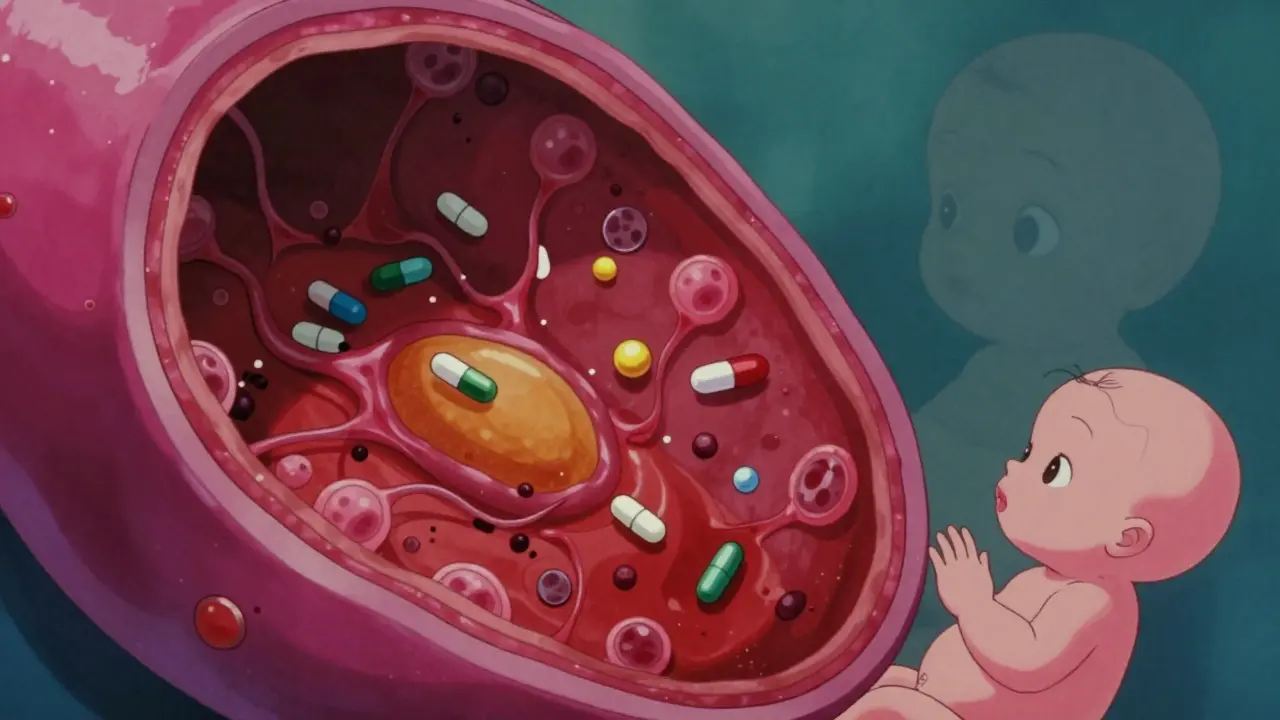
Real-World Examples: What Crosses and What Doesn’t
Some drugs are well-studied. Others aren’t. Here’s what we know:- SSRIs like sertraline: Cross easily. Cord-to-maternal ratios are 0.8-1.0. About 30% of babies exposed show temporary symptoms like jitteriness, feeding trouble, or mild breathing issues - known as neonatal adaptation syndrome. These usually resolve within days.
- Methadone and buprenorphine: Cross heavily. Fetal levels reach 65-75% of maternal levels. That’s why 60-80% of babies born to mothers on these drugs develop neonatal abstinence syndrome (NAS) - a withdrawal condition requiring hospital care.
- Valproic acid: Used for epilepsy. Crosses almost completely. Linked to a 10-11% risk of major birth defects - including spina bifida and heart problems - compared to 2-3% in the general population.
- Phenobarbital: Also for seizures. Gets into fetal blood nearly as much as in the mother. Long-term effects on cognition are still being studied.
- Digoxin: Used for heart conditions. Despite being a known substrate for P-gp, it crosses the placenta unaffected by common inhibitors like verapamil. That’s unusual. Doctors monitor levels closely because even small changes can affect the fetus.
- Paclitaxel (chemotherapy): Crosses in about 25-30% of maternal levels. But if P-gp is blocked, that number jumps to nearly 50%. That’s why chemotherapy during pregnancy requires extreme caution.
What’s Missing: The Knowledge Gaps
Here’s a sobering fact: 45% of prescription drugs used in pregnancy have no solid data on how they cross the placenta or what they do to the fetus. That’s not because they’re all dangerous. It’s because research has been slow, risky, and underfunded. The thalidomide disaster in the 1950s - where a drug meant to ease morning sickness caused severe limb defects in 10,000 babies - forced regulators to take fetal safety seriously. But even now, testing is limited. Animal studies don’t always translate. Mouse placentas are structurally different - they’re 3 to 4 times more permeable than human ones. So a drug that looks safe in mice might be dangerous in humans. New tools are emerging. Placenta-on-a-chip devices now mimic human placental tissue with remarkable accuracy. One model showed glyburide (a diabetes drug) transfer rates within 1% of real human tissue results. The NIH’s Human Placenta Project is using radioactive tracers to watch drugs move in real time - something never before possible without harming the fetus.What Should You Do?
If you’re pregnant or planning to be, here’s what matters:- Don’t stop prescribed meds without talking to your doctor. Untreated conditions like epilepsy, depression, or high blood pressure can be riskier than the medication.
- Ask: “Is this drug studied in pregnancy? What do we know about how it crosses the placenta?”
- For drugs with narrow safety margins - like lithium, warfarin, or antiepileptics - ask about therapeutic drug monitoring. Blood levels can be checked to keep doses safe for both you and your baby.
- Be cautious with over-the-counter drugs, herbal supplements, and recreational substances. Many people don’t realize nicotine, alcohol, and even some CBD products cross the placenta easily.

Diana Dougan
January 30, 2026 AT 05:44so the placenta is basically a bouncer at a club that lets in alcohol and nicotine but kicks out insulin like it’s a bouncer who hates tall people?? 🤡 i mean i get it but why does no one tell pregnant people that their tylenol is basically a VIP pass to the baby’s bloodstream??
Sazzy De
January 30, 2026 AT 17:52this is actually really helpful
ive been scared to take anything since i got pregnant
but knowing that some meds are safe and others just need monitoring makes me feel less alone
Blair Kelly
January 31, 2026 AT 14:38Let me be clear: the idea that ‘the placenta is a smart gatekeeper’ is dangerously oversimplified. It’s not ‘smart’-it’s a biological structure with passive diffusion, active transporters, and protein binding dynamics that are poorly understood in clinical practice. The FDA’s 2015 labeling changes are a Band-Aid on a hemorrhage. We’re still dosing pregnant patients based on data from non-pregnant adults. That’s not science-it’s negligence.
Rohit Kumar
February 1, 2026 AT 06:24In my culture, we say the mother and child are one breath-medicine flows not as invasion but as shared life. But this post reminds me: even in unity, there are invisible borders. The placenta does not choose-it responds. What we give, it carries. What we fear, it hides. We must learn its language, not just its limits.
Lily Steele
February 1, 2026 AT 13:55thank you for writing this
my OB just said ‘it’s fine’ when i asked about my anxiety med
now i have questions and i feel better about asking them
Gaurav Meena
February 1, 2026 AT 16:09As a father of two, I want to say this: if you're pregnant or supporting someone who is, please don't panic. Knowledge is power. Talk to your doctor. Ask about the placental transfer. And if you're unsure, wait for a second opinion. Your baby deserves thoughtful care, not fear-driven decisions. You're doing better than you think.
Jodi Olson
February 1, 2026 AT 21:20The notion that the placenta is a dynamic organ that responds to maternal stress levels is not merely biologically accurate-it is epistemologically significant. We are forced to confront the ontological entanglement of maternal and fetal physiology where pharmacokinetic variables become existential variables. This is not pharmacology. This is phenomenology of the intrauterine interface.
Carolyn Whitehead
February 3, 2026 AT 18:12i love how you explained this
so many people think if it's a pill it's bad
but some meds are lifesavers
you made it feel less scary
Amy Insalaco
February 5, 2026 AT 05:06While the article provides a superficially compelling narrative of placental pharmacokinetics, it conspicuously omits any meaningful discussion of the epigenetic modulation of transporter expression across gestational windows, nor does it contextualize the confounding effects of maternal glycemic status on passive diffusion gradients-both of which are critical to predictive modeling of fetal exposure. Furthermore, the uncritical citation of the NIH’s Human Placenta Project as a panacea is disingenuous; the use of radioactive tracers in vivo remains ethically and technically fraught, and the extrapolation of in vitro chip data to clinical outcomes constitutes a classic case of reification fallacy. This is not science-it’s science journalism dressed in jargon.