
That nagging ache in your shoulder or the tension headache that won’t quit might not be a pinched nerve or arthritis. It could be Myofascial Pain Syndrome, a condition defined by hyperirritable spots within taut bands of skeletal muscle known as trigger points. These invisible knots are responsible for up to 85% of chronic musculoskeletal pain complaints in clinical settings. If you’ve been told your pain is “all in your head” or simply given painkillers without a clear plan, understanding this condition is the first step toward real relief.
Myofascial Pain Syndrome (MPS) isn't just a vague description of soreness. It is a specific disorder where muscles stay contracted, cutting off their own blood supply and creating a cycle of pain and spasm. The concept was systematically described by Dr. Janet Travell and Dr. David Simons in their foundational 1983 text, establishing the framework doctors and therapists use today. Recognizing these symptoms early can prevent a temporary strain from becoming a chronic disability.
What Exactly Are Trigger Points?
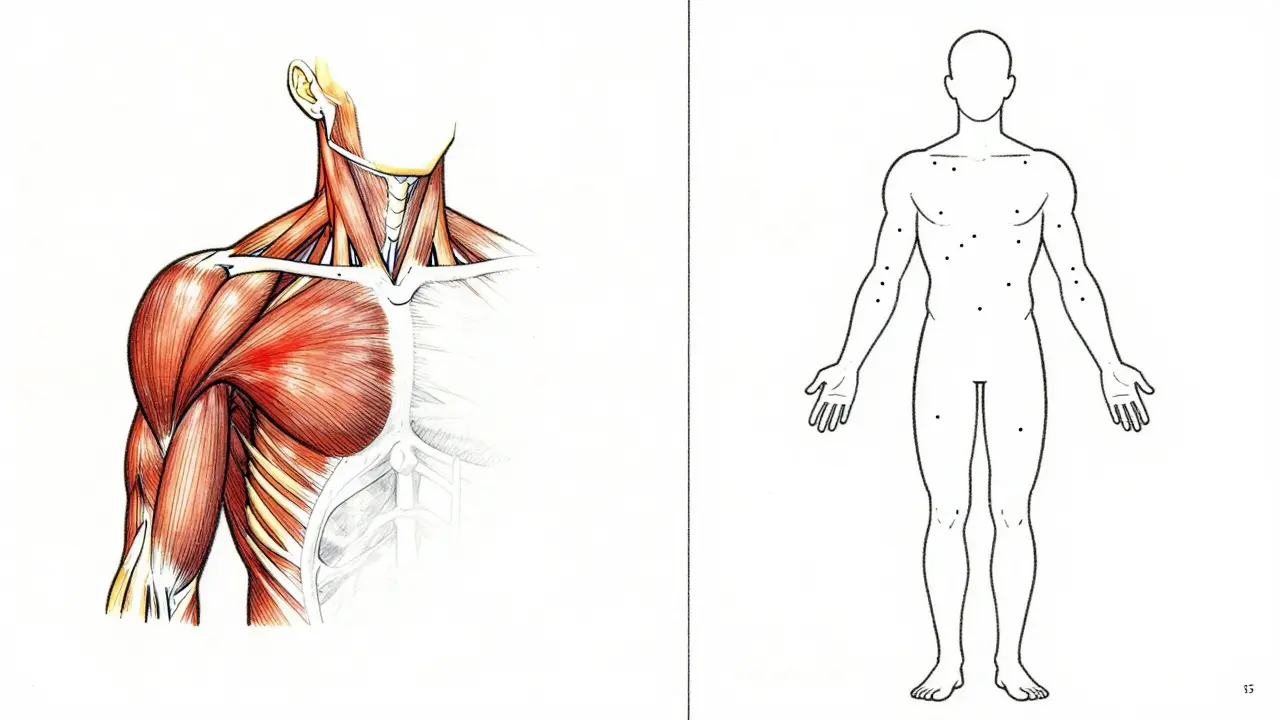
To treat MPS, you have to understand the enemy: the trigger point. Think of a trigger point as a microscopic knot in a rope. In medical terms, it is a discrete, focal spot located in a taut band of skeletal muscle. When you press on it, it doesn’t just hurt locally; it sends pain shooting elsewhere-a phenomenon called referred pain.
These nodules are tiny, usually measuring between 2-10 mm in diameter. They are chemically different from healthy muscle tissue. Research shows they contain 10 to 100 times more acetylcholine than normal muscle, along with higher levels of noradrenaline and serotonin. The pH level inside a trigger point drops to about 4.3, compared to the neutral 7.0 of healthy muscle. This acidic environment keeps the muscle fibers permanently contracted, compressing local blood vessels and starving the tissue of oxygen.
There are two types of trigger points you should know about:
- Active Trigger Points: These cause spontaneous pain even when you aren’t touching them. They limit your range of motion and weaken the muscle.
- Latent Trigger Points: These only hurt when you press directly on them. You might not notice them until a therapist finds them, but they still restrict muscle length and function.
A key diagnostic sign is the Local Twitch Response (LTR). When a practitioner presses or needles an active trigger point, the muscle fiber involuntarily contracts or "twitches." This occurs in about 70-85% of active cases and confirms the diagnosis.
MPS vs. Fibromyalgia: Knowing the Difference
It is common to confuse Myofascial Pain Syndrome with fibromyalgia because both involve widespread muscle pain. However, they are distinct conditions requiring different approaches. Fibromyalgia involves symmetrically located tender points across the body and central nervous system sensitization. MPS, on the other hand, is regional. The pain comes from specific muscles like the upper trapezius, levator scapulae, or temporalis.
According to the American Academy of Family Physicians, trigger points differ from fibromyalgia tender points in four critical ways. Trigger points occur in taut muscle bands, produce referred pain patterns, can be singular or multiple, and appear in any skeletal muscle. Tender points, conversely, are always multiple, symmetrical, and cause only local tenderness without referring pain. Misdiagnosis is frequent, with studies showing up to 57% of early-stage MPS cases are initially misidentified as structural pathology or nerve issues.
Why Do Trigger Points Form?
You don’t get MPS out of nowhere. Several risk factors contribute to the development of these painful knots. Acute trauma is a major culprit; for example, whiplash injuries lead to subsequent MPS in 50-70% of cases. Chronic postural stress is another huge factor. People who spend hours looking down at phones or computers often develop forward head posture, which increases the prevalence of trapezius trigger points by 3 to 5 times.
Structural abnormalities also play a role. A leg length discrepancy greater than 1 cm increases MPS risk by 40%. Furthermore, systemic health issues cannot be ignored. Vitamin D deficiency (serum levels below 20 ng/mL) correlates with a 60% higher incidence of MPS, and hypothyroidism is present in 15-25% of chronic cases. Addressing these underlying factors is crucial for long-term recovery.
Effective Release Techniques
Treating Myofascial Pain Syndrome requires breaking the pain-spasm cycle. There is no single magic bullet, but several evidence-based techniques show significant promise. The goal is to restore blood flow and reset the muscle’s resting length.
| Technique | Method | Efficacy Rate | Duration of Relief |
|---|---|---|---|
| Ischemic Compression | Sustained pressure (30-90 sec) | 60-75% | Short-term |
| Dry Needling | Filiform needle insertion | 65-80% | 4-12 weeks |
| Trigger Point Injection | Lidocaine injection (0.5-1%) | 70-85% | 2-8 weeks |
| Spray-and-Stretch | Vapocoolant spray + stretching | 50-65% | Variable |
Ischemic Compression is a manual therapy technique where a therapist applies sustained, direct pressure to the trigger point until the pain subsides. This typically takes 30 to 90 seconds. It works by forcing blood back into the area, washing away metabolic waste products. Randomized controlled trials show this method has a 60-75% short-term efficacy rate.
Dry Needling has gained massive popularity recently. It involves inserting thin filiform needles directly into the trigger point to elicit a local twitch response. Unlike acupuncture, which follows meridian lines, dry needling targets specific anatomical structures. Meta-analyses indicate it provides pain relief for 4-12 weeks in 65-80% of patients. It is particularly effective for deep-seated knots that hands cannot reach.
Trigger Point Injections use a small amount of lidocaine (without epinephrine) to numb the area and break the spasm cycle. While it offers immediate pain reduction in 70-85% of cases, a Cochrane Review noted no significant difference between lidocaine injections and dry needling at the 4-week follow-up mark. This suggests the mechanical disruption of the tissue may be more important than the medication itself.

Home Care and Maintenance
Professional treatment is vital, but recurrence rates are high-40-60% of patients report symptoms returning within six months if they don’t maintain their progress. Home management is not optional; it’s essential.
You can perform self-ischemic compression using simple tools. A tennis ball or foam roller applied to the affected muscle for 15-20 minutes daily can mimic professional massage. For neck and shoulder pain, leaning against a wall with a tennis ball between your upper trap and the spine is highly effective. Hold the pressure until the pain decreases by at least 50%.
Posture correction exercises are equally important. Perform three sets of ten repetitions, twice daily. Focus on chin tucks to counteract forward head posture and scapular retractions to strengthen the mid-back. Heat therapy can also help; applying heat at 40-45°C for 15 minutes before stretching increases tissue elasticity and makes release techniques more comfortable.
Compliance is the biggest hurdle. Studies show only 45-60% of patients stick to home programs after six weeks. To improve adherence, integrate these exercises into existing habits, such as doing stretches while watching TV or during work breaks.
When to See a Specialist
If over-the-counter pain relievers and rest haven’t helped after two weeks, it’s time to see a professional. Look for practitioners trained in manual therapy or physical medicine. The learning curve for accurate trigger point identification averages 6-12 months of supervised practice, so experience matters. Be wary of providers who diagnose based solely on imaging; MRI and X-rays rarely show trigger points. Diagnosis is clinical, relying on palpation and patient history.
Emerging treatments include Instrument-Assisted Soft Tissue Mobilization (IASTM) and Low-Level Laser Therapy (LLLT). IASTM uses specialized tools to break up scar tissue and fascial restrictions, showing 55-70% efficacy. LLLT uses specific wavelengths (808-905 nm) to reduce inflammation and promote healing, with systematic reviews indicating 40-60% pain reduction.
How long does it take to cure Myofascial Pain Syndrome?
There is no instant cure for MPS, as it is a chronic condition. However, significant pain reduction can occur within 4-12 weeks with consistent treatment. Most patients require a combination of professional therapy (like dry needling or manual release) and diligent home care. Recurrence is common if underlying causes like poor posture or vitamin deficiencies are not addressed.
Does dry needling hurt?
Dry needling can cause a brief, sharp sensation similar to a pinch or a muscle cramp when the needle hits the trigger point. This is often followed by a feeling of release. Most patients report that the discomfort is manageable and significantly less than the chronic pain they were experiencing beforehand. Soreness may last 24-48 hours after treatment.
Can trigger points go away on their own?
Latent trigger points may resolve with rest, hydration, and gentle movement. Active trigger points, however, tend to persist because they create a self-perpetuating cycle of ischemia and pain. Without intervention to break the taut band and restore blood flow, active trigger points rarely disappear completely on their own.
What is the best exercise for myofascial pain?
The best exercises focus on restoring length and strength to affected muscles. For upper back and neck pain, chin tucks and scapular retractions are highly effective. For lower back pain, gentle hamstring stretches and hip flexor releases are beneficial. Consistency is key; performing these exercises twice daily yields better results than occasional intense workouts.
Is Myofascial Pain Syndrome serious?
While MPS is not life-threatening, it can severely impact quality of life, sleep, and mobility. Chronic pain can lead to depression and anxiety if left untreated. It is considered a serious musculoskeletal disorder because it often mimics more severe conditions like herniated discs or nerve damage, leading to unnecessary tests and procedures if not correctly diagnosed.