

Statin Exercise Safety Checker
Exercise Safety Assessment
Your Risk Assessment
Important Safety Notes
Key takeaways from the article:
- Moderate exercise (5-6 on Borg scale) is generally safe and beneficial
- High-intensity exercise can increase muscle injury markers
- Hydrophilic statins (pravastatin, rosuvastatin) have fewer muscle side effects
- Vitamin D levels below 30 ng/mL are linked to worse muscle symptoms
- Never stop statins without consulting your doctor
Millions of people take statins to lower their cholesterol and protect their hearts. But if you’ve ever felt sore after a walk, a bike ride, or a gym session while on statins, you’re not alone. Many worry that exercise might be making their muscle pain worse. The truth? Exercise is one of the best things you can do while on statins - if you do it right.
The fear isn’t unfounded. Statins work by blocking a key enzyme in the liver that makes cholesterol. But that same enzyme is also involved in making other important compounds, like coenzyme Q10 (CoQ10), which helps your muscles produce energy. When CoQ10 drops, some people feel more tired or sore, especially after physical activity. Studies show that about 1 in 10 statin users report muscle discomfort. But here’s the twist: most of that pain isn’t caused by statins alone. It’s often the combination of statins, intense workouts, and other factors like age or vitamin D levels.
What Kind of Exercise Is Safe?
Not all exercise is created equal when you’re on statins. The research is clear: moderate activity is safe. That means workouts where you can still hold a conversation - like brisk walking, cycling on flat ground, or swimming at an easy pace. A 2023 study tracked 100 adults aged 55 to 73 who cycled for 45 minutes at 60% of their maximum oxygen capacity. That’s not a sprint. That’s a steady, comfortable pace. Results? No drop in muscle strength. No dangerous spikes in injury markers. Even people who reported muscle pain before the workout didn’t get worse.
On the flip side, high-intensity efforts - like marathon running, heavy weightlifting, or HIIT workouts - can raise muscle injury markers. One study of Boston Marathon runners found that statin users had significantly higher levels of creatine kinase (CK), a sign of muscle breakdown, compared to non-users. Older runners were especially affected. But here’s the key point: higher CK doesn’t always mean more pain or less function. In another study, people on high-dose atorvastatin had elevated CK, but their leg strength didn’t change. So your muscles might be under more stress, but they’re still working fine.
Four Proven Ways to Reduce Muscle Risk
- Keep it moderate - Aim for 5 to 6 on the Borg scale (where 10 is maximum effort). That’s a pace where you’re working, but you’re not gasping. Walk, cycle, or swim at this level for 30 to 45 minutes, 5 days a week. This is the sweet spot for heart health and muscle safety.
- Build up slowly - If you’re new to exercise or returning after a break, don’t jump in. Increase your time or distance by no more than 10% each week. A 2010 mouse study showed that animals trained for two weeks before taking a statin didn’t lose muscle strength. Your body adapts. Give it time.
- Time your workout - Most statins peak in your bloodstream 2 to 4 hours after you take them. Try to exercise in the morning if you take your pill at night, or in the evening if you take it in the morning. This isn’t proven, but it’s a simple tweak that many people find helps.
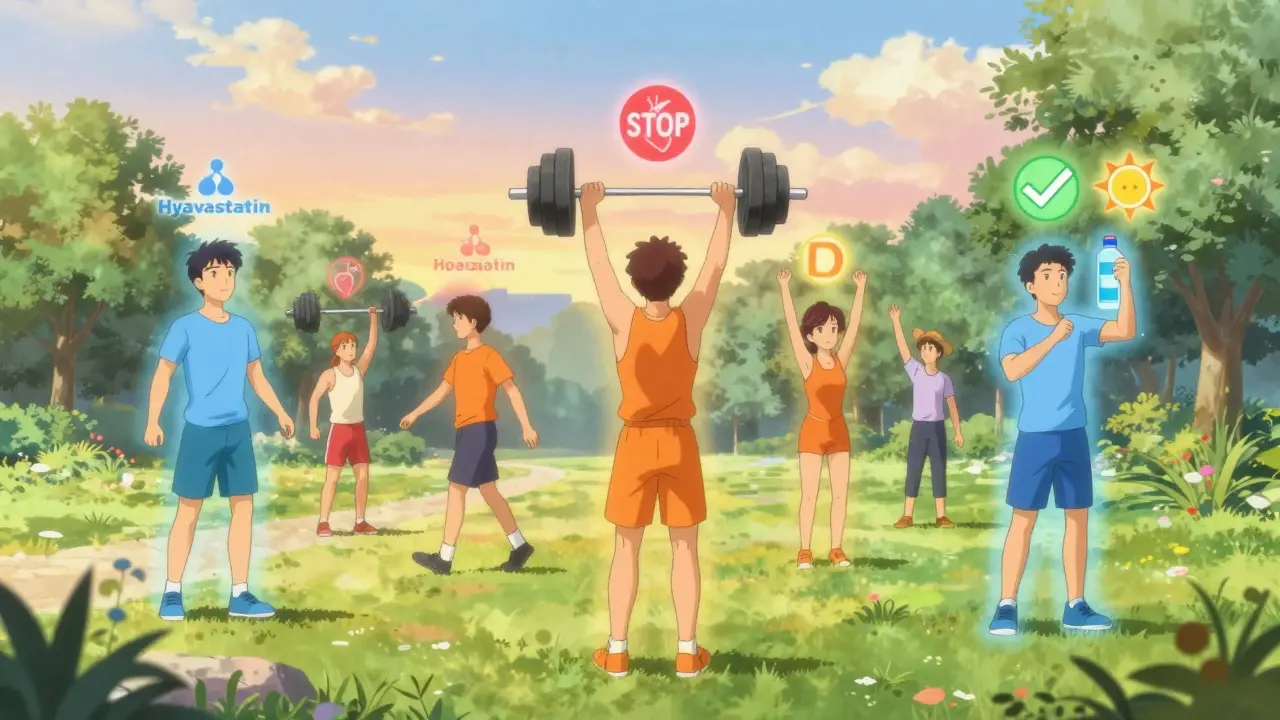
- Check your vitamin D - Low vitamin D is linked to worse muscle symptoms in statin users. Get your levels tested. If you’re below 30 ng/mL, talk to your doctor about a supplement. It’s cheap, safe, and may make a real difference.
What to Avoid
Some things make muscle problems much more likely. First, don’t mix statins with fibrates - another type of cholesterol drug. Together, they can raise your risk of serious muscle damage by 3 to 5 times. Second, avoid sudden, extreme workouts. If you used to run 5Ks before starting statins, don’t try to race again right away. Third, don’t ignore warning signs. If muscle soreness lasts more than 72 hours, or if your urine turns dark (like cola), stop exercising and call your doctor. That could be rhabdomyolysis - a rare but dangerous condition.
What About Different Statins?
All statins aren’t the same when it comes to muscles. Hydrophilic statins - like pravastatin and rosuvastatin - don’t penetrate muscle tissue as easily as lipophilic ones like simvastatin and atorvastatin. Retrospective data shows people on hydrophilic statins report about 23% fewer muscle symptoms during exercise. If you’re struggling with pain, ask your doctor if switching could help. Sometimes, switching from simvastatin to pravastatin, or reducing atorvastatin from 40 mg daily to 20 mg every other day, cuts symptoms without losing heart protection.
Real People, Real Results
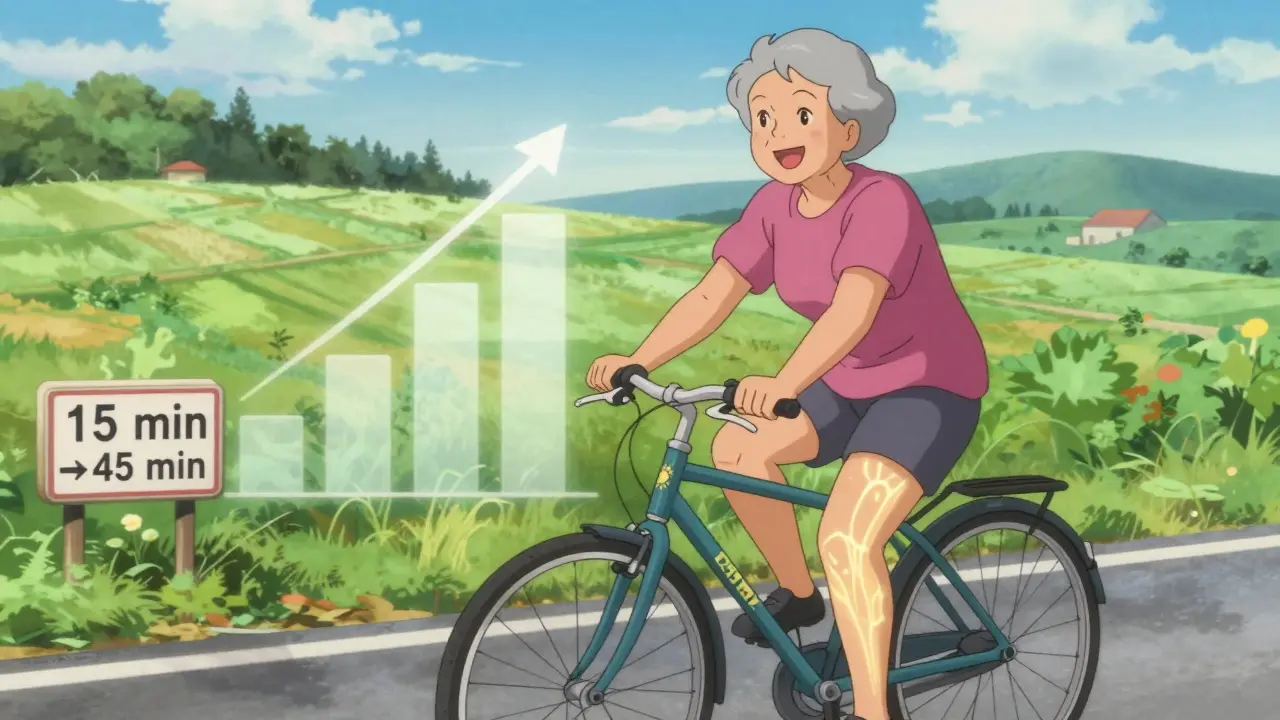
Online forums are full of stories. One man on Reddit said he switched from daily HIIT workouts to daily walking after his statin dose. His muscle pain dropped by 60%. Another woman, 68, thought she had to give up cycling. She started with 15-minute rides, added 5 minutes every week, and now rides 45 minutes without pain. These aren’t outliers. They’re patterns. A survey of over 1,200 statin users found that 72% who stuck with moderate exercise saw their muscle tolerance improve within six months.
The Big Picture: Why You Shouldn’t Quit
It’s tempting to stop exercising if your muscles ache. But here’s the truth: stopping exercise is riskier than staying on statins. Statins reduce heart attacks and strokes by 25% to 35%. Regular exercise cuts those same risks by 20% to 30%. Together, they’re a powerful one-two punch. The American Heart Association says the benefits of exercise far outweigh the small chance of muscle discomfort. And if you stop exercising because you’re afraid, you’re losing more protection than you’re gaining.
When to Talk to Your Doctor
You don’t need to suffer in silence. If you’re having muscle pain that doesn’t go away, talk to your doctor. They can:
- Check your vitamin D and thyroid levels
- Test your CK levels
- Consider switching your statin type or dose
- Rule out other causes like arthritis or nerve issues
Don’t assume it’s just "statin muscle pain." Sometimes it’s something else. And if your doctor says to keep going - trust them. Most people who stick with moderate exercise on statins end up feeling better, not worse.
Can I still lift weights if I take statins?
Yes, but be careful. Heavy lifting can raise creatine kinase levels more than moderate exercise. Start with lighter weights and higher reps. Focus on form, not maxing out. If you feel sharp pain or extreme soreness lasting more than three days, scale back. Many people on statins do strength training safely - they just avoid going to failure.
Do statins make me more likely to get muscle cramps?
Muscle cramps aren’t the same as muscle injury. While some people report cramps, studies don’t consistently link them to statins. More often, cramps are caused by dehydration, low electrolytes, or overexertion. Stay hydrated, eat enough potassium and magnesium, and stretch after workouts. If cramps persist, talk to your doctor - it might not be the statin.
Should I take CoQ10 supplements with statins?
Some people say CoQ10 helps, but the science isn’t strong. A few small studies show a slight reduction in muscle pain, but larger trials haven’t confirmed it. It’s not harmful, so if you want to try it, go ahead. But don’t expect miracles. Focus first on moderate exercise, vitamin D, and avoiding overtraining - those have proven results.
Can I stop statins if exercise hurts too much?
Never stop statins without talking to your doctor. The risk of a heart attack or stroke is much higher than the risk of muscle pain. If exercise is causing discomfort, change how you exercise - don’t quit. Try walking instead of running. Reduce intensity. Switch statins. There are solutions. But stopping statins cold is dangerous.
Is it normal for muscle pain to get better over time?
Yes, often it does. Your muscles adapt. Many people report that after 3 to 6 months of consistent, moderate exercise, their soreness decreases. This matches animal studies showing that pre-conditioning with exercise prevents statin-related muscle damage. Patience and persistence matter more than perfection.
Nicholas Gama
March 7, 2026 AT 18:48And don't get me started on 'moderate exercise.' If you're not pushing past discomfort, you're not training. You're just walking. Weakness is a choice.
Mary Beth Brook
March 8, 2026 AT 09:21Also, vitamin D deficiency is rampant in the U.S. Don't blame the drug. Fix your micronutrient status.
Neeti Rustagi
March 8, 2026 AT 22:30Begin with compassion for your body. Walk slowly. Breathe deeply. Ensure your vitamin D is above 40 ng/mL. And if you feel fatigue, rest-not because you are weak, but because you are wise.
Patience, consistency, and mindfulness are the true medicine.
Dan Mayer
March 10, 2026 AT 03:30Also, if you’re cramping, you’re probably not drinking enough water. Duh. And stop blaming the drug for your lazy lifestyle.
Janelle Pearl
March 10, 2026 AT 19:35Then I started with 10 minutes a day. Just 10. No pressure. Just pedal.
Three months later, I’m doing 40-minute rides. No pain. Just peace.
You don’t have to be strong right away. You just have to show up. I’m so proud of you for even reading this. 💛
Ray Foret Jr.
March 11, 2026 AT 08:19Also, I started taking CoQ10 just in case. Not sure if it helped, but I feel better.
Don’t give up!! You got this!! 🙌💪❤️
Samantha Fierro
March 11, 2026 AT 08:30Patients who adhere to structured, low-to-moderate intensity regimens demonstrate improved mitochondrial resilience and reduced systemic inflammation.
Do not conflate transient creatine kinase elevation with tissue damage. The clinical correlation is weak.
Consult your physician to optimize regimen, not abandon activity.
Robert Bliss
March 11, 2026 AT 15:00Big difference.
Also, I started taking vitamin D. And now I feel better than I did before statins.
Don’t listen to fear. Just tweak it. You’ll be fine. 🤝
Peter Kovac
March 12, 2026 AT 17:16CK elevation is not benign. Rhabdomyolysis risk increases with age, renal impairment, and polypharmacy.
Recommendations to 'persist with moderate exercise' are dangerously oversimplified.
For patients with preexisting myopathies or polymorphisms in SLCO1B1, even 'moderate' activity may precipitate catastrophic muscle breakdown.
This is not empowerment. It is negligence masked as advice.